pianist and medical doctor

Tag: 2019-04

  • 01(25): The fascinating story of Helicobacter pylori

    Ask any kid what he thinks of when he comes across the word “scientist”. It is not surprising to hear scientists being described as weird, introverted, bespectacled old men with grey hair in white lab coats who do crazy stuff involving explosive chemical reactions in the laboratory. This stereotypical portrayal is perpetuated by the abundance of children’s books, cartoons and the mass media. Sometimes, these scientists go to extreme lengths to prove a particular point. For example, they might use their own bodies as experimental vessels to test their hypotheses simply because ethics committees wouldn’t allow them to test their hypotheses on the bodies of others as it would be “unethical”. Would you knowingly infect yourself with dangerous bacteria to test a hypothesis?

    I thought so.

    Neither would I. Yet, this is exactly what Dr Barry Marshall did. The Australian doctor infected himself with bacteria. Due to what he did, he demonstrated that most stomach ulcers are actually an infectious disease. This valuable information has helped save many lives.

    Peptic ulcers are open sores found in the endothelial lining of the stomach and/or the upper portion of the small intestine. The most common symptom associated with these ulcers is abdominal pain. If things get bad enough, one can start bleeding, or even have one’s stomach burst.

    Back in the 1970s, ulcers were most common in middle-aged men who smoked and drank alcohol. Having ulcers seemed to run in the family. As such, doctors assumed that ulcers occurred when there was overproduction of acid in the stomach, and the ulcers were a result of stress, and perhaps some genetic defect. As such, the typical advice was for the patient to relax, watch what he consumes, and take some antacids.

    Most notably, it was assumed that the stomach was sterile (ie completely bacteria-free). It is understandable to see why people thought that. After all, the pH of the stomach lumen is around 2-2.5, indicating its high acidity. What organism could possibly survive such an acidic environment?

    Then, in 1979, an Australian doctor, Dr Robin Warren began to have his doubts. This was because the pathologist began to regularly see comma-shaped bacteria in the samples from patients who had gastritis. In that same year, Dr Barry Marshall was appointed as “Registrar in Medicine” at the Royal Perth Hospital (RPH). Dr Warren and Dr Marshall met in 1981 while Dr Marshall was doing his internal medicine fellowship training at the RPH.

    In 1982, the duo established a formal study and found that a majority of all their ulcer patients had been infected with the bacteria too. They identified the bug as Helicobacter pylori, and suspected that its presence was the true reason for peptic ulcers and gastritis.

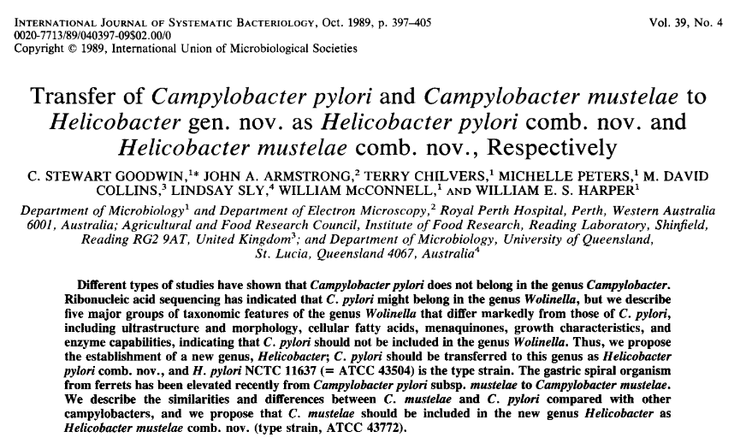
    NB: At the time of the study, this bug wasn’t known as H. pylori. It was first known as Campylobacter pyloridis. However, in 1987, it was re-named Campylobacter pyloris. This was because ‘pylori’ is the genitive case of the Latin nominative ‘pylorus’, which is the circular opening leading from the stomach into the duodenum. As mentioned in the paper, ‘pyloridis’ is a linguistic error that had to be corrected. The Latin word ‘pylorus’ in turn comes from the Greek word ‘πυλωρός’, transliterated ‘puloros’, which means ‘gatekeeper’.

    Then, when 16S rRNA (component of the 30S small subunit of a prokaryotic ribosome) gene sequencing and other research showed two years later (by October 1989) that the bacterium didn’t belong in the genus Campylobacter, the bacterium was placed in its own genus Helicobacter. As you might have guessed, the prefix of the new genus name ‘helico-‘ comes from the ancient Greek word helix.
    Anyway, back to the study. The hypothesis was absurd for its time and I’m sure very few of the duo’s peers were convinced that anything useful could come out of it. How could anything survive the highly acidic environment of the stomach? If this were true, why hadn’t someone discovered it earlier? The odds seemed to be against Dr Warren and Dr Marshall.

    By 1984, Marshall was convinced of his results and must have been exasperated that others were not convinced. This was because in 1983, the previous year, the duo had submitted their findings hitherto to the Gastroenterological Society of Australia. However, the reviewers turned the papers down, rating it in the bottom 10% of the papers received in 1983.

    So, Marshall did something radical. After ensuring he had no H. pylori of his own, he became his own guinea pig, and in one gulp of meat broth at 10:00 am, he purposefully swallowed a whole load of the bacteria. Unsurprisingly, he began to experience indigestion, nausea, bad breath, and began vomiting in the coming days. Although he hadn’t developed an ulcer, it was close. It was gastritis. H. pylori penetrates the mucosa layer of the stomach lumen and exposes the submucosa epithelial cells to all that acid in the lumen.

    The infection usually takes a while to cause a problem, and the symptoms can be exacerbated by things like smoking and stress. This could be why older men with less-than-stellar health records seemed the most susceptible. Nevertheless, correlation is not the same as causation. Without H. pylori, most people would never even get peptic ulcers. Marshall and Warren also went on to demonstrate that certain drugs could get rid of H. pylori. In recognition of this groundbreaking work, the Australian duo was awarded the 2005 Nobel Prize in Physiology or Medicine. Marshall is the younger of the two.

    This disco-era discovery turned out to have an even bigger impact than anyone imagined. Today, the World Health Organization recognises H. pylori as a carcinogen. The same damage the bacteria does to the lining of the stomach with an ulcer also causes gastric cancer. As more people got antibiotics to cure their ulcers, gastric cancer incidence rates plummeted.

    Yet, the situation turned out to be not that simple. While most ulcers are caused by H. pylori, most people with H. pylori don’t develop ulcers, and even fewer get gastric cancer. The presence of H. pylori might even help as it seems to protect people from developing heartburn, and protect people from getting cancer in the oesophagus. Unfortunately, we can’t get the best of both worlds. The strains of H. pylori that are the most dangerous to the stomach are also the most protective to the oesophagus. As such, the current consensus among doctors seems to be to keep the status quo unless H. pylori starts causing problems. If it does cause problems, then green lights to the most common initial treatment – a ‘triple therapy’ for one week:

    1) Amoxicillin, a penicillin-type antibiotic, which means that it is similar to penicillin. So, if the patient is allergic to penicillin, he should avoid all drugs in the penicillin family and take something like metronidazole.
    2) Clarithromycin, which is an acid-stable macrolide with a broad spectrum of antibacterial activity, well absorbed with a wide tissue distribution and with mild side effects. Clarithromycin has a low minimum inhibitory concentration (MIC50) for H. pylori and its effect is potentiated by acid inhibition.
    3) Proton pump inhibitor (eg omeprazole). It works by irreversibly inhibiting H+/K+ ATPase on gastric parietal cells.

    However, even this may not be sufficient. The main reasons for the eradication failure of the standard ‘triple therapy’ above include escalating antibiotic resistance, poor compliance, and rapid metabolism of proton pump inhibitor. Generally, resistance to clarithromycin and metronidazole has been on the rise. Interestingly, though amoxicillin is one of the most commonly used antibiotics, resistance to amoxicillin remains extremely low (<5%) in most countries. If the rates of clarithromycin resistance are known to be > 15%, then bismuth-based quadruple therapy can be tried.

    You might still be wondering how H. pylori is able to survive the acidic environment of the stomach lumen. The answer lies in the specific adaptations that H. pylori has developed.

    Do you see the things that look like tails? They are called flagella (plural of ‘flagellum’). The flagella confer H. pylori motility. With the flagella, H. pylori burrows into the gastric mucin gel to reach the epithelial cells, where it is less acidic. This is possible because of chemotaxis. H. pylori senses the pH gradient in the mucus and tends to move towards the region of lower acidity.

    In addition to chemotaxis, H. pylori produces lots of an enzyme called urease. As its name suggests, the cytosolic urease catalyses the conversion of urea (found within the stomach) to ammonia and carbon dioxide:

    (NH2)2CO + H2O → CO2 + 2NH3
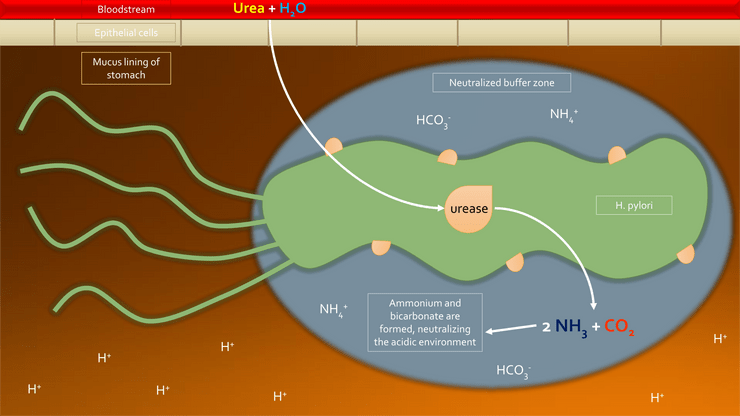
    The ammonia reacts with the strong acid in the vicinity of H. pylori to give rise to a relatively neutralised buffer zone that surrounds H. pylori. Thus, with these adaptations, H. pylori is able to endure the acidity of its environment.

    In fact, the cytosolic urease in H. pylori is the very basis of the urea breath test: a rapid diagnostic procedure used to identify infections by H. pylori. For the test, patients swallow urea labelled with an uncommon isotope. The detection of isotope-labelled carbon dioxide in exhaled breath indicates that the urea was split, which in turn indicates that urease (the enzyme that H. pylori uses to metabolise urea) is present in the stomach) is present. This thus corresponds to the presence of H. pylori.

    Interesting, isn’t it?

    Yours faithfully,
    Nic Loh
    16 April 2019

    References
    1. https://en.wikipedia.org/wiki/Helicobacter_pylori
    2. https://www.youtube.com/watch?v=HP6Zf1ff7Sw
    3. https://en.wikipedia.org/wiki/Robin_Warren
    4. https://en.wikipedia.org/wiki/Barry_Marshall
    5. https://www.mayoclinic.org/diseases-conditions/peptic-ulcer/symptoms-causes/syc-20354223
    6. https://ijs.microbiologyresearch.org/content/journal/ijsem/10.1099/00207713-39-4-397
    7. https://www.flickr.com/photos/nsf_beta/4822021538/in/set-72157621768317570
    8. https://en.wikipedia.org/wiki/Proton-pump_inhibitor

  • 01(24): Winning the genetic lottery for handspans as a pianist isn’t enough

    The handspan, or simply “span”, can be defined as the distance between the tip of one’s thumb and one’s pinky of the same hand. Understandably, a pianist is going to have a headache if his hand is not able to accommodate a particular series of notes as dictated on the sheet music. The hands are sometimes forced into awkward positions. How does he get around this? He has several options:

    1) omit some notes or omit a single note
    2) roll the chord (hence, all the notes of the block would not be played at the same time) 3) not even play the piece at all

    That which needs to be done needs to be decided on a case-by-case basis.

    In this post, I shall talk about some scenarios that I have encountered, some research that has been done regarding this issue, and the historical development that is partially responsible for this.

    Let us start by considering one of the most well-known pieces that isn’t technically too challenging. The piece is Minuet in G Major.

    NB: Contrary to popular belief, this piece is not written by Bach. Since 1970, it had been discovered that this piece was actually composed by another person: Petzold. Regardless of who composed this, its legendary status remains forevermore. Most people would recognise the piece just from the first bar alone! Nevertheless, it has been thought that it was composed by Bach for so long that it has its own catalogue number in Bach’s catalogue of works (i.e. BWV Anh. 114).

    The minuet is a technically simple piece and it would not be uncommon for beginners to the piano to learn this piece. The largest harmonic interval that this piece demands (or requests) is a major sixth. This is found in the last bar of the piece.

    This is highly manageable and virtually everyone who attempts this piece should be able to play a major sixth with his span. Even young children should be able to do a major sixth. Here are spans of some notable pianists and composers:

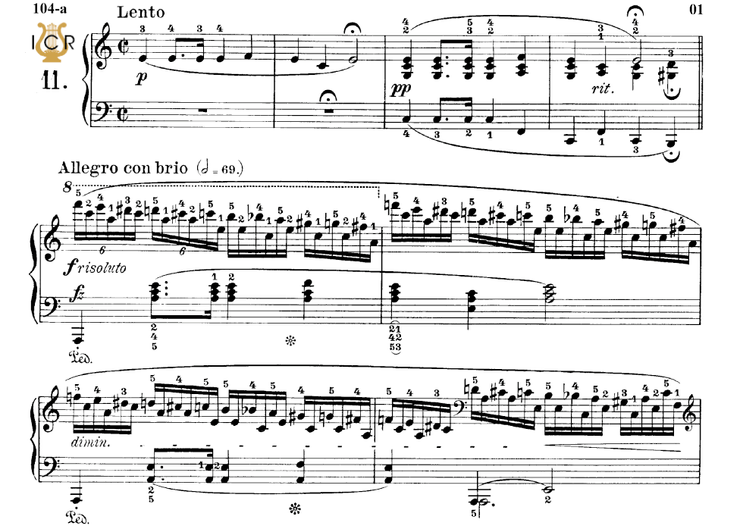
    Move to the Romantic/20th century repertoire and you find that the pieces are more technically challenging. They make Petzold’s minuets look like child’s play (*shhh, they really are*). There are now huge runs which span multiple octaves with accidentals strewn everywhere. Here are the opening bars of one of Chopin’s etudes. How deceptive the first four bars are:

    We have come to the age of the virtuoso, where humble harpsichords fade away. Keyboard instruments have become bigger. Thanks to the precedent established by performers such as Paganini and Liszt, performers would now play from memory. Audiences now constantly look forward to the “next big thing”.

    I quote from the Wikipedia article on the piano: “In the period from about 1790 to 1860, the Mozart-era piano underwent tremendous changes that led to the modern form of the instrument. This revolution was in response to a preference by composers and pianists for a more powerful, sustained piano sound, and made possible by the ongoing Industrial Revolution with resources such as high-quality piano wire for strings, and precision casting for the production of massive iron frames that could withstand the tremendous tension of the strings. Over time, the tonal range of the piano was also increased from the five octaves of Mozart’s day to the seven octave (or more) range found on modern pianos.“

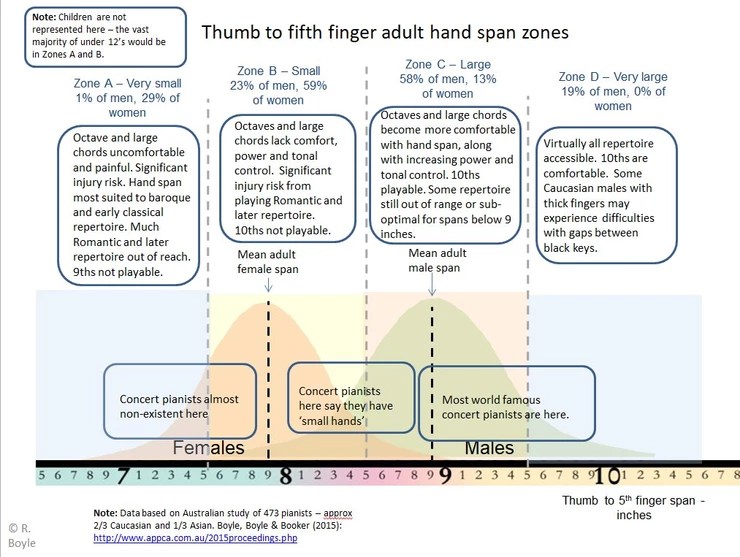
    In many compositions, octave harmonic intervals on both the left and right hands are common. At the most extreme end of the spectrum, harmonic intervals of tenths are not unusual, particularly in works by Liszt and Rachmaninoff. After all, take a look at this:

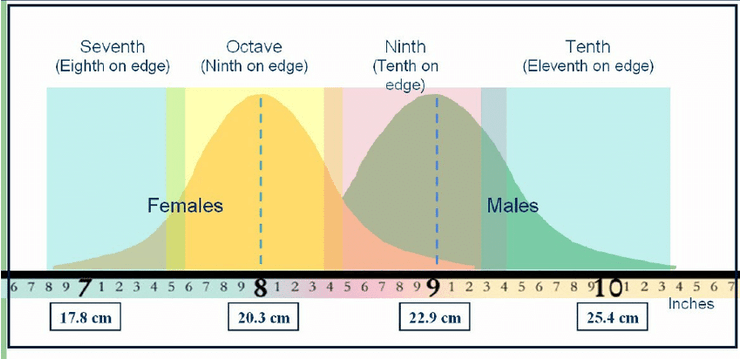
    This other infographic below is perhaps more useful for telling you how the handspan (in inches or centimeters) corresponds to the interval that you would be able to reach.

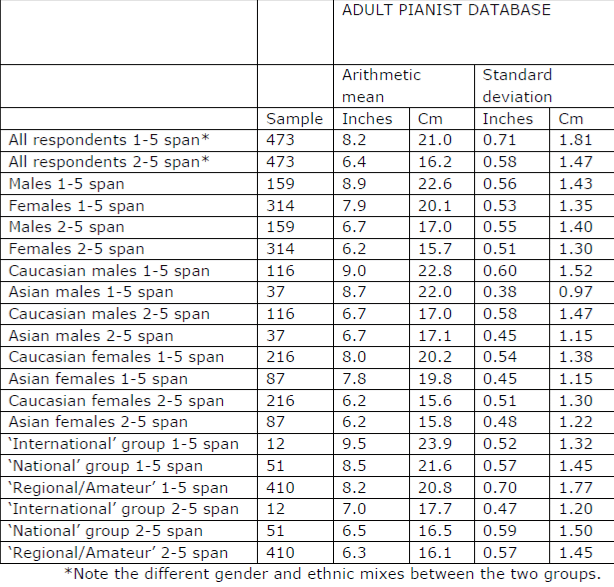
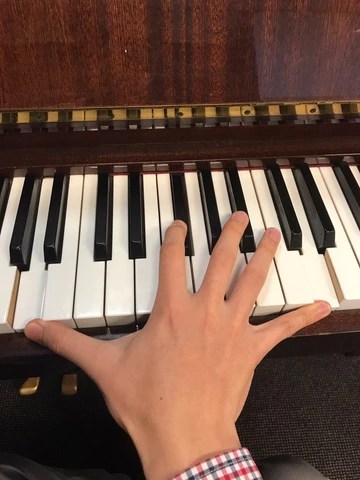
    My 1-5 handspan measures 9.8 inches, and I’m an Asian male. Let’s see some interesting statistics from the literature review that was done in 2015 (Australian study of 473 pianists where 2/3 participants were Caucasian and 1/3 were Asian). See reference [4] for the link to the full literature review in PDF format.

    Assuming a Gaussian distribution for the above data, then:

    my 1-5 span would be at the 98.8 percentile among all 473 adult pianists.

    my 1-5 span would be at the 94.6 percentile among all 159 male (73% Caucasian and 27% Asian) adult pianists.
    my 1-5 span would be at the 99.8 percentile among 37 adult Asian male pianists.

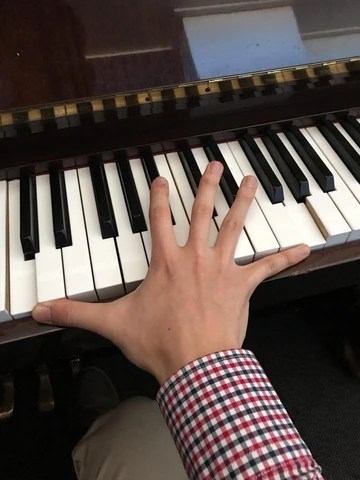
    Not bad at all. Here is my 1-5 span for the right hand:

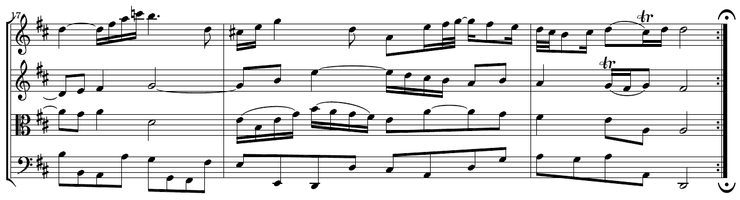
    Both my left and right hands can do 11ths semi-comfortably. This has been so useful once, where I needed to play the final chord of a piano transcription of the Aria from Bach’s third orchestral suite, better known as “Air on the G String”. The ending chord for that piano transcription is what you see in the photograph above. In my opinion, rolling the chord would kill the majestic end of the piece as each note of the chord is so paramount in establishing the sheer character of the conclusion. They all needed to be heard simultaneously. The piano transcription I played from was highly faithful to the original parts of the string orchestra (see the four individual parts below). Essentially, the piano transcription covered all four voices from the four instruments accurately! Such are the benefits of being able to stretch an 11th!

    If I really tried, I can do a 12th too, but that is not realistically achievable under performance circumstances at all.

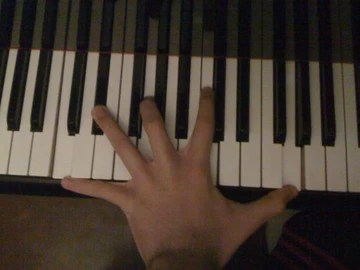
    Meanwhile, some modern Rachmaninoffs can do the infamous C-Eb-G-C-G. This is absolutely mind-blowing. With this kind of handspan, you can probably play some beginner pieces meant for both hands, with just one hand. This is the largest handspan I have ever seen. If anyone has seen an image/photograph of a handspan greater than that of the image below (online/real life), let me know!

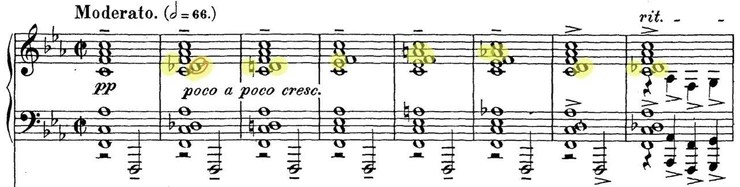
    Well, I’m contented with what I have. With my handspan of an 11th, I can play the opening block chords of Rach 2 comfortably (thank God these are semibreves and not crotchets). Personally, I feel that the full effect of the dissonance and the rising tension can only be exuded when all the chords are played as blocks. Of course, for pianists who do not have such large handspans…

    Recently, I learnt a piece that I had actually wanted to learn for quite a long time. It is Animenz’s transcription of Departures, one of the ending songs for a Japanese animation series called “Guilty Crown”. I learnt an extract of the transcription, which you can view here:

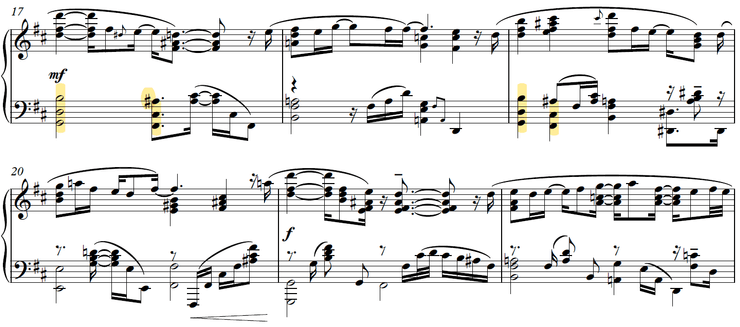
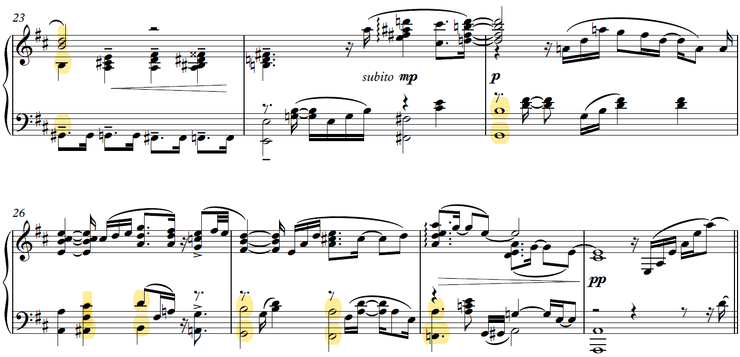
    I frankly don’t know if I could live with learning this piece if I had to do away with all the tenths that Animenz puts into his transcription. A harmonic tenth simply adds more flavour than an octave. Look at the following six bars. The highlighted chords are huge intervals.

    Once again, look below. This must be rather discouraging for anyone who wants to play the tenths faithfully as blocks but is unable to.

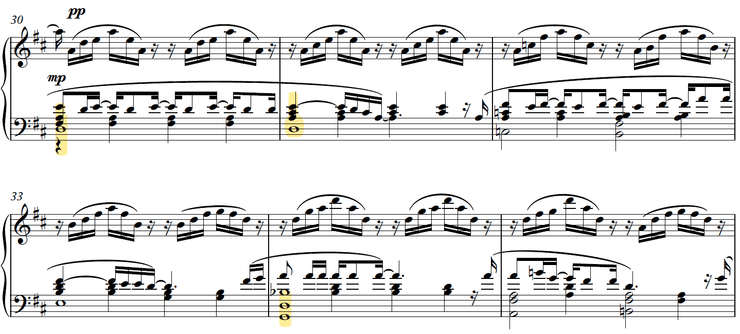
    The following six bars of music are one of the most beautiful and unique I have come across in a piano transcription. They actually motivated me to learn this piece! Observe how the melody is in the upper voice of the left hand. The lower portion of the left hand plays consistent rhythmic notes while the right hand drones up and down beautifully. Charming! At some points, such as the the first beat of bar 32, I could not realistically do that C-A-C-F# chord. Hence, I needed to use my right hand to play the F#. The more interesting point is the Bm7 chord in bar 35. For a while, I actually did the full chord in my left hand. However, accuracy was being compromised because the transition duration to the chord was short. So, I decided to play that top D with my right hand instead, and that turned out quite well.

    I didn’t go on to learn the rest of the piece after bar 38 because I felt that it would take too much time and effort to learn the entire piece. So, we see that even though my handspan is pretty large, that alone isn’t enough to learn and master pieces. There must also be that technical ability that allows the pianist to navigate challenging pieces, along with a million other factors for him to consider. One must also be clever when choosing the fingering to adopt for a particular passage. The example regarding the Bm7 chord in bar 35 is classic.

    Moreover, playing the opening block chords of Rach 2 doesn’t mean that I can play the entirety of Rach 2. On the other hand, there are internationally-acclaimed concert pianists who cannot play the block chords for the opening of Rach 2 but can play Rach 2 reasonably well.

    In conclusion, I would say that being able to stretch large intervals certainly does help when learning more advanced piano repertoire. If you can do a tenth comfortably, virtually the entire repertoire is accessible, at least according to one of the infographic above. Nevertheless, don’t be complacent. One still has to work on technique, and put in deliberate effort when striving to perfect a piece. For those who cannot stretch large intervals, I would say: don’t fret! As I mentioned at the start of the post, there are many things you can do to work around it: omit some notes, roll the chord, use a different fingering, use the pedal, choose a different piece, etc. There is so much more to piano music than just being able to stretch and play some chords with big intervals (as much as I feel that playing block chords as written is quite important). In either scenario, the important thing is not to be complacent or discouraged respectively. One must work diligently and put in serious effort in order to become a competent pianist.

    The content enclosed between the following two dividers is a direct quote from reference [1] which I found particularly interesting. It succinctly illustrates yet another aspect of the piano which has evolved over time, in addition to the increased dynamics and range. Modern pianos have wider keys than the pianos 200 years ago. This partially accounts for why certain pieces that were composed a long time ago have intervals that alienate a significant proportion of contemporary pianists when attempted on a modern piano. On the pianos of the past, these intervals wouldn’t have required the same extent of hand-stretching as that of today. A consequence of the widening of the piano keys over time has been that a smaller proportion of modern pianists is able to play octaves, ninths, tenths, etc. Well, the piano has historically revolved and been designed for the adult European male pianist. Go figure.

    Given that Caucasians have larger hands on average than Asians, I’m not at all surprised that the widening of the piano keys over time has simply reinforced the perception that the piano is a challenging instrument, particularly in predominantly Asian societies such as Singapore.


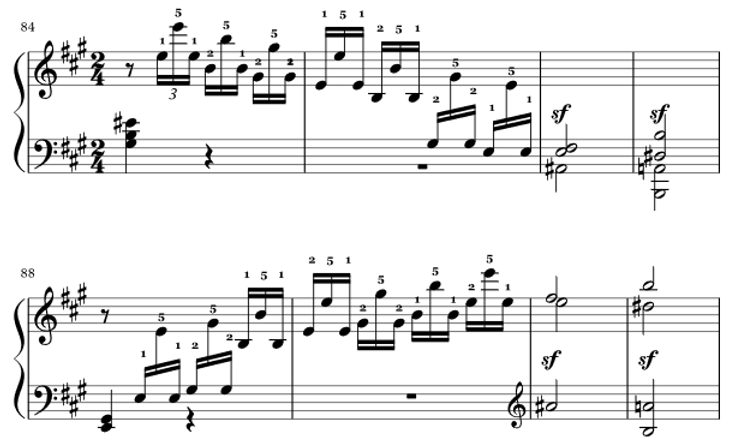
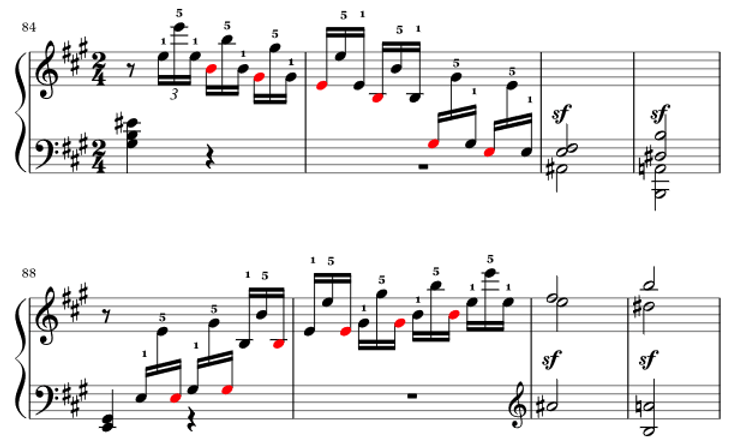
    “It’s worth noting that piano keyboards used to be smaller! The keys on so-called fortepianos – the early pianos that Haydn, Mozart and Beethoven played – were slightly narrower. Moreover, the keys were much lighter to play and only could be pressed about half as far as today’s grand pianos. This certainly affects pianists when we play music written for these older pianos on modern instruments with their much heavier keys that we also need to press further down. Beethoven wrote a pianistically novel passage in his second published piano sonata. The opening movement of the Sonata in A major, Op. 2, No. 2, has this passage:

    “This is a rare example of Beethoven specifying fingering. However, even pianists with large hands are unable to play this passage using Beethoven’s fingering on a modern piano. (If you know of anyone who does so, please leave a comment below. I’ve never heard of any modern-day pianists using this fingering.) The keys on today’s pianos are simply too wide for this fingering to make any sense. Instead, the best solution in this case is to split the passage between the hands:”


    Yours faithfully,
    Nic Loh
    3 April 2019

    References & Further Reading
    1. https://www.key-notes.com/blog/piano-hands
    2. https://mattixmusic.com/why-memorize-music/
    3. https://en.wikipedia.org/wiki/Piano#Early_fortepiano
    4. https://www.researchgate.net/publication/287901848_PIANIST_HAND_SPANS_GENDER_AND_ETHNIC_DIFFERENCES_AND_IMPLICATIONS_FOR_PIANO_PLAYING