This blog post is my translation attempt on the fifth chapter of LLPSI FR. If you wish to learn Latin, all you have to do is just follow me from chapter 01. The Latin text is designed such that you can learn Latin from scratch just by reading the text itself without any external aid. Such is the power of context. For my translation attempt on the fourth chapter, please check out an earlier post: 02(10).
I am making this translation to actively consolidate my knowledge of Latin. As for how to use the text, I would advise that you read the original Latin text, and refrain from consulting my translation attempt unless you need to!
The villa and the garden
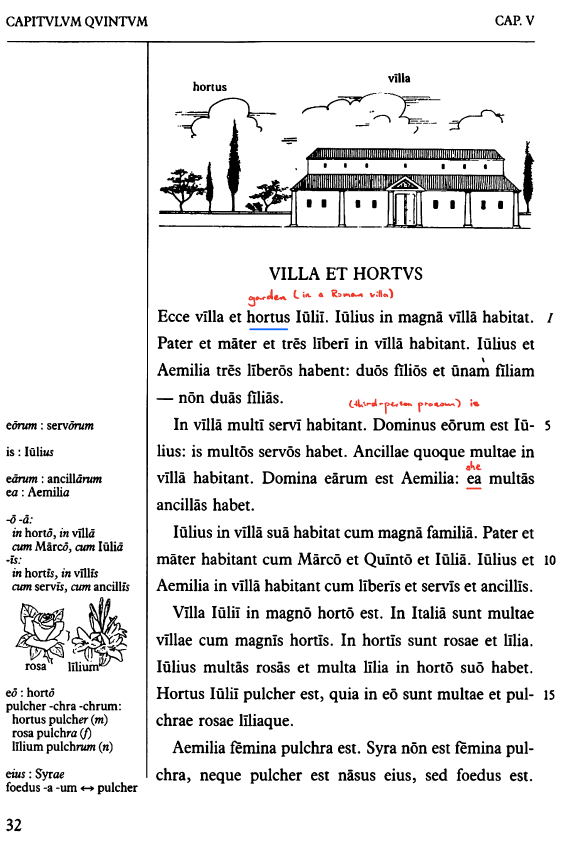
Here is the villa and the garden of Julius. Julius lives in the large villa. The father, mother, and the three children live in the villa. Julius and Aemilia have three children: two sons and one daughter – not two sons.
Many servants live in the villa. Their master is Julius: he has many servants. Many maids also live in the villa. Their lady-boss is Aemilia: she has many maids.
Julius lives in his villa with a large family. Father and Mother live with Marcus, Quintus, and Julia. Julius and Aemilia live in the villa with children, servants, and maids.
The villa of Julius is in a large garden. In Italy, there are many villas with large gardens. In the garden are roses and lilies. Julius has many roses and many lilies in his garden. Julius’ garden is beautiful, because in it are many beautiful roses and lilies.
Aemilia is a beautiful woman. Syra is not a beautiful woman, and her nose is not beautiful, but is ugly.

Syra, who is a good maid, has a large and ugly nose. Julius is the husband of Aemilia, a beautiful woman. Julius loves Aemilia because she is a beautiful and good woman. Aemilia loves her husband Julius and lives with him. The father and mother love their children. Julius does not live alone, but lives with Aemilia and the large family in the villa.
There are two doors in the villa: a large door and a small door. The villa has two doors and many windows.
In Julius’ villa, there is a large hall and a large water basin. What is in the water basin? There is water in it. There are no windows in the atrium.
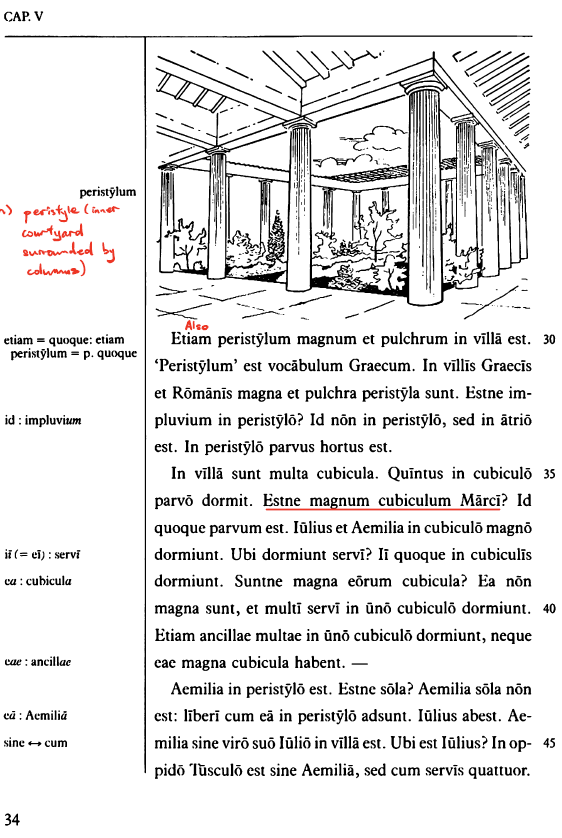
In the villa, there is also a large and beautiful peristyle (an inner courtyard surrounded by columns). ‘Peristylum’ is a Greek word. In Greek and Roman villas, there are large and beautiful peristyles. Is the water basin in the peristyle? The water basin is not in the peristyle, but in the hall. In the peristyle is a small garden.
There are many bedrooms in the villa. Quintus sleeps in a small bedroom. Is the bedroom of Marcus large? It is also small. Julius and Aemilia sleep in a large bedroom. Where do the servants sleep? The servants also sleep in bedrooms. Are their bedrooms large? The bedrooms are not large, and many servants sleep in one bedroom. It is also the case that many maids sleep in one bedroom, and they do not have large bedrooms.
Aemilia is in the peristyle. Is she alone? Aemilia is not alone: she is with her children in the peristyle. Julius is absent. Aemilia is in the villa without her husband Julius. Where is Julius? Julius is in the town of Tusculum without Aemilia, but with four servants.
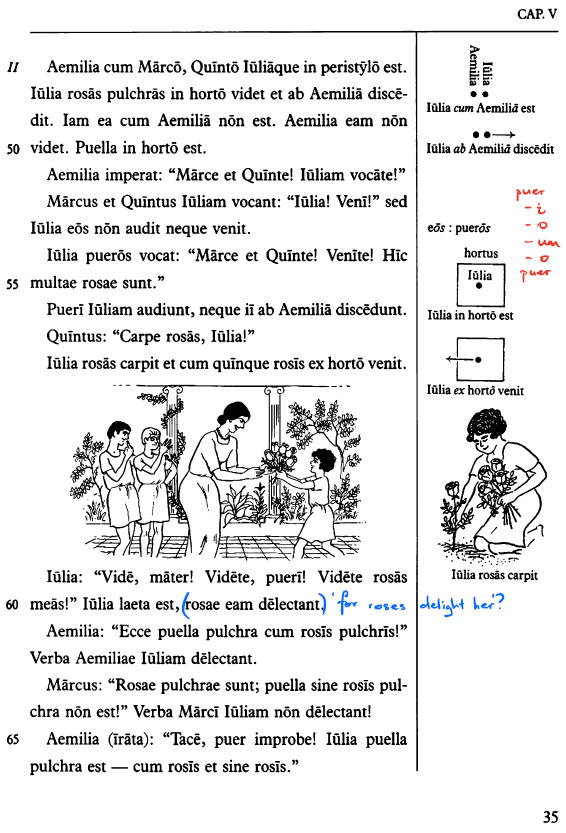
Aemilia, along with Marcus, Quintus, and Julia, is in the villa. Julia sees the beautiful roses in the garden and leaves Aemilia’s presence. Now, Julia is now in Aemilia’s presence. Aemilia does not see her. The girl is in the garden.
Aemilia commands: “Marcus and Quintus! Call for Julia!”
Marcus and Quintus call for Julia: “Julia! Come!” but Julia neither hears them nor comes.
Julia calls the boys: “Marcus and Quintus! Come! There are many roses here.”
The boys hear Julia, and the boys do not leave Aemilia’s presence.
Quintus: “Gather the roses, Julia!”
Julia gathers the roses and comes from the garden with five roses.
Julia: “Look, Mother! Look, boys! Look at my roses!” Julia is happy; the roses delight her.
Aemilia: “Here is my beautiful daughter with beautiful roses!”
The words of Aemilia pleased Julia.
Marcus: “The roses are beautiful; the girl is not beautiful without the roses!” The words of Marcus does not please Julia!
Aemilia (angry): “Silence, bad boy! Julia is a beautiful girl – with roses and without roses”.
Julia: “Listen, Marcus and Quintus!”
Marcus: “Mother does not see your ugly nose!”
Marcus and Quintus laugh: “Hahaha!”
Julia: “Listen, Mother: and now the boys are laughing at me!”
Julia cries and leaves the boys with one rose.
Aemilia: “Silence, bad boys! Julia’s nose is not ugly. Leave the peristyle! Take the other roses and put them in the water!”
The boys take the other four roses and leave with them.
Aemilia, who is now alone in the peristyle, calls for the maids: “Delia and Syra! Come!”
Delia and Syra come from the hall.
Aemilia asks them: “Are the boys in the hall?”
Delia responds: “In the hall.”
Aemilia: “What are Marcus and Quintus doing?”
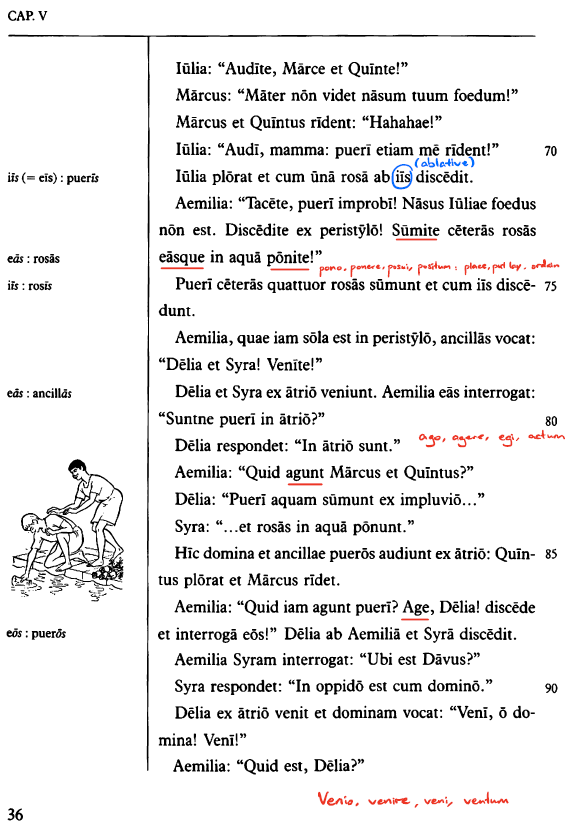
Delia: “The boys are taking water from the water basin…”
Syra: “…and putting the roses in the water.”
Here, the lady-boss and maids can hear the boys from the atrium: Quintus cries and Marcus laughs.
Aemilia: “What are the boys doing now? Go, Delia! Leave and ask them!” Delia leaves the presence of Aemilia and Syra.
Aemilia asks Syra: “Where is Davus?”
Syra responds: “In the town with Master.”
Delia comes from the hall and calls the lady-boss: “Come, Lady-boss! Come!”
Aemilia: “What is it, Delia?”
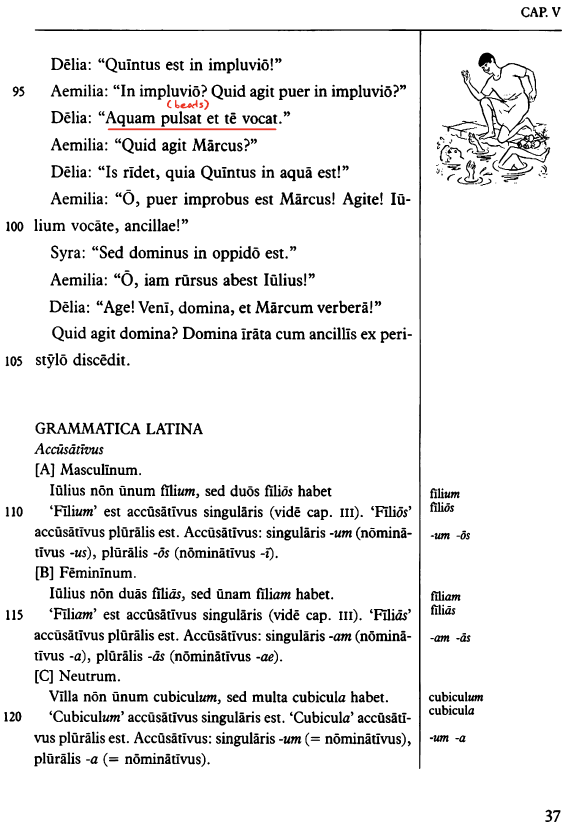
Delia: “Quintus is in the water basin!”
Aemilia: “In the water basin? What is the boy doing in the water basin?”
Delia: “Beating the water and calling you.”
Aemilia: “What is Marcus doing?”
Delia: “He is laughing because Quintus is in the water!”
Aemilia: “O, what a bad boy Marcus is! Go! Call for Julius, maid!”
Syra: “But Master is in town.”
Aemilia: “O, Julius is away again!”
Delia: “Go! Come, lady-boss, and beat Marcus!”
What does the lady-boss do? The angry lady-boss leaves the peristyle with the maids.
A translation attempt by yours truly
NL
3 July 2020