pianist and medical doctor

Tag: 2022-06

  • 04(13): The secret of success according to the world’s greatest sushi chef

    Background

    What is your favourite cuisine?

    Personally, it would be Japanese (Western is a joint favourite). My love for Japanese food began at the tender age of nine, when I was granted even more daily pocket money upon advancing to being a Primary Three student at Pei Hwa Presbyterian Primary School (PHPPS). A photograph of the primary school is attached below. When I was in Primary One or Two, school sessions would occur in the afternoon, and there would be lunch and dinner at home. As for my classmates and I, we would just talk to one another and play catching in the school field.

    However, from Primary Three through Six, school sessions would occur in the morning, and it became pretty popular for my fellow classmates and I to consume food during recess time (most likely due to my peers and I now indulging in our newly-acquired increased purchasing power), in addition to the breakfast and lunch many of my peers and I would enjoy at home.

    Favourite meal at the primary school canteen

    One of my fondest memories of primary school would be that of consistently buying a particular set meal from the Japanese food stall of the school canteen during the half-an-hour recess time. The meal consisted of the following: rice, some dark brown sauce, egg, and three pieces of yakitori (Japanese skewered chicken; the Japanese words ‘yakitori’ literally translate to ‘grilled bird’). There would also be seaweed strips sprinkled over the rice and other ingredients. All of this would be presented on a translucent rectangular tray, from which I would partake of the scrumptious food.

    Sushi

    Since that first exposure to Japanese food (at worst, a simulacrum of it), I have gone on to try other aspects of Japanese cuisine as the years passed. In particular, I stumbled upon sushi, a huge component of Japanese cuisine that is responsible for the cuisine’s widespread appeal. Sushi is an element of Japanese cuisine that I deeply relish, and it is precisely what I will talk about more in this post.

    At least in the local context, authentic Japanese sushi is rather pricey as proper ingredients which are as fresh as reasonably possible, of excellent quality, often have to be imported directly from Japan. This contributes to the steep price of authentic Japanese sushi.

    The overwhelming ubiquity of ‘fake’ wasabi

    Just take wasabi as an example of the sheer value of ‘proper’ ingredients in the art of making sushi.

    The overwhelming majority of so-called ‘wasabi’ served in restaurants does not contain any real wasabi. Such ‘fake’ wasabi is manufactured from a blend of Western horseradish, mustard flour, cornstarch, and green food colouring (the green colouring is required to convince people into thinking they’re consuming ‘real’ wasabi, which is actually green in colour). Many who think they know what wasabi tastes like have never actually tasted the real stuff, unless they have gone to top-of-the-line omakase restaurants such as Shoukouwa, or other places which serve real wasabi.

    Unlike ‘fake’ wasabi, ‘real’ wasabi paste is obtained by grating the rootstalk (the technical term in botany for this would be ‘rhizome’) of the wasabi. When one grates real wasabi, the volatile compounds that confer the real wasabi its distinguished taste begin to disintegrate within minutes. That’s why real wasabi paste tastes best when it’s freshly grated. Wasabi is also considered challenging to grow, and this characteristic contributes to the vegetable’s high price. On the other hand, ‘fake’ wasabi is cheap and has a long expiration date.

    Fake wasabi has a strong taste that overwhelms any delicate fish taste on the sushi. It delivers a strong blast of spiciness that comes from the mustard flour (recall the few basic ingredients that I mentioned above regarding what constitutes ‘fake’ wasabi). On the other hand, ‘real’ wasabi accentuates the delicate taste of fish in the sushi we consume. Real wasabi is not spicy. Rather, the taste of real wasabi is more like the aroma of spiciness but without the pungent punch of the mustard flour in the fake wasabi.

    Sushi (cont.)

    It’s not just the ingredients which are considered in the art of making authentic sushi. The expertise required for making authentic sushi needs to be considered too. Proper sushi-making is an art where knowledge is possessed only by a limited number of highly skilled sushi chefs. They have skills which are rare (even rarer outside of Japan). Coupled with the high demand for authentic sushi, anyone who has undergone an introductory economics class can tell you that the potent combination of a ‘low supply and high demand’ would result in the partaking of authentic sushi being a costly activity.

    As a mere college student who isn’t swimming in multigenerational wealth, the hope of being able to enjoy authentic sushi regularly is but a distant dream. The fiscally prudent option, and what seems to be a reasonable compromise between quality and price, would be to settle for much more affordable mainstream sushi restaurants. While the experience at mainstream restaurants can never rival that of top omakase restaurants, it allows many Singaporeans the opportunity to still enjoy sushi at reasonable prices, which in my opinion, is still a great thing overall.

    Moderately inauthentic sushi is still better than not having any sushi at all.

    Jiro Dreams of Sushi

    The thing which even inspired me to write about Japanese cuisine, and sushi in particular, was a documentary I had watched yesterday afternoon entitled “Jiro Dreams of Sushi”.

    This documentary was released in 2011. As the documentary begins, we are greeted by the soothing melody of the first movement of Tchaikovsky’s Violin Concerto in D Major, one of my favourite pieces of classical music.

    When this well-known piece of classical music finally comes to a halt in the documentary, we hear the first words of the legendary sushi master, Jiro Ono.

    “Once you decide on your occupation, you must immerse yourself in your work. You have to fall in love with your work. Never complain about your job. You must dedicate your life to mastering your skill. That’s the secret of success and is the key to being regarded honorably.”

    Jiro Ono, 96-year-old sushi chef

    Jiro Ono is the Japanese chef and owner of Sukiyabashi Jiro, arguably the best sushi restaurant in the world. The restaurant can only seat up to ten people at any given time, and had earned three Michelin stars every year since 2007 until the year where it stopped receiving reservations from members of the public. Reservations are now only available to previous regulars, people with special connections, or people who book their reservations through the concierge of a luxury hotel. Sukiyabashi Jiro is no longer officially a three Michelin star restaurant because one of the guiding principles in how Michelin stars are awarded is that the eatery must be available to members of the general public.

    In the documentary, we hear from Jiro’s older son:

    “The techniques we use are no big secret. It’s just about making an effort and repeating the same thing every day. There are some who are born with a natural gift. Some have a sensitive palate and sense of smell. That’s what you call “natural talent”. In this line of business, if you take it seriously, you’ll become skilled. But if you want to make a mark in the world, you have to have talent. The rest depends on how hard you work.”

    Yoshikazu Ono, the older son of Jiro Ono

    One of the most well-known food critics in Japan speaks of Jiro, “He repeats the same routine every day. He even gets on the train from the same position. He has said that he dislikes holidays. The holidays are too long for him. He wants to get back to work right away. It’s unthinkable for most people.”

    The food critic later goes on to say (the bolded text in this paragraph and the following three paragraphs all constitute quotes by this food critic), “A great chef has the following…attributes: first, they take their work very seriously and consistently perform on the highest level; second, they aspire to improve their skills; third is cleanliness…; the fourth attribute is impatience; they are not prone to collaboration; they’re stubborn and insist on having things their own way…”

    “In France, the first Michelin guide was published in 1900. Michelin inspectors look first for quality. Next they look for originality, and finally they look for consistency. Jiro’s restaurant easily meets their standards. A perfect three-star Michelin rating means it is worth making a trip to that country just to eat at that restaurant.”

    “When Jiro got three stars, everyone was astonished. There are only 10 seats there! The restroom is outside the premises. There’s not another three-star restaurant in the world like that. But the Michelin investigators say, “No matter how many times you eat at Jiro’s, the sushi there is incredible.” They said that three stars is the only rating adequate for the restaurant.”

    “Always look beyond and above yourself. Always try to improve on yourself. Always strive to elevate your craft”.

    The climax of the documentary occurs towards the end of the documentary when it is revealed in the words of the food critic that during the first year that the restaurant was checked by Michelin, Jiro Ono didn’t make sushi for Michelin even once. Yoshikazu was the one who made sushi for them. Clearly, if Jiro permitted, Yoshikazu was skilled enough to take over the restaurant if circumstances called for it.

    Lessons for us

    Jiro Ono’s life is simply fascinating. I’ll quote him again:

    “Once you decide on your occupation, you must immerse yourself in your work. You have to fall in love with your work. Never complain about your job. You must dedicate your life to mastering your skill. That’s the secret of success and is the key to being regarded honorably.”

    His words are applicable beyond the domain of making sushi, and are incredibly inspiring.

    In my case, the question of whether medicine is the field I should have chosen to come to with the benefit of hindsight is no longer an important or relevant one. The reality is that I decided to apply for medical school with the best available information to me at the time, and here I am. I had decided that I wanted to graduate with a medical degree and procure gainful employment which would ideally capitalise on the skills I would have acquired over the course of the undergraduate degree programme.

    According to the advice of Ono, I should now immerse myself in medicine and what it takes to be a successful medical student. I have to fall in love with being a medical student. What Ono may be trying to drive across is that such passion and love for what one does comes with becoming better at what one does in the context of a positive feedback loop. This ties in well with the advice given by Cal Newport in his influential career advice book, So Good They Can’t Ignore You.

    Moreover, regarding Ono’s advice on not complaining about one’s job, though I have not graduated from medical school and started working as a doctor, I can identify moments in which I have lamented about certain aspects of being a medical student. Often, such lamentations are not constructive. A more meaningful thing to do is working diligently and humbly at improving my skills. Hopefully and ideally, this would manifest as me becoming more competent with each passing day.

    I consider myself fortunate to have encountered such advice while still a student, even before I have entered the unforgiving working world. But even if you, dear reader, are already working, fret not. This advice is still highly relevant.

    Whether we’re still in school or working, let’s focus on getting better at what we do. Don’t complain about our school or work.

    As long as we do the above with consistency over the span of the many decades which we shall dedicate to mastering our craft, I’m confident that we will have a better shot at attaining success and being regarded honourably, just like Jiro Ono.

    Nic
    29 June 2022

  • 04(12): Aesthetic medicine – does it deserve such a bad rap?

    Background

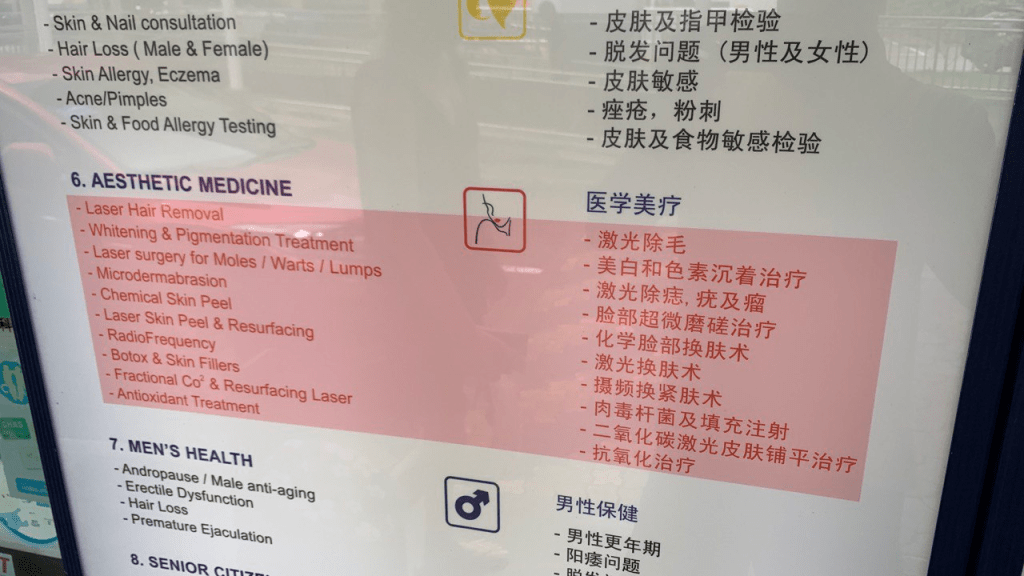
    Yesterday, I went to get a haircut and while I was en-route to the barber, I encountered a sign which advertised the list of aesthetic services offered by a GP clinic, which itself was a member of a chain of GP clinics. Interestingly, aesthetic medicine isn’t recognised as a specialty or subspecialty in Singapore. Doctors who attempt to market themselves as an ‘aesthetic surgeon’, ‘aesthetic physician’, or a similar title will have to face various penalties as this would be deemed unethical by the Singapore Medical Council.

    Anyway, on the topic of specialties, as a mere medical student, it’s still rather premature to hone in specifically on a single specialty. After all, this isn’t the US where medical students are required to pick their specialty early on. In Singapore, doctors have the flexibility to slowly discover where their interests and aptitude lie. In tandem with the advice given by senior medical students and doctors, I have decided to keep an open mind regarding what I might find myself doing in the future. Besides, as someone who is about to advance to Year 4 of medical school, there are still so many specialties that I have yet to gain exposure to in the form of clinical rotations.

    As such, besides ophthalmology, I possess a broad interest in many other areas including, but not limited to: family medicine (including aesthetic medicine), internal medicine (cardiology, dermatology, endocrinology, infectious diseases, medical oncology, neurology, nuclear medicine), pathology, radiology, radiation oncology, and otorhinolaryngology.

    In this blog post, I would like to talk specifically about aesthetic medicine. The perception of aesthetic medicine by the general public doesn’t seem to be a positive one. Most people seem to view aesthetic medicine as an exploitative field where practitioners are so fiscally oriented to the extent that it is borderline sickening.

    A late doctor’s thoughts on life, wealth, success, and happiness

    The thoughts of the late Dr Richard Teo Keng Siang (1972-2012) have amplified such a perception. You can read his thoughts on life, wealth, success, and happiness here, a webpage which offers a transcript of a speech he delivered a few months before his passing. The webpage also offers an embedded YouTube video of his speech, which was recorded eight months after he had been diagnosed with terminal lung cancer.

    For those among us who have chosen not to read the entire transcript or watch the video, the essence of Dr Teo’s speech is as follows:

    As a person from a below-average family background, he was told by the media and his peers that happiness is about success, and that success is about being wealthy. So, Dr Teo made it his goal to become wealthy. Dr Teo was a brilliant student who excelled academically, even in medical school. After graduating from medical school, he obtained a traineeship in ophthalmology, and was also awarded a research scholarship to develop lasers to treat the eye. In the process, he was able to obtain two patents: one for developing the relevant medical devices, and one for developing the lasers. Despite attaining various impressive academic accolades, he realised that these per se did not bring him any wealth. Once his MOHH bond was completed, he left for the private sector (specifically, to practise aesthetic medicine) because he decided that ophthalmology training was taking too long, and that there was much more money to be made in the private sector. He became very rich from practising aesthetic medicine. However, one day, he presented with back pain and approached his colleague at SGH for an MRI just to rule out spondylolisthesis and other ominous conditions. Unfortunately, the results of the MRI scan and subsequent investigations were not reassuring as Dr Teo had hoped. Dr Teo was eventually diagnosed with terminal lung cancer, and given a prognosis that many patients would deem highly unfavourable. He finally opines that true happiness doesn’t come from serving yourself, and that we ought not to let society tell us how to live. We ought not to let the media tell us what we’re supposed to do. We have to decide whether we are working solely for our own benefit, and/or whether you are going to make a difference in the lives of others.

    This speech by Dr Richard Teo is so well-known that I have encountered his story on three separate occasions. I remember hearing about Dr Richard Teo for the first time when I was preparing for my GCE O Level exam in my final year at Maris Stella. That was in 2013. As for the second time, I encountered it via a link that a fellow friend who was a medical student shared on her Facebook profile (this was before I deleted my Facebook account for good). Lastly, I also remember hearing it for the third time during my church’s Watchnight service on 31 Dec 2019, where the pastor shared Dr Teo’s story in an attempt to emphasise the point that much of the material possessions that we can indulge in are truly ephemeral in the light of eternity.

    With such a story to top it off, it is therefore no surprise that some people feel that aesthetic medicine is the epitome of unbridled capitalism, where people who are insecure about their physical appearance (particularly those of the fairer sex) are mere cash cows to be milked till their udders are sore. Some people even go to the extent to say that providing aesthetic services is not really medical practice. However, in my opinion, even after all that Dr Teo had said in his speech, such perceptions of aesthetic medicine are too harsh. They are too one-sided and fail to offer a balanced perspective of what aesthetic medicine has to offer.

    A careful reading of the transcript of Dr Teo’s speech would allow one to realise that aesthetic medicine is neither evil nor exploitative per se. What’s more critical is your intention that undergirds your practice of aesthetic medicine, which will manifest in your attitude towards patients, and consequently, how you treat them.

    Aesthetic medicine can offer individuals the opportunity to put their best foot forward in this society which places such an undue emphasis on one’s external appearance (like it or not). This can give patients greater self-confidence, allowing them to fulfill their potential even as they wend their way through society.

    Thus, in this blog post on aesthetic medicine, I would like to take the opportunity to briefly introduce some examples of aesthetic services that may be offered in a GP clinic. This is in no way an attempt to promote any specific clinic. Rather, undergoing the process of writing this blog post would mean that I would need to acquire a basic understanding of each of the procedures that is advertised. Ultimately, I hope to have a better understanding of those aesthetic services as aesthetic medicine is a future area of practice that I’m considering. Additionally, as an inquisitive person, it brings me great joy to learn more about things that pique my curiosity. It brings me great joy to engage in writing, and sharing what I’ve learnt with you, dear reader.

    The following image is a photograph I took of the sign:

    I shall attempt to briefly describe how each procedure within Section 6 (highlighted in pink) works, based on the readings I have done for this blog post. Note that there’s going to be some overlap between the sections as the listed bullet points are not mutually exclusive.

    Laser Hair Removal

    Laser hair removal is a procedure which involves shining a laser on the region with the unwanted hair. The light is absorbed by the melanin (a dark pigment) in the hair. Within the melanin, the light energy is converted into heat, which damages the follicles that produce the hair. This in turn impairs future hair growth. The effect isn’t permanent, though such laser hair removal effectively delays hair growth for a long time. Any hair that grows out subsequently may be shorter and thinner than before.

    Whitening & Pigmentation Treatment

    Skin whitening can be achieved via chemical peels, or IPL (intense pulsed light therapy). Chemical skin peels will be discussed in a later section.

    As for IPL therapy, which is also known as a photofacial, it is a non-surgical modality for one to improve the colour and the texture of the skin. IPL uses the energy from photons to target a certain coloured pigment on your skin. When the particular region of skin is heated, the body gets rid of the unwanted cells in that region, and that gets rid of the thing you’re being treated for. Unlike lasers, an IPL device sends out more than one wavelength of pulsating light. As such, IPL can treat a range of skin conditions at the same time.

    Nevertheless, you can’t have your cake and eat it too. Due to the use of several wavelengths at a relatively gentle intensity on your skin, multiple sessions are normally required for the desired results to be achieved. After IPL, you may look younger because your skin tone is more even. And since the light doesn’t hurt other tissue, you can get better quickly.

    As for pigmentation, the skin can either be hypopigmented or hyperpigmented. Hypopigmentation refers to having skin that is lighter than your overall skin tone. Conversely, hyperpigmentation refers to having skin that is darker than your overall skin tone.

    There are many modalities that can be employed to treat hypo- or hyper-pigmentation. These include dermabrasion, chemical skin peels, laser skin peels, and IPL.

    Laser Surgery for Moles/Warts/Lumps

    Moles, warts, and lumps are typically harmless, and patients often want them removed or at least reduced in size for cosmetic reasons. One way of achieving this is via laser surgery. However, at least for moles, lasers (which are typically CO2 lasers) are only used for small moles. This is because for larger moles, the laser would not be able to penetrate deep enough to eliminate the pigmented cells that give rise to the moles.

    Microdermabrasion

    Remember how I mentioned ‘dermabrasion’ earlier? Well, that is different from microdermabrasion. Dermabrasion is an exfoliating technique that uses a rotating instrument to remove the outer layers of skin, and as you can imagine, this is most often requested for the facial region. Immediately following dermabrasion, treated skin will display some of the cardinal signs of inflammation such as rubor (reddening) and tumor (swelling). Note that I’m not actually suggesting that a neoplasm would form as a result from dermabrasion! It’s just that the Latin word ‘tumor’ is used to refer to ‘swelling; oedema’! The skin that grows back after dermabrasion is usually smoother.

    As you may have guessed from the terms, microdermabrasion is a less aggressive form of dermabrasion. Microdermabrasion is a noninvasive cosmetic procedure which involves the doctor spraying or rubbing fine crystals onto the skin with a wand that gently exfoliates the surface, removing the top layer. The complications aren’t severe as that of dermabrasion (e.g. there’s no bleeding in microdermabrasion); however, the results of microdermabrasion unfortunately aren’t as spectacular as that of dermabrasion.

    Chemical Skin Peel

    Chemical peels work by having a chemical solution is applied to the skin to remove layers of the skin, revealing the underlying skin. There are three types of chemical skin peels: light, medium, and deep. As we go from light to deep, the thickness of the skin that is ‘peeled’ off increases. For the light skin peel, only the epidermal layer is peeled off. However, for the deep chemical skin peel, both the entirety of the epidermis and the dermis are peeled off. After the skin peel is done, the new skin underneath is often smoother, appears less wrinkled, and may have less damage.

    Note that deep chemical skin peels are really rather invasive and nowadays, they are increasingly done less in favour of laser resurfacing, which we shall soon cover in the next section.

    Laser Skin Peel & Resurfacing

    Laser resurfacing treatment involves the emission of beams of light (this is basically what a laser is) to penetrate the skin and target either pigment, haemoglobin, or water in the skin. Depending on what is targeted, different skin abnormalities can be addressed. When pigment is targeted, age spots, sun spots, and dark spots can be reduced. When intradermal haemoglobin is targeted, erythema (reddening), scars, and stretch marks can be reduced. When intradermal water is targeted, wrinkles and fine lines can be reduced.

    Radiofrequency

    Radiofrequency skin tightening involves the doctor using a handheld device that is connected to a machine that creates radio waves. They will pass the device over your body to apply radio waves to your skin. The radio waves are exothermic, and this stimulates the production of more intradermal collagen and elastin. This treatment also speeds up cell turnover, and as such, the skin gets firmer and thicker over time. The process can take about an hour, depending on how much skin you are having treated. The treatment will leave you with minimal discomfort. You may see these treatments called by the brand names Thermi, Exilis, Profound RF, and Thermage, among others. The ‘Therm-‘ prefix that you see in some of these brand names should remind you that the radio waves are exothermic!

    Botox & Skin Fillers

    We have come to what is arguably one of the most famous aesthetic services: Botox.

    Botox is the brand name for botulinum toxin, which is a substance that is produced by the bacterium Clostridium botulinum and a few other related organisms. As the name suggests, this toxin is toxic! Specifically, the toxin is toxic to the nerves. It prevents the release of the neurotransmitter acetylcholine (ACh) from axon endings at the NMJ (neuromuscular junction), thus causing flaccid paralysis. When people are infected by this organism, and experience flaccid paralysis, the disease they are said to have is botulism. It’s similar to how when people are infected by a related organism, Clostridum tetani, they are said to have tetanus.

    Unlike the experience in botulism, where the infective bacterium is rampant in the body and affecting all sorts of nerves via the unbridled spread of the botulinum toxin, Botox treatment is administered meticulously by the doctor. In Botox treatment, small amounts of the toxin are carefully delivered to specific regions via fine-needle injections.

    Based on the pathophysiology of botulism, it’s not hard to see how Botox treatment can reduce wrinkles. With the administration of Botox on the face, signals (the neurotransmitter ACh) that cause the facial muscles to contract are blocked. Temporarily, at least, this would reduce the wrinkles around the eyes and on the forehead.

    Fractional CO2 & Resurfacing Laser

    See the above point on Laser Skin Peel and Resurfacing.

    Antioxidant Treatment

    Antioxidant treatment can entail a process known as iontophoresis, which is a process of transdermal drug delivery by use of a voltage gradient on the skin. Molecules are transported across the stratum corneum (the most superficial layer within the epidermis) by electrophoresis and electro-osmosis and the electric field can also increase the permeability of the skin.

    Think of iontophoresis as basically priming the skin for receiving the antioxidant (the increased skin permeability would mean increased absorption of the antioxidant). This is one solution to the perennial challenge that cosmeceutical companies face, which is to develop products that can penetrate well enough into the human skin.

    Let’s talk specifically about Vitamin C (ascorbic acid), a well-known antioxidant. When iontophoresis is used in combination with vitamin C, absorption is effectively expedited (once again, due to the iontophoresis-induced increased skin permeability). Transdermal delivery of vitamin C via iontophoresis would improve superficial pigmentation issues such as freckles, spots, and acne.

    Conclusion

    There is a wide variety of aesthetic services that are available at many GP clinics. It is intellectual sloth to simply paint broad strokes of aesthetic medicine as an arena in which the udders of insecure cash cow patients are milked in the name of unfettered profit maximisation. Doctors who provide aesthetic services are often unfairly stereotyped as greedy and exploitative.

    At least through the lens of a member of the general public who is also a medical student, I opine that aesthetic medicine appears to possess tremendous potential as a means by which people can heighten their self-confidence, and allow them to put their best foot forward in a world which can be rather critical of people’s external appearances.

    Moreover, the practice of aesthetic medicine isn’t confined within the four walls of a physical clinic. Excellent patient management is anchored in good patient education, which in the context of aesthetic medicine would include educating the patient on the importance of having, as a baseline, a skincare routine. I challenge you to find me a single doctor who doesn’t think that consistent application of moisturiser and sunblock (even for patients without any known dermatological conditions) is good practice.

    Let’s be more open-minded and remember that health, as defined by the World Health Organisation, is ‘a state of complete physical, mental and social well-being and not merely the absence of disease or infirmity’.

    Nic
    21 June 2022

  • 04(11): Justin Bieber – a case study on facial nerve palsy and basic neurolocalisation

    Introduction

    During my first week of the IM (Internal Medicine) rotation almost a year ago, I remember being asked by a doctor to perform an examination of a particular patient’s cranial nerves. The patient had been diagnosed with Ramsay-Hunt syndrome. That encounter left an impact on me.

    Now, whenever I encounter the eponymous syndrome or read about facial nerve palsies in my medical studies, I never fail to be reminded of that patient.

    In this article, I share how I was recently reminded of that patient yet again.

    This morning, I entered my school’s medical library for my own self-study and decided to do some quick casual browsing through today’s copy of “The Straits Times” to start the day. I chanced upon a headline that caught my attention: “Justin Bieber recovering from virus, says surgeon“, as seen by the photograph I have taken of the print article I read:

    Justin Bieber? Who?

    Bieber rose to fame in the late 2000s, where uploaded YouTube videos of the precocious teenager doing some casual singing went viral and allowed him to jump-start his singing career. He is most well-known for the song ‘Baby’ which become a global hit. Whilst a secondary school student at Maris Stella, I remember that song being played nearly everywhere – in malls, etc. The song was also a means by which Bieber received a seemingly substantial amount of criticism by all sorts of people. I’m not sure whether it’s still the case, but I believe that the official music video for ‘Baby’ was the most disliked video on YouTube by absolute dislike count metrics (before YouTube officially removed videos’ public dislike count).

    The matters of Bieber don’t particularly concern me and I am neutral about his life and craft. He neither appeals to me nor attracts my disdain. In terms of music, I am simply interested in other genres of music: classical, and movie soundtrack, for example. However, it’s easy to understand why Bieber has become a target of a significant amount of online vitriol.

    Bieber is a classic example of someone leveraging online fame to cement financial success. This perhaps stokes jealousy in the hearts of many young men throughout the world who secretly aspire to achieve what he has: fame and fortune. Some people are of the view that Bieber has supposedly attained such fame and fortune because of his sheer luck and that he doesn’t actually possess the raw talent to warrant the success that he has attained.

    I don’t think Bieber’s station in life is particularly admirable, and I wouldn’t want to be in his shoes if given the choice, but the reasons for this view will not be elaborated in this article. I merely wish to introduce Bieber to readers who may not be familiar with him. He shall be the subject of our brief study on facial nerve palsies and basic neurolocalisation.

    Understanding facial nerve palsies, and a simple exercise on neurolocalisation

    The published photograph, along with a short video uploaded by Bieber himself, suggests that he has right-sided facial paralysis. This is evident from the fact that in the published photograph, Bieber is unable to close his right eyelid, suggesting the likely failure of the right orbicularis oculi muscle (the muscle responsible for allowing you to close your eyelid voluntarily) to contract. We also note a mildly asymmetrical smile that is raised on the left side of Bieber’s face, and the loss of the horizontal creases on his right forehead. These are classic features of an ipsilateral facial nerve (CN VII) palsy. In this case, Bieber has a right-sided facial nerve palsy.

    In fact, we can go one step further and determine more precisely where along the neuroaxis the lesion is located. One of the first few questions we can ask ourselves in the process of neurolocalisation is whether the lesion is an upper or lower motor neuron lesion.

    In the case of Bieber, since there is forehead involvement, his facial nerve palsy is likely due to a lower motor neuron lesion (i.e. anywhere including the facial nucleus, and the entirety of the course of the facial nerve). This is because the upper division of the facial nucleus receives bilateral upper motor neuron innervation (i.e. in a typical focal upper motor neuron lesion resulting in a CN VII palsy, the forehead muscle function would remain intact because it receives bilateral UMN innervation).

    Aetiology of Bieber’s right-sided facial nerve palsy

    In a useful set of slides I was shown by one of my clinical tutors for my Internal Medicine posting, two questions were posed to the reader regarding the approach to neurolocalisation:
    – 1) Where is the lesion?
    – 2) What is the lesion?

    Now that we seem to have reached the limits of precision regarding the level of the lesion responsible for Bieber’s clinical presentation at the present time, the next natural step in our journey of arriving at a provisional diagnosis is determining the aetiology of the lesion. This can be achieved by considering the remainder of the history that was taken of Bieber, and the findings of any physical examination that was performed on Bieber.

    Given that Bieber seems to have been diagnosed with Ramsay-Hunt syndrome (as stated in the print article), also known as herpes zoster oticus, it is not unreasonable to assume that he may have also presented with right-sided hearing loss, and/or a painful vesicular erythematous rash in and/or around his right ear.

    Note that herpes zoster oticus is different from herpes zoster ophthalmicus, a condition I mentioned in a previous blog post last year. As you might imagine, both conditions are subtypes of herpes zoster, the technical term for shingles, which in turn is a disease caused by the reactivation of the varicella-zoster virus (VZV) that would have previously infected the patient. Shingles is known for manifesting as a painful vesicular erythematous rash. In herpes zoster oticus and herpes zoster ophthalmicus, such a rash may appear on the ear, or the nose respectively.

    Let’s explore what Ramsay-Hunt syndrome entails a bit more. While the zoster rash and the facial nerve palsy are classic features of Ramsay-Hunt syndrome, other symptoms and signs may be present in a patient that has been diagnosed with Ramsay-Hunt syndrome. These include, but are certainly not limited to: vertigo, hearing impairment, change in taste, dry eyes, and dry mouth.

    I’m not able to confidently explain why a CN VII lesion leads to vertigo and hearing impairment as the affected corresponding functions correspond to CN VIII – the vestibulocochlear nerve. Nevertheless, if I were to hazard a guess, manifestations of vertigo and hearing impairment could be due to some focal lesion affecting both CN VII and CN VIII under circumstances where either both cranial nerves are in particularly close anatomic proximity or the threshold for the precipitation/formation of a space-occupying lesion that compresses both nerves is reduced.

    What I find easier to account for are the symptoms of dry mouth and dry eyes. It is known that taste to the anterior two-thirds of the tongue is achieved through the nervous innervation by the chorda tympani, a branch of the facial nerve. Thus, ageusia secondary to facial nerve palsy is certainly a possibility in Ramsay-Hunt syndrome. Moreover, CN VII is associated with parasympathetic fibres which are responsible for the stimulation of the sublingual and submandibular glands. So, I can imagine how a CN VII lesion might result in a patient having dry mouth. A similar mechanism exists for how these parasympathetic fibres which are associated with the facial nerve also innervate the lacrimal gland. As such, in a facial nerve palsy, I can also imagine how a patient might experience dry eyes.

    Of course, as a disclaimer, please don’t take what I have said in the preceding paragraphs as gospel truth. My knowledge of neuroanatomy and physiology will pale in comparison to what you’ll find in proper textbooks and the words of senior doctors and researchers. I’m merely voicing out my thought process and sharing how I think about certain conditions with the limited contextual knowledge I currently possess. There is no paucity of researchers out there who have devised hypotheses and proposed mechanisms for the above signs and symptoms – sophisticated hypotheses and mechanisms that are grounded in a more holistic, comprehensive, and nuanced understanding of neuroanatomy and physiology than what a mere medical student can possibly recall off the top of his head.

    Concluding message

    It’s been a while since I made a blog post. I hope to post more frequently and regularly. Anyway, I hope this short and simple case study involving a recent example of a celebrity’s circumstances has allowed us to learn about medical content in a more interesting way. This would probably be most helpful for medical students who are also fans of Bieber (though I’m sure they would be disappointed that Bieber has found himself in this predicament).

    Nic
    13 Jun 2022