pianist and medical doctor

Tag: 2023-03

  • 05(02): A brief reflection on palliative medicine

    Originally submitted on 2 March 2023 for consideration for (and won) the Palliative Medicine Book Prize:

    Prior to the palliative medicine posting, I was thrilled to learn that I would have in-person clinical exposure to palliative medicine, a privilege denied to many of my seniors due to COVID-19 restrictions. This experience was particularly poignant for me as my interest in medicine had been sparked by an experience I had more than a decade ago.

    In 2010, my mother presented to our GP with a large firm RHC mass and was otherwise asymptomatic. As a never-smoker, never-drinker, and someone who ate healthily and exercised all her life, she had even finished a marathon as an adult! Appropriately, she was referred for an urgent CT Abdomen, and the scan results were concerning. Grappling with the first stage of the Kübler-Ross cycle, we opted for the biopsy, and even had the sample flown to three renowned labs worldwide, including Mayo Clinic. “There would be a higher chance of ruling out a false positive this way, right?”, we desperately thought.

    The labs all independently reached the same conclusion – gallbladder carcinoma. Despite increasingly aggressive doses of bevacizumab, her condition eventually deteriorated with multilevel vertebral metastases. On her last visit to her oncologist, the doctor conveyed that there was nothing more he could do for her and that she should “get admitted to a hospice”.

    I saw it all – the progressive alopecia which prompted her purchase of a black neck-length wig, and the recurrent emotional conversations between my parents. Her functional decline was so rapid and heart-wrenching. Her cachexia worsened steadily, and soon, her inability to converse became more pronounced. Eventually, she was granted a terminal discharge by Assisi and passed away in our home in April 2011. Through it all, my late mom had the privilege of receiving excellent palliative care from the doctors, nurses, and allied health professionals at Assisi. This effort by the multidisciplinary palliative care team provided the much-needed solace to make the journey as bearable as possible, and it is my wish that more people would be aware of what this nascent branch of medicine can offer to patients and their loved ones.

    During my two-day hands-on experience, I had the opportunity to prepare fentanyl syringe packages for a patient at TTSH planned for terminal discharge. This experience gave me a glimpse of what goes on behind the scenes of the care associated with managing patients’ symptoms and helping them to achieve a peaceful and dignified death. I also witnessed a doctor formally document a patient’s death at DPH. After documenting the death, the doctor repositioned the patient into a more dignified posture. In Being Mortal, Gawande remarks that our “ultimate goal, after all, is not a good death but a good life to the very end.” Palliative medicine plays an essential role in this pursuit by providing patients with the support and care they need to live the remainder of their lives with dignity and respect.

    As I reflect on my experiences, I am struck by how misconceptions from the part of both fellow healthcare professionals (e.g. getting the palliative care team on board too late to allow for a smoother transition) and patients and their caregivers all contribute to the suboptimal use of all that palliative care can actually offer. Many people erroneously believe that palliative care is only appropriate for patients who are actively dying from advanced cancer. However, the reality is that palliative care can benefit patients at any stage of a serious illness and can help manage symptoms, improve quality of life, and support patients and their families throughout their illness journey.

    In conclusion, from this short yet meaningful four-day stint in palliative medicine, I now have an even greater understanding of the critical role that palliative care plays in improving the quality of life for seriously ill patients and their families. I hope to honour my mother’s memory by providing compassionate care to my patients in my future clinical practice. Regardless of whether I find myself specialising in palliative medicine, I hope to abide by the eloquent words of the late Paul Kalanithi in his best-selling autobiography:

    “The physician’s duty is not to stave off death or return patients to their old lives, but to take into our arms a patient and family whose lives have disintegrated and work until they can stand back up and face, and make sense of, their own existence.“


    Nicholas Loh
    20 March 2023

  • 05(01): Quadriceps or quinticeps?

    Introduction

    As part of my thrice-weekly full-body strength training routine, I incorporate full back squats into two of my gym sessions, which currently fall on Tuesdays and Saturdays. On Thursdays, I focus on deadlifts to ensure even training of my lower limb muscles. Both exercises are important for balanced lower limb muscle development, with deadlifts targeting the posterior thigh muscles like the hamstrings, while squats emphasize the anterior thigh muscles such as the quadriceps femoris.

    Despite people tending to find upper limb muscles (eg biceps, triceps, deltoids) more impressive in general, it’s important to not skip lower limb development! Only with appropriate lower limb development can proportionate overall muscular development be achieved. And that means doing exercises which works main lower limb muscle groups such as the quads, which is the focus of our blog post today.

    Basic anatomy regarding the quadriceps

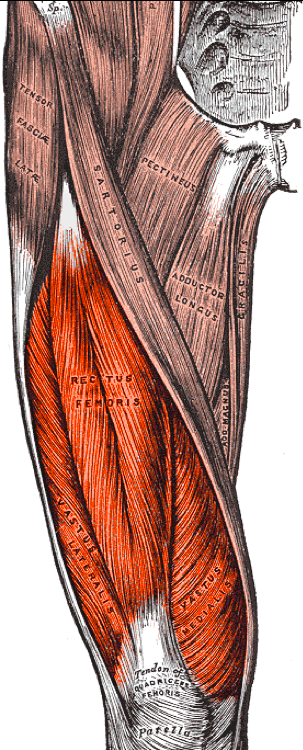
    The quadriceps femoris muscle (also called the quadriceps, or simply ‘quads’) is a large muscle group on the front of the thigh that includes four prevailing muscles. The name ‘quadriceps femoris’ is literally Latin for “four-headed muscle of the femur.”

    As the traditional etymology suggests, the quadriceps femoris muscle is subdivided into four separate muscles, known as “heads.” The rectus femoris muscle occupies the middle of the thigh and covers most of the other three quadriceps muscles. It originates on the ilium and is named for its straight course. The vastus lateralis muscle is on the lateral side of the femur, and the vastus medialis muscle is on the medial side of the femur. The vastus intermedius muscle lies between vastus lateralis and vastus medialis on the front of the femur, but deep to the rectus femoris muscle. Typically, it cannot be seen without dissection of the rectus femoris. Attached here is a illustration of the anterior thigh muscles from an edition Gray’s Anatomy.

    However, research has suggested that the quadriceps femoris may actually be composed of five muscles, rather than four. This newly discovered muscle has been dubbed the “tensor vastus intermedius” (TVI), and its presence may have important implications for our understanding of the musculature of the lower limb.

    The Discovery of the Tensor Vastus Intermedius

    The existence of the TVI was first proposed in a 2016 study published in the journal Clinical Anatomy. The study entitled “A newly discovered muscle: The tensor of the vastus intermedius“, was conducted by a team of researchers (Grob et al.) from the University of Central Florida, who used dissection and histological analysis to examine the structure of the quadriceps femoris muscle.

    The premise of their study was that they noted a tensor-like muscle between thevastus lateralis (VL) and the vastus intermedius (VI), and hence they wanted to clarify whether this intervening muscle was a variation of the VL or the VI, or a separate head of the extensor mechanism. This study demonstrated that the quadriceps femoris is architecturally different from previous descriptions: there is an additional muscle belly between the VI and VL, which cannot be clearly assigned to either the former or the latter. Distal exposure revealed that this muscle belly becomes its own aponeurosis, which continues distally as part of the quadriceps tendon, before of course finally inserting on to the medial aspect of the patella.

    It is important to note that while Grob et al. proposed the name ‘tensor vastus intermedius’, the reality is that this specific muscle has been reported previously in the literature.

    Implications for Anatomy and Physiology

    The naming of the fifth muscle as the TVI, and hence giving rise to a ‘quinticeps femoris’ has important implications for our understanding of the musculature of the lower limb. For example, knowing that there are five muscles in the quadriceps femoris rather than four could potentially change the way that we approach surgical procedures that involve this muscle group. It could also shed light on the evolution of lower limb musculature in humans and other animals.

    In addition, as I was trying to hint at from the title of this blog post, the discovery of the quinticeps femoris raises questions about the nomenclature of the qunticeps femoris muscle group. If there are in fact five muscles in this group, should we continue to refer to it as the “quadriceps”? Or would it be more accurate to call it the “quinticeps femoris”? This is a question that particularly pedantic anatomists and physiologists will need to grapple with in the coming years.

    Half a decade after the study by Grob et al., a systematic review on the anatomy, morphology, and function of tensor of vastus intermedius (TVI) was published in 2021. Alas, the review sheds light on the lack of high-quality evidence on the muscle’s morphology and clinical significance. While the TVI is located between the vastus lateralis and vastus intermedius, there is insufficient high quality evidence for us to confidently state its functional and clinical importance. As more research on TVI morphology emerges, we will gain a better understanding of the role of the muscle and the overall function of the quinticeps femoris.

    Conclusion

    The discovery of the quinticeps femoris is a fascinating development in the field of anatomy and physiology. Whether or not we end up calling it the “quinticeps femoris,” or simply deciding to stick to the good old “quads”, it is clear that the newly discovered TVI (tensor vastus intermedius), one of the five muscle heads of the quinticeps femoris, is an important part of the human body, and one that we are only just beginning to understand.


    Nicholas Loh
    3 March 2023