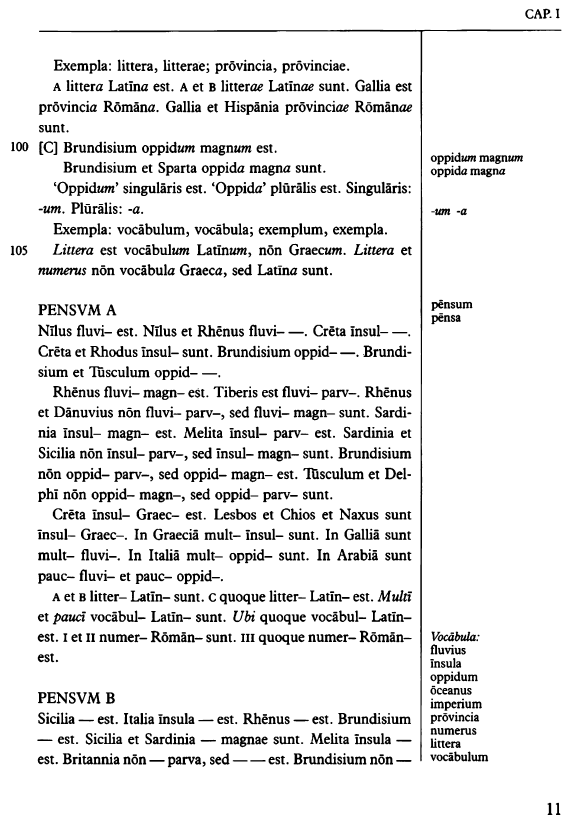
This blog post is my translation attempt on the third chapter of LLPSI FR. If you wish to learn Latin, all you have to do is just follow me from chapter 1. The Latin text is designed such that you can learn Latinfrom scratch just by reading the text itself without any external aid. Such is the power of context. For my translation attempt on the capitulum secundum, please check out an earlier post: 02(08).
I am making this translation as a way for me to actively consolidate my knowledge of Latin. As for how to use the text, I would advise that you read the original Latin text, and refrain from consulting my translation attempt unless you need to! —
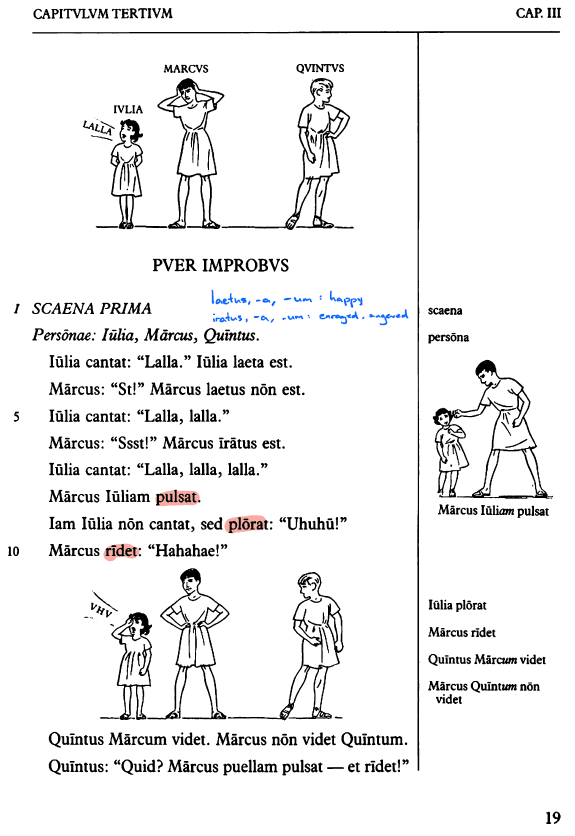
The Shameless Boy
Scene One People: Julia, Marcus, Quintus.
Julia sings: “Lalla.” Julia is happy. Marcus: “Stop!” Marcus is not happy. Julia sings: “Lalla, lalla.” Marcus: “Ssst!” Marcus is angry. Julia sings: “Lalla, lalla, lalla.” Marcus hits Julia. Now Julia does not sing, but cries: “Uhuhu!” Marcus laughs: “Hahaha!”
Quintus sees Marcus. Marcus does not see Quintus. Quintus: “What? Marcus hits a girl – and laughs!”
Quintus is angry and Marcus strikes! Now, Marcus is not laughing. The angry Marcus hits Quintus. Julia: “Where is Mother?” Julia does not see Aemilia. Julia says to Aemilia: “Mother! Marcus hits Quintus!” Marcus (angry): “Shush!” Marcus strikes Julia. Julia cries and calls for Aemilia: “Mamma! Mamma! Marcus hits me!” Aemilia comes.
Scene Two People: Aemilia, Julia, Marcus, Quintus
Aemilia asks: “Who calls me?” Quintus responds: “Julia calls you.” Aemilia asks Quintus: “Why does Julia cry?” Quintus responds: “Julia cries, because Marcus hit her.” Aemilia: “What? The boy hits the little girl? Fu! Why does Marcus hit Julia?” Quintus: “Because Julia sings.” Aemilia: “O Julia, my little girl! Marcus is not a good boy; Marcus is a bad boy!”
Quintus: “Julia is a good girl.” Aemilia asks Quintus: “Where is Julius? Why has he not come?” Aemilia does not see Julius. Marcus responds: “Father sleeps.” Quintus: “Mother did not ask you, but asked me!” Aemilia: “Shush, boys! Where is Father?” Quintus: “Father is not here, but Marcus is here.” Quintus calls for Julius: “Father! Father!”
Julius does not hear Quintus, and does not come. Why does Julius not hear Quintus? Julius does not hear him, because Julius is sleeping. Marcus: “Haha! Father is sleeping and does not hear you.” Aemilia: “Fu, boy!” Aemilia is angry. Mother beats the boy: tuxtax, tuxtax… Marcus cries: “Uhuhu!” Julius hears him. Now, Father is not sleeping.
Scene Three People: Julius, Aemilia, Julia, Marcus, Quintus
Quintus: “Father comes.” Aemilia does not hear Quintus, because Marcus cries. Julius sees Quintus and asks him: “Why does Marcus cry?” Quintus responds: “Marcus cries, because Mother beats him.” Julius: “But why does Mother beat Marcus?” Quintus: “Marcus is beaten because he is a bad boy. Marcus strikes the little girl!” Julia: “Mamma! Father is here.” Aemilia sees Julius. Aemilia: “Your Marcus is a bad boy!” Julius: “Fu, boy! A good boy does not beat a girl. A boy who hits a little girl is bad!” The angry Julius beats the bad boy: tuxtax, tuxtax, tuxtax…
Marcus cries. Quintus is happy and laughs. Julia is not happy and does not laugh. Why is Julia not happy? Julia is not happy, because Marcus cries. Julia is a good girl!
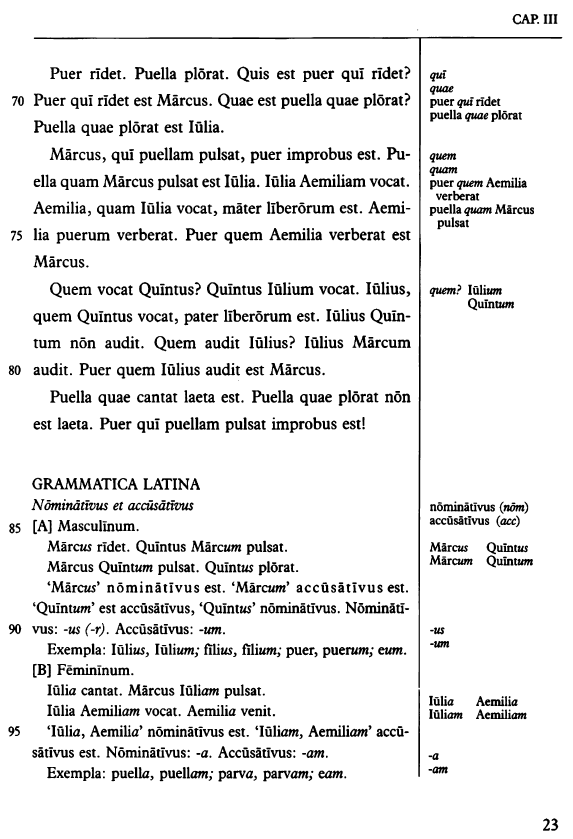
A boy laughs. A girl cries. Who is the boy who laughs? The boy who laughs is Marcus. Who is the girl who cries? The girl who cries is Julia.
Marcus, who hits a girl, is a bad boy. The girl who Marcus hits is Julia. Julia calls for Aemilia. Aemilia, whom Julia calls, is the mother of the children. Aemilia beats the boy. The boy whom Aemilia beats is Marcus.
Whom does Quintus call? Quintus calls Julius. Julius, whom Quintus calls, is the father of the children. Julius does not hear Quintus. Whom does Julius hear. Julius hears Marcus. The boy whom Julius hears is Marcus.
The girl who sings is happy. The girl who cries is not happy. A boy who hits a girl is bad!
Translation attempt of Capitulum Tertium of LLPSI Familia Romana by yours truly on 30 June 2020.
This blog post is my translation attempt on the second chapter of LLPSI FR. If you wish to learn Latin, all you have to do is just follow me from chapter 1. The Latin text is designed such that you can learn Latin just by reading the text itself without any external aid. Such is the power of context. For my translation attempt on the capitulum primum, please check out an earlier post: 02(07). —
Julius is a Roman man. Aemilia is a Roman woman. Marcus is a Roman boy. Quintus is also a Roman boy. Julia is a Roman girl.
Marcus and Quintus are not men, but are boys. The men are Julius, Medus, and Davus. Aemilia, Delia, and Syra are women. Is Julia a woman? Julia is not a woman, but a little girl.
Julius, Aemilia, Marcus, Quintus, Julia, Syra, Davus, Delia, and Medus are a Roman family. Julius is the father. Aemilia is the mother. Julius is the father of Marcus and Quintus. Julius is also the father of Julia. Aemilia is the mother of Marcus, Quintus, and Julia. Marcus is the son of Julius. Marcus is the son of Aemilia. Quintus is also the son of Julius and Aemilia. Julia is the daughter of Julius and Aemilia.
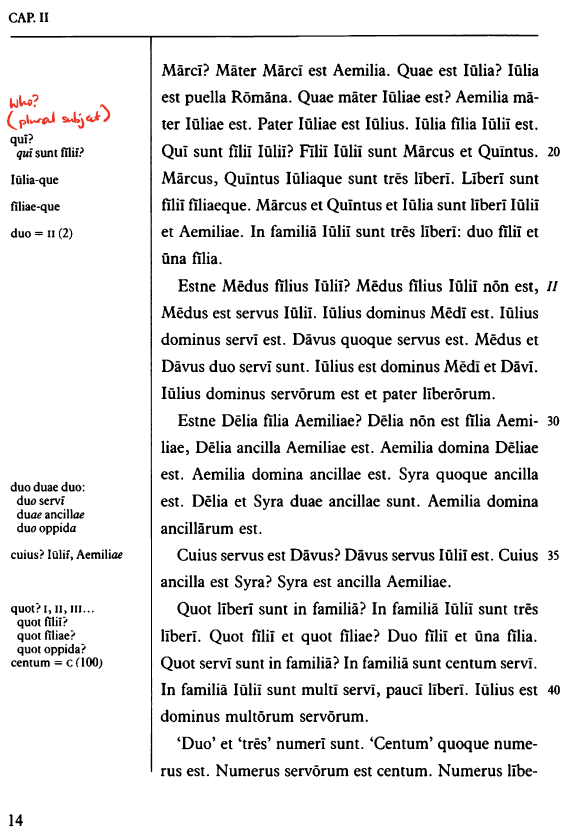
Who is Marcus? Marcus is a Roman boy. Who is the father of Marcus? Julius is the father of Marcus. Who is the mother
of Marcus? The mother of Marcus is Aemilia. Who is Julia? Julia is a Roman girl. Who is the mother of Julia? Aemilia is the mother of Julia. The father of Julia is Julius. Julia is the daughter of Julius. Who are the sons of Julius? The sons of Julius are Marcus and Quintus. The three children are Marcus, Quintus, and Julia. The children are sons and daughters. Marcus, Quintus, and Julia are children of Julius and Aemilia. In the family of Julius are three children: two sons and one daughter.
Is Medus a son of Julius? Medus is not a son of Julius; Medus is a servant of Julius. Julius is the master of Medus. Julius is the master of the servant. Davus is also a servant. The two servants are Medus and Davus. Julius is the master of Medus and Davus. Julius is the master of the servants and the father of the children.
Is Delia the daughter of Aemilia? Delia is not the daughter of Aemilia; Delia is a maid of Aemilia. Aemilia is the lady-boss of the maid. Syra is also a maid. The two maids are Delia and Syra. Aemilia is the lady-boss of the maids.
Whose servant is Davus? Davus is the servant of Julius. Whose maid is Syra? Syra is the maid of Aemilia.
How many children are in the family? There are three children in the family of Julius. How many sons and daughters are there? There are two sons and one daughter. How many servants are there in the family? There are a hundred servants in the family. In the family of Julius, there are many servants, and few children. Julius is the master of many servants.
‘2’ and ‘3’ are numbers. ‘100’ is also a number. The number of servants is 100. The number of children
is 3. 100 is a large number. 3 is a small number. The number of servants is large. The number of children is small. In the family of Julius, there is a large number of servants, [but] a small number of servants.
Medus is a Greek servant. Delia is a Greek maid. In Julius’ family, there are many Greek servants and Greek maids. Is Aemilia a Greek woman? Aemilia is not a Greek woman, but [a] Roman [woman]. Julius is not a Greek, but a Roman [man].
Sparta is a Greek town. There are three towns: Sparta, Delphi, and Tusculum. Of these, there are two Greek towns and one Roman town. In Greece and in Italy, there is a large number of towns. There is a large number of rivers in Gall. The rivers of Gall are large. Are the rivers of Africa large? In Africa, there is one large river: the Nile; the other rivers of Africa are small. Are there large Greek islands? The two islands, Creta and Euboea, are large; the other Greek islands are small.
Who is Cornelius? Cornelius is a Roman master. The two Roman masters are Julius and Cornelius. Medus is not a servant of Cornelius. Medus is a servant of Julius.
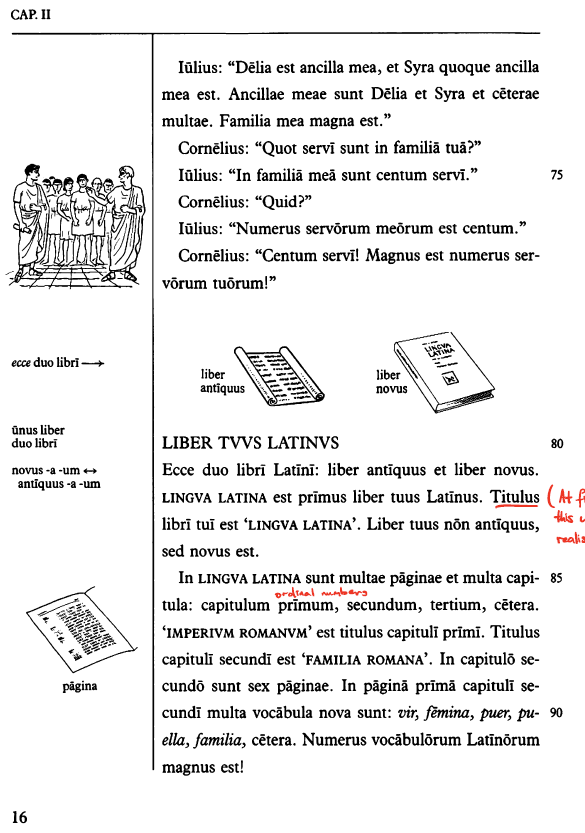
Cornelius: “Whose servant is Medus?” Julius: “Medus is my servant.” Cornelius: “Is Davus your servant?” Julius: “Davus is also my servant. My servants are Medus, Davus, and many more…” Cornelius: “Is Delia your maid?”
Julius: “Delia is my maid, and Syra is also my maid. My maids are Delia, Syra, and many others. My family is large.” Cornelius: “How many servants are there in your family?” Julius: “There are 100 servants in my family.” Cornelius: “What?” Julius: “The number of my servants if 100.” Cornelius: “A 100 servants! The number of your servant is large!”
Your Latin book Here are two Latin books: an old book and a new book. Lingua Latina is your first Latin book. The title of your book is ‘Lingua Latina’. Your book is not old, but is new. In Lingua Latina, there are many pages and many chapters: the first, second, third chapters, and more. ‘Imperium Romanum’ is the title of the first chapter. The title of the second chapter is ‘Familia Romana’. In the second chapter, there are six pages. On the first page of the second chapter, there are many new words: vir, femina, puer, puella, familia, and more. The number of Latin words is large!
The diagram shows an island (insula), town (oppidum), and river (fluvius).
Rome is in Italy. Italy is in Europe. Greece is in Europe. Italy and Greece are in Europe. Spain is also in Europe. Spain, Italy, and Greece are in Europe.
Egypt is not in Europe; Egypt is in Africa. Gall is not in Africa; Gall is in Europe. Syria is not in Europe, but in Asia. Arabia is also in Asia. Syria and Arabia are in Asia. Germany is not in Asia, but is in Europe. Britain is also in Europe. Germany and Britain are in Europe.
Is Gall in Europe? Gall is in Europe. Is Rome in Gall? Rome is not in Gall. Where is Rome? Rome is in Italy. Where is Italy? Italy is in Europe. Where are Gall and Spain? Gall and Spain are in Europe.
Is the Nile in Europe? The Nile is not in Europe. Where is the Nile? The Nile is in Africa. Where is the Rhine? The Rhine is in Germany. The Nile is a river. The Rhine is a river.
The Nile and Rhine are rivers. The Danube is also a river. The Rhine and Danube are rivers in Germany. The Tiber river is in Italy.
The Nile is a large river. The Tiber is not a large river, the river Tiber is small. The Rhine is not a large river, but a large river. The Nile and Rhine are not small rivers, but are large rivers. The Danube is also a large river.
Corsica is an island. Corsica, Sardinia, and Sicily are islands. Britain is also an island. Italy is not an island. Sicily is a large island. Melita is a small island. Britain is not a small island, but a large island. Sicily and Sardinia are not small islands, but large islands.
Brundisium is a town. Brundisium and Tusculum are towns. Sparta is also a town. Brundisium is a large town. Tusculum is a small town. Delphi is also a small town. Tusculum and Delphi are not large towns, but small town.
Where is Sparta? Sparta is in Greece. Sparta is a Greek town. Sparta and Delphi are towns of Greece. Tusculum is not a Greek town, but a Roman town. Tusculum and Brundisium are Roman towns. The island of Sardinia is Roman. Creta, Rhodus, Naxus, Samos, Chios, Lesbos, Lemnos, Euboea are all islands of Greece. In Greece, there are many islands. In Italy and in Greece are many towns. In Gall and in Ger-
-many, there are many rivers. Are there many rivers and many towns in Arabia? In Arabia, there are not many, but few rivers and few towns.
Creta isn’t a town, is it? No, Creta is not a town! What is Creta? Creta is an island. Sparta isn’t an island, is it? Sparta is not an island! What is Sparta? Sparta is a town. What is the ‘Rhine’? The Rhine is a large river. The Atlantic Ocean isn’t small, is it? It is not small, but a large ocean.
Where is the Roman Empire? The Roman Empire is in Europe, in Asia, and in Africa. Spain, Syria, and Egypt are Roman provinces. Germany is not a Roman province: Germany is not in the Roman Empire. But Gall and Britain are Roman provinces. In the Roman Empire, there are many provinces. The Roman Empire is great!
Letters and Numbers
I and II are numerals. III is also a numeral. I, II, and III are Roman numerals. I and II are small numerals. CIↃ is a large numeral.
A and B are letters. C is also a letter. A, B, and C are three letters. A is the first letter; B is the second letter.
C is the third letter. Γ is a Greek letter. C is a Latin letter. C and D are Latin letters. Γ and Δ are Greek letters.
Fluvius and oppidum are Latin words. Ubi is also a Latin word. In the word ubi, there are three letters. In the first chapter, there are a thousand words.
In the word insula, there are six letters and three syllables: first syllable in-, second -su-, third -la. In the word non, there are three letters and one syllable.
What is III? III is a Roman numeral. What is Γ? Γ is a Greek letter. C isn’t a Greek letter, is it? It is not a Greek letter, but a Latin letter. Is B the first letter? B is not the first letter, but the second. What is non? Non is a Latin word. Non, sed, magnus, numerus are Latin words. Vocabulum is also a Latin word!
A few years ago, I decided to start learning Latin for various reasons.
Firstly, I thought that it was and still do think it is a majestic and beautiful language. Its words just have that accompanying gravitas. It had so much weight. Somehow, the mere fact that something is written in Latin seems to lend it greater credence. This could explain why so many mottos and well-known sayings are in Latin. It doesn’t sound as grand in English.
Secondly, many of the difficult words in the English language, which includes but is not limited to medical and scientific jargon, often make use of Latin and Greek roots by combining them to yield esoteric language. I had the idea that if I went about learning Latin, I would have a much better shot at deciphering a lot of medical jargon (particularly in anatomy), and many challenging English words that I encounter as I read the literary classics, medical textbooks, and other texts.
Thirdly, I thought it would be cool to be able to read the Bible in another language. I think it is quite interesting to read Scripture in Latin, a language known for its beauty. I particularly like how some expressions are rather concise in Latin. For example, consider this: Dixitque Deus : Fiat lux. Et facta est lux.
This is Genesis 1:3, and the KJV reads: ‘And God said, Let there be light: and there was light’.
As I read the original Latin, several things jump out at me. Allow me to walk you through my train of thought. The first is the word ‘Dixitque’. The suffix -que just means ‘and’. ‘Dixit’ refers to how somebody said something in the third person. All we know from ‘dixit’ is that a third person spoke it. It could be a he or a she. We don’t know. This third person is of course clarified by the word following ‘Dixitque’: Deus. The ‘third person’ who did the speaking is none other than God Himself.
I am reminded of the puzzle game called ‘Dixit’.
I wonder how many people know that ‘dixit’ is an actual Latin word. It’s subtle, isn’t it? The root word for ‘dixit’ is dico, dicere, dixi, dictum and from this root springs words such as ‘diction’, ‘dictionary’, dictation’, ‘contradict’, ‘dictator’, ‘predict’, ‘benediction’ (‘bene’ means good’; so go figure what Benedict as a name means), and ‘verdict’. ‘Verdict’ is interesting. We know what -dict in ‘verdict’ stands for by now. What about ‘ver-’? We see this in words such as ‘verify’ and ‘veracity’. The Latin word ‘ver’ means ‘truth’ or ‘true’?
Do you know what Harvard’s motto is?
Perhaps you could have figured it out from the logo. Veritas, which means ‘truth’. Unsurprisingly, in Roman mythology, Veritas is a goddess. No prizes for guessing what she is a goddess of.
Most people should recognize that ‘Deus’ refers to ‘God’. From this word, we have words such as ‘deity’, and phrases such as ‘deus ex machina’.
What is Mozart’s middle name? Most people should know this one. Yes.
Amadeus. It can be split into ama- and -deus.
The prefix ama- means ‘love’ (I’m sure you have heard of ‘amore’). So ‘Amadeus’ can be rendered as ‘one who loves God’. Amadeus is not a name that you would hear nowadays. However, its feminine form ‘Amanda’ is alive and well. In a similar vein, the Latinized form of my name is Nicolaus, which is quite uncommon. However, the feminine form ‘Nicola’ is alive and well. I suppose the equivalent feminine form of ‘Nicholas’ would then be ‘Nicole’, which is also rather common.
We have deviated quite a bit. I’ll just make two more short points. Consider the word ‘et’. That means ‘and’. In fact, can you think of a symbol or character that looks like ‘et’ and shares its meaning?
&. Yes, the ampersand, &! The ampersand actually originated as a ligature of the letters ‘e’ and ‘t’ in ‘et’. According to the Wikipedia article, the word ‘ampersand’ is a corruption of the phrase “and per se & (and)”, meaning “and by itself and (represented by the symbol &)”. Marvellous, isn’t it?
Lastly, we have the word ‘lux’. Not that interesting. From this Latin word springs words such as ‘luminosity’, ‘elucidate’, ‘luminate’, and ‘translucent’.
See the sheer number of connections one can make just from that short Genesis 1:3.
For a very long time, the Bible was only available in Latin. Latin was the language of the educated. For century after century in Europe, various regions all had their local languages. The Bible as we know it has the Old Testament and the New Testament. The original language of the OT is Hebrew with some bits of Aramaic. The original language of the NT, on the other hand, is Koine Greek (or common Greek). Perhaps due to the influence of the Catholic Church for much of medieval times, Latin earned its place as the language of the elite. It probably also helped that by the time the biblical canon was well-established, the Roman Empire that we associate with Caesar and Augustus had faded. I do not know the relevant history well enough to be able to make a definitive comment but what I will say is that the languages spoken by the masses, at least from the time of Christ onwards, slowly morphed from the classical Latin that has survived in the form of the works of classic writers such as Caesar. Latin was preserved in writing. However, regarding the spoken form of Latin, Vulgar Latin, according to the relevant Wikipedia article, ‘is a blanket term covering vernacular dialects of the Latin language spoken from earliest times in Italy until the latest dialects of the Western Roman Empire, diverging still further, evolved into the early Romance languages – whose writings began to appear about the 9th century’. Many factors reinforced one another to give rise to the sheer influence of a Latin translation of the Bible.
What happened in the 4th century was that Pope Damasus I commissioned Jerome to revise various Latin manuscripts for the Gospels that were used by the church at the time. Presumably, things would be neater and more organized if there were just one standardized manuscript that the church could use. It seems that Jerome was quite spontaneous, as he decided to go the extra mile. Jerome extended his task to that of most of the Bible, essentially making his own Latin translation of the Bible, which would be known as the Vulgate. Once published, the Vulgate was widely used and it was basically the same text used by the Catholic Church from that point on for the next 1,500 years (from around the year 400 (note that Jerome was commissioned by Damasus I in AD 381) to the year 1979, when the Catholic Church decided to use a new Latin translation, the Nova Vulgata). This is what Wikipedia has to say on the influence of the Vulgate on Western culture:
For over a thousand years (c. AD 400–1530), the Vulgate was the most commonly used edition of the most influential text in Western European society. Indeed, for most medieval Western Christians, it was the only version of the Bible ever encountered. The Vulgate’s influence on Latin culture throughout the Middle Ages and the Renaissance into the Early Modern Period is even greater than that of the King James Version in English. For Christians during these times, the phraseology and wording of the Vulgate permeated all areas of culture.
These constitute some of my thoughts that had prompted me to want to learn Latin a few years ago. However, I gave it up after a while. I did self-study it to the extent that I can dissect Genesis 1:3 and various other bits of the Bible. However, I am not at the proficiency where I can read the Bible comfortably in Latin without needing to consistently consult a dictionary. I do intend to resume learning Latin again for good though.
You might be asking at this point? So Nicholas, how did you actually start learning Latin? Allow me to introduce you to LLPSI, or Lingua Latina Per Se Illustrata (which could be rendered ‘The Latin Language Intrinsically Illustrated’). This is a series which comes in two parts: 1) Pars I Familia Romana; 2) Pars II Roma Aeterna. I used this series when I first started learning Latin on my own a few years ago.
It employs the ‘natural method’, which is a rather interesting concept. Basically, the entire LLPSI series doesn’t contain a single word of English. The entire book is in Latin. The learner learns by context, visual cues, and gradual acquisition. It starts off very easy. For instance, Its first sentence is ‘Roma in Italia est’. I am confident that every decent speaker of English or a Romance language will be able to know instantly what that means.
What I intend to do is that I’ll post screenshots of the text in my blog posts. You will be able to learn Latin by reading them. I will also post my translation attempt of the text, which I think is helpful for my learning. You may also find it helpful to consult it.
I need to ensure the question to which I am giving my response is the same as the question that another party might be asking. It is easy to take for granted that both the former and the latter are always equivalent. They are not always the same, given the different lenses through which people view the world, and I opine that this constitutes the basis for countless misunderstandings that have occurred since time immemorial. It is probably impossible to absolutely reconcile the subjective differences in our understanding of the question, but we can do what we can by clarifying the keywords.
The thing that we need to define here is what is meant by ‘intelligence’. Intelligence is an interesting concept, to me at least, and this concept is certainly rather controversial. In relatively recent times, psychologists seem to have discovered new types of intelligence. This is not unreasonable, particularly if one imagines intelligence as a thing which helps one “move forward successfully” in the world. There are definitely phenomena that would reasonably fulfil such a description. The next few paragraphs outline some “forms of intelligence” that some psychologists have proposed to account for this.
One prominent psychologist who is a proponent of different kinds of intelligence is Robert Sternberg, who is known for his triarchic model of intelligence. As the term ‘triarchic’ suggests, Sternberg’s theory posits that there are three types of intelligence:
1) analytical intelligence (being able to complete academic-style and typical questions that one might encounter on IQ tests; it is often the case that these tasks are fairly well-defined problems with a single correct answer);
2) synthetic/creative intelligence (being able to deal with novel problems by relying on one’s existing set of skills; this may manifest in an individual giving a ‘wrong’ answer because he sees things through a different lens);
3) practical intelligence (“street-smarts”; the way I interpret this is that this is a bit similar to synthetic intelligence, but as the term ‘practical’ suggests, this proposed kind of intelligence pertains to everyday life instead of novel problems; the similarity manifests as requiring the individual to draw on an existing set of skills).
Another prominent psychologist who is perhaps even more well-known as a proponent of different kinds of intelligence is none other than Howard Gardner, who devised his theory of multiple intelligences. This theory of multiple intelligences had a dramatic effect on educational psychology when it was first proposed.
Unfortunately, this supposed dramatic effect does not actually tell us much because educational psychology, among all fields, is arguably the most susceptible to fads. We have heard about the different learning styles, etc. The incorporation of these trends, one after another, may not necessarily be a good thing at all. Gardner’s theory, which was outlined in his 1983 book Frames of Mind: The Theory of Multiple Intelligences, categorically states that there are eight different types of intelligence [1]:
As we have seen earlier, Sternberg proposed the idea of a practical intelligence. We also know how people promulgate the idea of EQ, which is supposedly a measure of the extent of emotional intelligence. From my experience in the equatorial city-state, some people, when referring to a highly sociable person, make statements such as “Waah, look at him sia, he really high EQ leh; vely good people skills sia”, or “Aiya, your studies not so good one, never mind lah, with your high EQ, people will like you at work no matter wat”. There exists a view that such arbitrary categorization of intelligence is absolutely meaningless, and constitutes an entire pile of garbage, and such a view is underpinned by philosophical and technical justification.
Firstly, one cannot just frivolously introduce any old random adjective to qualify a noun. The whole point of having a word is so that it establishes a boundary between what the word describes, and what the word does not describe.
Ok, let me walk you through this. Suppose we can make the word ‘intelligence’ mean whatever we want initially, which does not actually sound entirely unreasonable. The meaning of words at a given moment, after all, depends on what the majority of people at that particular moment who use the word refer to. Such is the dichotomy of descriptivism and prescriptivism in linguistics. For example, the word ‘meme’ is hardly even new at all. It actually has more than one meaning (most people are probably only aware of the one meaning) and has been in use for a long time. Apart from the common meaning which has dominated popular culture for the last decade or so, the word ‘meme’ can also refer to ‘an element of a culture or system of behaviour passed from one individual to another by imitation or other non-genetic means’ [2]. The word ‘meme’, as such, can also be used as a technical word in anthropology, as we can see from this alternate definition.
Anyway, let us consider the issue of ‘intelligence’. Hypothetically, let us suppose that the ability to cook very well is a form of intelligence. It then follows that one may designate another form of intelligence “cooking intelligence”. Unfortunately, the problem with this construct is that the word ‘intelligence’ is now so blasphemed that one cannot even tell what ‘intelligence’ means anymore. So, why is such use of adjectives to qualify intelligence even necessary? Some would argue that such categorization is not necessary at all. English, as it is in 2020, is an extremely rich language, and we have precisely a word to designate what is meant by the ability to cook very well:
Talent (side note: and just like ‘meme’, even ‘talent’ technically has more than one meaning).
We have two separate words: ‘intelligence’ and ‘talent’. The question that the skeptic would then pose is, “How do you determine the difference between intelligence and talent?” That is certainly a valid question because these two concepts are certainly similar to a certain extent. This is where the process of construct validity shines [3].
To illustrate what I mean: suppose we randomly select 1,000 people in Singapore, Australia, or anywhere in the world, and can somehow objectively rank the 1,000 people on their cooking ability. In addition to this, you can rank this same group of people on their ability to multiply two two-digit numbers mentally quickly (e.g. 67 x 54). If these two abilities were intelligences, then the people who could cook well would also be able to multiply two two-digit numbers more quickly mentally on average. If intelligence were the right term to encompass both these abilities, we would be seeing a relatively high correlation between cooking ability and the multiplication ability. However, the actual correlation between the two abilities simply does not meet this criterion (i.e. there is no relatively strong positive correlation).
For intelligence to mean intelligence, every manifestation or form of intelligence that is subsumed by intelligence (i.e. intelligence qualified by whatever adjective you want to slap on it) needs to demonstrate a relatively high degree of correlation with another form of intelligence. Otherwise, they are not the same thing, or at least similar, statistically speaking!
Now, maybe you see where I am going with this.
In order to investigate intelligence (i.e. What is intelligence?), there are perhaps two sub-questions to contend with:
1) If and how does intelligence manifest in the world in which we live? 2) What do we mean by intelligence?
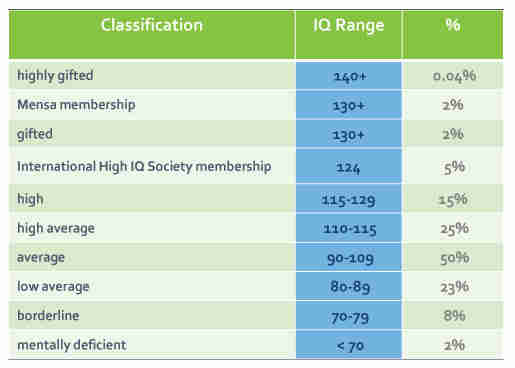
So there is quite clearly an empirical and a definitional issue to be worked out here. People have been studying IQ and intelligence since at least the 1920s. IQ, is a rather unique construct. This is because IQ is the most rigorous concept to have ever arisen from the social sciences. If you think IQ is a load of garbage, you might as well as toss out the field of psychology. This is because the psychologists who first developed intelligence testing were the ones who established the statistical techniques that all subsequent psychologists used to test their hypotheses. IQ is the most stringently and accurately defined construct in psychology. Do you remember the concept of practical intelligence as proposed by Sternberg? Well, according to Professor Jordan Peterson, interest in “practical intelligence” has fallen dramatically since the 90s because when “practical intelligence” is matched head-to-head with standard IQ intelligence, IQ convincingly accounts for the variability in terms of the explanatory power for various phenomena which are associated with success in a particular domain.
IQ is the single best predictor of a person’s success in life. The second-best predictor is the trait conscientiousness, one of the Big Five traits. This could be because unlike IQ, we have not developed a very valid way to measure conscientiousness. Conscientiousness is currently measured by self-report (or even peer reports) on personality tests, which can be easily manipulated to yield extremes because it is so easy to predict what response will yield a higher conscientiousness score. On the other hand, it is statistically impossible for one to be able to just churn out correct answers on an IQ test at a proportion which is beyond one’s threshold of intelligence.
Regarding prediction of life success, conscientiousness yields about r = 0.4 (which is considered a high-end estimate for conscientiousness), whereas IQ yields about r = 0.5 to 0.6. Both correspond to a variance (need to square the r value) of about 16% and 25% (if we are using the low end of r = 0.5 for IQ). So, even low-end estimates of the predictability of IQ of long-term success are superior to what we currently know of conscientiousness by a factor of 25/16= 1.5truncated (i.e. IQ has about 1.5 times the predictive power of long-term life success than the second-best predictor we have: conscientiousness, even by conservative standards). Now you can see why intelligent people who are also highly conscientious are so potent in their ability to just destroy the competition. I think this is somewhat rare though (not only because the extremes of traits are rare), because intelligent people may become complacent and essentially choose to be unconscientious, thinking that their intelligence alone is enough to carry them through life. On the other hand, less intelligent people try to be more conscientious to compensate for their lack of intelligence. This concept is concisely expressed in the Chinese idiom:
勤能补拙, which literally means that diligence can mend one’s stupidity. How candid.
Now that we have talked about IQ, let us consider the “different forms” of intelligence again. What does it mean to have different form of intelligence? Suppose we have Form A and Form B, how highly correlated do these forms of intelligence have to be before we can say that they are the same thing? In other words, how uncorrelated do two different forms need to be before they are deemed to be essentially different? The answer to these questions lie in the practical utility of these different forms of intelligence.
Imagine that I am trying to figure out how well Sally will do in university. I measure some metric “a”, which is correlated at r = 0.7 with “b”. These two forms are pretty well-correlated. So, is there any point in measuring both things? The way to figure this out is by doing a statistical analysis: use some sort of dependent variable or target (e.g. Sally’s university GPA), and establish a regression equation. We then need to ask ourselves: can we predict Sally’s GPA better if we use one variable, or two variables? In addition to using different variables in a regression equation, the weights given to the different variables can also be different, and this is reflected by the different coefficients of each variable (e.g. GPA = 2.4a + 1.3b).
So, back to the original question: are there multiple types of intelligence? The first thing we need to ask is “what do we mean by ‘are there’”? The answer to that would be to specify the question.
Step 1: We can try to predict people’s performance in university (as a proxy for long-term success in life), as we have done with Sally. To start, we need to assume that “if intelligence is not associated with university success, then you are probably not talking about intelligence”. In other words, is it reasonable to assume that intelligence and university success share something in common? This is a definitional issue that needs to be settled. Most people would respond affirmatively, although you could technically choose not to (e.g. adopting the view that intelligence plays absolutely no role in university success; rather, other factors such as socioeconomic status, wealth; and of course, these other factors do indeed influence success, which is why IQ and personality traits cannot fully explain the variance in success).
Step 2: So, once we have established this basic proposition, the next thing that we do is to consider each of the supposed different types of intelligence that were outlined above. A measure needs to be made for each of these different types, and the measure needs to be able to measure the same thing (of course within the limits of acceptable experimental error) across multiple instances in the same person. This is absolutely critical because what use is a ruler if it can stretch and change in length (i.e. the actual distance between the marked intervals fluctuate)? The same thing needs to be measured multiple times, and yield a reliable and accurate result, ideally speaking.
Step 3: The next step is to determine the extent of correlation between all these “different types of intelligence”. If we determine that two types of intelligence have basically perfect correlation, then those two types are one or the same type of intelligence. A factor analysis can be done to determine the thing that is common between all the different types of intelligence, which is unsurprisingly: intelligence. It is important to note that this is a proposition, not a fact. If someone were more likely to be musically inclined if he were also inclined in mathematical ability, then the hypothesis would be that there is a single factor that is responsible for all the different manifestations of intelligence.
Step 4: You can also do the same thing not just with Sally’s university GPA as the dependent variable, but also with her PSLE results (end-of-elementary school barrier exam in Singapore), her GCE O-level results, her GCE A-level results, her job performance, and other proxies of success as the dependent variable. Then, what you can say is that the thing that is common between all those supposedly different types of intelligence which predicts Sally’s success across her entire life is called intelligence. THAT common thing, my friends, is how you end up with IQ.
In other words, IQ, which measures g (that you can see in that huge circle at the top of the above diagram), is what is common among all possible intelligence tests. Of course, people are going to debate this because “what constitutes a test?” Psychometricians have managed this by essentially saying that not everything that is measured is called intelligence.
For example, extraverted people are more socially adept. Are we going to call that intelligence? Of course not! We going to call that personality, specifically extraversion.
Are people who can tolerate more stress deemed more intelligent? No! That is yet another component of personality: low neuroticism.
Are people who are more co-operative more “emotionally intelligent”? No again! Are people who are more competitive less intelligent? As such, this is also yet again another component of personality: agreeableness/disagreeableness. Females are more agreeable than males, and this certainly contributes to the manifestation of how many managerial, leadership roles, and what society deems as “positions of authority and power” are predominantly occupied by men.
The final question then is, once IQ and personality traits have been factored in, are there any differences between the “different types of intelligence”?
Once IQ and personality traits have been considered, there are NO differences between the so-called different types of intelligence.
I think the only thing responsible for the actual variation in the manifestation of “different types of intelligence” that we observe over time in a particular person is domain-specific deliberate practice (e.g. engaging in more deliberate practice on the piano would yield better performance ceteris paribus), which of course cannot be due to inherent intelligence as we have already controlled for IQ.
The reason that many people are proponents for “different types of intelligence” lies in the fact that people are uncomfortable with the fact that there are real tangible differences between individuals. The idea that someone is naturally predisposed to be able to solve problems cross-domain and across time better than another person is frightening to some. Moreover, I suspect that many are uncomfortable discussing intelligence because an individual’s intelligence has been erroneously conflated with his intrinsic worth as a human being. Intelligence is an issue which warrants more discussion in society but the reality is that many people in the world are insufficiently mature to discuss the implications of our current understanding of intelligence on social and educational policy.
NL 2 June 2020
References: Peterson, JB (2016). “2016 Personality Lecture 13: Openness and Intelligence”. Date published: 30 March 2016. Date accessed: 2 June 2020. https://www.youtube.com/watch?v=qRFxulvRC7I Peterson, JB (2017). “2017 Personality 18: Biology & Traits: Openness/Intelligence/Creativity I”. Date Published: 19 April 2017. Date accessed: 2 June 2020. https://www.youtube.com/watch?v=D7Kn5p7TP_Y
[1] Slavin, Robert (2009), Educational Psychology, p. 117, ISBN 0-205-59200-7 [2] Google Dictionary (2020). Meaning of ‘meme’. Accessed online: 2 June 2020. [3] Trochim, W (2020). Construct Validity. Accessed online: 2 June 2020. https://conjointly.com/kb/construct-validity/