pianist and medical doctor

Tag: 2019-01

  • 01(07): Story behind the hymn ‘Living For Jesus’

    I first heard the hymn during a church service a few months ago. It was the closing hymn for the service, and I could not help but feel how apt the hymn is as a choice for the closing hymn. Its melody is truly grand and majestic. Do you remember my post regarding the hymn ‘Great Is Thy Faithfulness’? Well, the composer for that hymn, Thomas O. Chisholm, also composed the hymn ‘Living for Jesus’. In case you were wondering, Chisholm’s middle name is Obadiah.

    Fun facts: The name ‘Obadiah’ is Modern Hebrew for ‘slave of God’. It is a theophorical name, meaning ‘servant of God’ or ‘worshipper of Yahweh’. The book of Obadiah is the shortest book in the Old Testament; the text consists of a single chapter, divided into 21 verses. Hence, when citing a verse reference from Obadiah, the convention is to omit the chapter reference. For example, quoting from verse 7 would just be ‘Obadiah 7’, and not ‘Obadiah 1:7’. Can you imagine a scenario where someone asks everyone in the group to flip to Obadiah 7, and another person asks, ‘Which verse?’ Haha!

    It is cognate to the Arabic name ‘Abdullah’, which is probably much more familiar to you. The suffix of Obadiah’s name (i.e. -iah) means ‘of God’. It thus should not surprise you that there are many names with this suffix in the Old Testament (e.g. Moriah, Josiah, Isaiah, Hezekiah, Jeremiah, Zephaniah, Zechariah; ok, I think you get my point). Interestingly, consider the name ‘Elijah’ too. The suffix ‘-jah’ is basically ‘-iah’, since the letters ‘i’ and ‘j’ are simply variants of each other.

    The progression of Chisholm’s life was covered in a previous post, so I shall not be repeating it here. Additionally, you may check out the references for a more detailed exposition of Chisholm’s life. According to Dr Hawn’s article on the history of ‘Living For Jesus’, the late hymnologist William J. Reynolds noted that ‘Living For Jesus’ actually started with the tune. The words were only added later by Chisholm. The following paragraph is a direct quote from Dr Hawn’s article, which expresses the subject matter more succinctly than I could ever achieve:

    “C. Harold Lowden [1883-1963] composed the tune about 1915, and it was first published under the title ‘Sunshine Song’ in a Children’s Day Service that he wrote. Early in 1917, while preparing a collection of hymns for publication, he came across this song and was impressed that the tune needed a stronger text. He substituted ‘Living for Jesus’ for the original title and sent the tune to Thomas O. Chisholm, then living at Winona Lake, Indiana for a new text.” Even though Chisholm protested that he had never written a text for a pre-existing tune, Lowden insisted, telling the author that he “believed God had led me to select him” to provide a text for this music. Within a short time, Chisholm returned the tune with four stanzas and a refrain. The hymn appeared as a separate song sheet in the spring of 1917, and was used at a number of youth conferences that summer. More than a million copies of the hymn were sold in this form.”

    Once again, enable the annotations to view the lyrics while the video plays.

    Yours faithfully,
    Nicholas Loh
    31 January 2019


    References
    1. https://www.umcdiscipleship.org/resources/history-of-hymns-living-for-jesus-pledges-full-commitment-to-christ.
    2. https://en.wikipedia.org/wiki/Obadiah
    3. https://en.wikipedia.org/wiki/Book_of_Obadiah

  • 01(06): Holy, Hallow, Sanctus

    The three words describe the same thing – holiness. The first is self-explanatory as it is the most familiar to us. The second is more interesting. Where have you seen this word before? Most people would simply note in glee, ‘Halloween!’, and they would be right. According to the etymology as established on Wiktionary, the word ‘Halloween’ is a shortening of of ‘All-Hallow-even’ (i.e. All Hallows’ Eve – the name of the evening before All Saints’ Day). As you might infer, All Saints’ Day falls on 1 November, and as its name implies, it is a Christian festival celebrated in honour of all the saints, known and unknown. However, most people would associate the now-pagan festival of Halloween with children going door-to-door in costume and demanding candy with menaces (mainly in the UK, Canada, USA, and Ireland). Such is the influence of the mass media.

    On the other hand, astute Christians would note that the word ‘hallow’ appears in the first petition of the Lord’s Prayer (cf Matthew 6:9), which reads: ‘Hallowed be thy name’. The 101st point of the Westminster Shorter Catechism discusses the first petition more concisely and accurately than I could ever hope to achieve. It is as follows:

    Q101. What do we pray for in the first petition?
    A101. In the first petition, which is, Hallowed be thy name, we pray that God would enable us, and others, to glorify him in all that whereby he maketh himself known; and that he would dispose all things to his own glory.

    I could talk extensively about the Lord’s Prayer, but that deserves its own blog post. In the Vulgate, the Latin Bible employed by the Roman Catholic Church for a long time, the first petition is rendered ‘sanctificetur nomen tuum‘. The extensively inflective nature of Latin allows the first petition to be expressed in merely three words, compared to that of four words in the KJV! The Latin word ‘sanctificetur’ is the third-person singular present passive subjunctive of the Latin word ‘sanctifico’. Yes, just let that sink in for a moment. Look how much inflection and conjugation there is in Latin. It puts modern English to shame. The word ‘sanctifico’ is comprised of ‘sanctus’ (holy) and ‘-fico’ (do, make). The verb ‘sanctifico’ thus means ‘to consecrate; make holy’. The legacy of ‘sanctus’ is seen in English words such as ‘sanctuary’, ‘sanctify’, and ‘sanctification’. The word ‘nomen’ is Latin for ‘name’ and is actually where we get our words ‘nomenclature’, ‘nominal’, and ‘nominate’. It should be no surprise that an overwhelming majority of the bombastic words in English have their roots in Latin.

    In the spirit of the previous posts, I made a video with a relevant hymn. Some of you might have already seen this coming. The hymn is not ‘Holy, Hallow, Sanctus’, but ‘Holy, Holy, Holy’ (they are technically the same, but oh well, whatever). Haha.

    Its lyrics was established by Reginald Heber in 1826 and the music was composed by John B. Dykes in 1861. The hymn is based on the latter part of Revelation 4:8, which reads: ‘…Holy, holy, holy, Lord God Almighty, which was, and is, and is to come.‘

    The tune title was named NICAEA, and it was written specifically for ‘Holy, Holy, Holy’. The tune was aptly named after the Council of Nicaea, the 4th-century council at which the Trinity was upheld as an essential doctrine of Christianity. Like the hymns featured in the previous blog posts, this is also a well-known hymn. Once again, please enable annotations to view the lyrics while the video plays. I hope this hymn blesses you.

    Thank you for reading this post!

    Yours faithfully,
    Nicholas Loh
    30 January 2019

    References
    1. Story behind the hymn. https://songsandhymns.org/hymns/detail/holy-holy-holy
    2. Wiktionary entry for the word ‘hallow’. https://en.wiktionary.org/wiki/hallow#English
    3. Wiktionary entry for the word ‘halloween’. https://en.wiktionary.org/wiki/Halloween
    4. First petition of the Lord’s prayer (WSC 101). https://reformed.org/documents/wsc/index.html?_top=https://reformed.org/documents/WSC.html

  • 01(05): The story behind the hymn ‘Great is Thy Faithfulness’

    ‘Great is Thy Faithfulness’ is one of the most recognisable hymns of all time. Its author and musician are Thomas O. Chisholm (1866-1960) and William M. Runyan (1870-1957) respectively. It is so popular that it is still sung even in most contemporary and liberal churches which have abandoned the traditional singing on hymns.

    This endearing hymn has its roots in the biblical passage of Lamentations 3:22-24, which reads: 22It is of the LORD’s mercies that we are not consumed, because his compassions fail not. 23They are new every morning: great is thy faithfulness. 24The LORD is my portion, saith my soul; therefore will I hope in him.

    The above text is a quotation from the Authorized Version, better known as the King James Version (KJV). The italicized words were added by the translators of the KJV to aid the reader because the translators wanted the translation to be clear and readable. However, to ensure that readers understood that these words were not in the manuscripts that they worked with, the translators set the additional words in italics.

    According to an article on Gaither Music, Chisholm wrote “Great Is Thy Faithfulness” as a testament to God’s faithfulness through his ordinary life. Chisholm was born in a humble log cabin and became a Christian when he was 27. He entered the ministry when he was 36; however, poor health forced him to retire after just one year. For the rest of his life, Chisholm spent many years living in New Jersey and worked as a life insurance agent. Despite having a desk-bound job, he wrote nearly 1,200 poems throughout his life, including several published hymns. Chisholm explained towards the end of his life that his income had not been large at any time due to impaired health in his earlier years. His impaired health persisted throughout his life. He insisted that he would not fail to record the unfailing faithfulness of a covenant-keeping God, for God had given him many wonderful displays of His providing care. Chisholm had immense gratitude for what God had done in his life.

    Like the previous blog post, I also made a video as ‘Great is Thy Faithfulness’ is also one of my favourite hymns. Once again, please enable annotations to view the lyrics. I hope you are blessed by this video!

    Yours faithfully,
    Nicholas Loh
    29 January 2019

    References
    1. Story behind ‘Great is Thy Faithfulness’. http://gaither.com/news/%E2%80%9Cgreat-thy-faithfulness%E2%80%9D-story-behind-hymn
    2. Lyrics from: https://www.sermonaudio.com/hymn_details.asp?PID=greatisthyfaithfulness
    3. https://www.lifebpc.com/resources/hymns-of-grace-glory
    4. King James Bible Council. https://www.kjbrc.org/the-use-of-italics-in-the-king-james-bible/
    5. Cover image. https://www.sixcleversisters.com/free-printable-hymn-art-great-thy-faithfulness/
    6. Images of Chisholm in his younger days. http://www.hymntime.com/tch/bio/c/h/i/chisholm_to.htm

  • 01(04): Calvary or cavalry?

    Last September, my pastor gave a sermon entitled ‘Jesus led to Golgotha’. One learning point I had from that sermon was the meanings and etymologies of the words ‘Golgotha’ and ‘Calvary’. The word ‘Golgotha’ means ‘skull’ in Aramaic, one of the two languages of the Old Testament. Golgotha is also known as Calvary, which is derived from the Latin word ‘calvaria’, which in turn, unsurprisingly, also means ‘skull’. Hence, ‘Golgotha’ and ‘Calvary’ refer to the same thing.

    Naturally, this made me wonder about the term used for soldiers who ride on horseback. Is the term ‘calvary’? No, it is not! The word that describes soldiers on horseback is ‘cavalry’. I then realised that I had erroneously conflated the two terms ‘Calvary’ and ‘cavalry’ all my life! It is easy to see why people can confuse the two terms though. They are rarely used in everyday speech and writing!

    Fast forward a few months. During one of the services, a friend within the church was playing one of the most heartwarming melodies on the organ. He played it as the Lord’s Supper was being administered. As I was not familiar with the melody, I was eager to find out the name of the hymn which contained such a majestic melody. I then found out after the service that it was hymn number 555 in the hymnal that we used: Hymns of Grace and Glory. The hymn was ‘Lead me to Calvary’.

    Since learning about that hymn, it has become one of my favourite hymns. Here is a video that I put together recently. I hope it blesses you (enable annotations for the lyrics)!

    Yours faithfully,
    Nicholas Loh
    28 January 2019

  • 01(03): Do leap years always occur every four years?

    While learning about watches, I chanced upon the fancy feature of ‘perpetual calendars’. However, before talking about perpetual calendars in watches, I should also discuss annual calendars in watches and watches without either feature. In mechanical/automatic watches without either the annual or perpetual calendar feature, there is a date wheel that adjusts every 24 hours and runs from 1 to 31. The watch owner is expected to manually correct the date on the first of the month following any month that has fewer than 31 days (5 times a year: February, April, June, September, and November).

    Annual calendars keep track of months with 30 or 31 days. This means that the owner needs to adjust the date on 1 March each year since annual calendars are unable to handle months with fewer than 30 days (*cough* February).

    Perpetual calendars not only take into account that all months can have a different number of days (it is usually either 30 or 31 days in a month; however, there are usually 28 days in February), they are also able to take into account the fact that February has 29 days in leap years. So, this means the date on a watch with the ‘perpetual calendar’ feature will always been correct, right? After all, the word ‘perpetual’ suggests eternal adherence. To fully grasp this issue, we need to examine the history of our calendar.

    The calendar that is ubiquitous in today’s world is known as the Gregorian calendar. It is named as such because the calendar is named after Pope Gregory XIII, who introduced it in October 1582. Before talking about the Gregorian calendar, let us discuss the calendar it replaced – the Julian calendar.

    The Julian calendar got its name from Julius Caesar, who introduced it in 46 BC. It was a reform of the Roman calendar, and it took effect on 1 January 45 BC. The Julian calendar has two types of years: ‘normal’ years with 365 days and ‘leap’ years of 366 days. There exists a simple cycle of three ‘normal’ years followed by a leap year and this pattern continues forever without exception. The Julian year is therefore, on average, 365.25 solar days long.

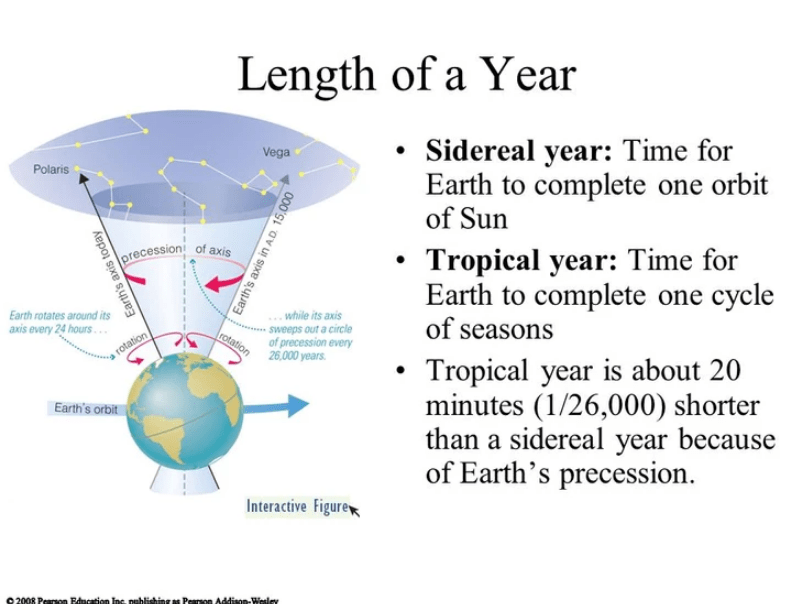
    At this point, some readers might be confused. ‘Isn’t this the way our calendar works?’ you might ask. What’s wrong with this? Why did we need to switch to the Gregorian calendar? Doesn’t the leap year every four years ensure that the average year is close enough to the actual tropical year? Strictly speaking, the tropical year is about 20 minutes shorter than the solar/sidereal year due to the seasonal cycle not remaining exactly synchronised with the position of the Earth in its orbit around the Sun resulting from the precession of the equinoxes. But, hey, let’s take the tropical year and solar year to be basically synonymous.

    Surprise, surprise. One tropical year is 365.24217 solar days long, implying that the mean tropical year is approximately 365 days, 5 hours, 48 minutes, 45 seconds. To clarify, 1 solar day in this context is NOT 86,400 seconds (ie 24 hours). A day that lasts exactly 24 hours is known as an ephemeris day (which is not the kind of ‘day’ we are talking about).

    As we established three paragraphs earlier, the Julian calendar is 365.25 solar days. 365.25 is not the same as 365.24217. Although this difference is miniscule over a matter of a few years, you can imagine how this error will accumulate over many centuries. Although Greek astronomers had known, at least since Hipparchus, a whole century before the Julian reform, that the tropical year was slightly shorter than 365.25 solar days, the Julian calendar did not compensate for this difference. As a result, the Julian calendar year gains about three days every four centuries compared to observed equinox times and the seasons.

    So, how do you fix a discrepancy of three days over four centuries?

    Something absolutely brilliant.

    The difference between the Gregorian and Julian calendars is that in the Gregorian calendar, year numbers evenly divisible by 100 are not leap years, except that those evenly divisible by 400 remain leap years. What does this mean? That means 2000 was a leap year, whereas 2100, 2200, and 2300 will not be leap years!! The mean Gregorian year is thus 365.2425 days long, which is much closer to the tropical year (difference of 0.0008 solar days) than the Julian calendar (difference of 0.0083 solar days).

    At the time of the Gregorian reform, there was a 10-day difference between the Julian and Gregorian calendar. To deal with the difference that this drift had already reached, the date was advanced so that 4 October 1582 was followed by 15 October 1582. There was no discontinuity in the cycle of weekdays (i.e. 4 October 1582 was a Thursday and 15 October 1582 was a Friday).

    Of course, the Gregorian calendar isn’t perfect either. The Gregorian calendar diverges from astronomical observations by one day in 3,030 years. Perhaps we could consider every year that is a multiple of 3032 to not be a leap year? It shall be the Nicholasian calendar. HAHA,

    What does this mean then for the ‘perpetual calendars’ in watches that I mentioned earlier? They are perpetual only in the Julian Calendar! Watches with ‘perpetual calendars’ will erroneously consider 2100, 2200, and 2300 to be leap years. Thus, such watches aren’t, strictly speaking, perpetual.

    Nic
    27 January 2019

    References:
    https://en.wikipedia.org/wiki/Julian_calendar
    https://en.wikipedia.org/wiki/Gregorian_calendar
    https://slideplayer.com/slide/4160613/
    https://www.history.com/news/5-things-you-might-not-know-about-julius-caesar

  • 01(02): Why do most timepieces with Roman numerals use ‘IIII’ instead of ‘IV’?

    This is something I never noticed until I chanced upon an online article discussing this issue. Upon reading this, my eyes were immediately set upon the dial of my Longines. Indeed, ‘IIII’ is used instead of ‘IV’. I continued reading the article and found it to be intriguing. The link to the article I read can be found in the references. However, it is a rather long read (9-min read). So, I shall distil it to give you the essential takeaways. The most notable exception to the observation would be Big Ben of London. The Big Ben uses ‘IV’.

    Big Ben of London

    I) The first possible explanation for this is that ‘IIII’ was the earliest way to write ‘4’ in Roman numerals. Even though the most common way to represent ‘4’ in Roman numerals today is ‘IV’, it was not always the case. Perhaps watchmakers wanted to continue this tradition. The earliest timepiece models even used ‘VIIII’ instead of ‘IX’. However, this situation was problematic as the numerals ‘III’ and ‘VIII’ were confused for ‘IIII’ and ‘VIIII’. Interestingly, as I write this paragraph, the spellcheck function detects ‘IIII’ and ‘VIIII’ as spelling errors and thus flags them with a red squiggly line beneath them. This does not occur with ‘III’ and ‘VIII’. According to the article, the first mechanical clocks were created in Europe during the 13th century, and Roman numerals were still used extensively then. Most clocks were mounted on churches, and Latin was the official language of the Roman Catholic Church. It thus made sense to use Roman numerals instead of Arabic numerals on the dials of timepieces.

    Longines Record Collection: COSC-certified; this image has been taken from the Longines website.

    The article then goes on to mention a few other possible reasons that ‘IIII’ is used in lieu of ‘IV’. Here are some possible reasons:

    II) ‘IV’ was avoided because it was deemed as an offence to Jupiter, a god in Roman mythology. Consider the word ‘Jupiter’. The letter ‘j’ was one of the last letters to be added to the Latin alphabet. For much of history, the letter ‘j’ did not exist. The letter ‘i’ was used where we would use the letter ‘j’ today. Consider the letter ‘y’ and some names such as ‘Johanna’. ‘Johanna’ would traditionally be pronounced with a ‘y’ sound at the start. Moreover, consider the sound of ‘y’ in words such as ‘gypsy’, ‘rhythm’, ‘fly’, and ‘by’. Also consider the letter ‘u’ in ‘Jupiter’. It was basically interchangeable with the letter ‘v’ in medieval times. In fact, the King James Bible, as originally published in 1611, is a classic example of this. The word ‘love’ would often be spelt ‘loue’, etc. Hence, coming back to what we were originally discussing, we see then that ‘Jupiter’ would have been written as IVPITER. What do you observe about the first two letters of the name?

    This issue of not writing down the name of a god reminds me of a similar practice of adherents of Judaism. According to the Wikipedia article on the Tetragrammaton, the written tetragrammaton must be treated with special sanctity. Writing the tetragrammaton unnecessarily is prohibited, so as to avoid it treated disrespectfully. To guard the sanctity of God’s name, a letter within the tetragrammaton is substituted for another letter. Alternatively, a letter is substituted for a hyphen. This practice is applied to the English name ‘God’, which adherents of Judaism would write as ‘G-d’.

    III) It was easier for the non-educated folk. The additive notation in ‘IIII’ would certainly have been easier for the majority of the illiterate and non-educated European population. The subtractive notation might have been confusing. When this is coupled with the fact that ‘IV’ and ‘IX’ can be confused for ‘VI’ and ‘XI’, it is easier to empathise with the people back then.

    IIII) The ‘Lazy Clockmaker’ hypothesis. This is a hypothesis that is not taken seriously.

    V) The Sun King, Louis XIV. One explanation is that like Jupiter, Louis XIV did not want to have part of his name on the dial. However, this theory is quite implausible because the practice of having ‘IIII’ instead of ‘IV’ on timepieces had been around a long time before the birth of Louis XIV.

    VI) The visual balance. This reason is one of the most convincing. Consider watches which have ‘IIII’ and ‘IX’ to represent ‘4’ and ‘9’ respectively. The Roman numerals on the watch would be as follows: I, II, III, IIII, V, VI, VII, VIII, IX, X, XI, XII. The first third of the dial would have the ‘I’ type. The second third of the dial would have the ‘V’ type. The last third of the dial would have the ‘X’ type. When the dial has three distinct areas, it is perceived as more elegant and harmonious.

    Conclusion: There is no definitive explanation for having ‘IIII’ instead of ‘IV’ in watches. It is likely to be a combination of some of the above reasons. I end the article with yet another exception to the trend:

    H. Moser & Cie. is one of the few modern watchmakers to use IV on its dials.

    Nic
    21 January 2019

    P.S. Did you notice that I used ‘IIII’ in the list numbering?

    References
    1. https://monochrome-watches.com/why-do-clocks-and-watches-use-roman-numeral-iiii-instead-of-iv/.
    2. https://en.wikipedia.org/wiki/Tetragrammaton

  • 01(01): Blogogenesis

    In the early days of digital self-expression, initiating a personal blog on ‘blogspot.com’ was a prevalent trend. Much like the Greek gods who dined on ambrosia, the youth of that era relished the opportunity to share their thoughts and experiences with the world. Over a decade later, the landscape has shifted, and active bloggers have become a rarity among my contemporaries.

    Individuals create and maintain blogs for various reasons, such as engaging in online commerce or utilising the platform as a means of catharsis, hoping to find resonance among empathetic readers.

    Socrates, in Plato’s Apology, posited that “the unexamined life is not worth living.” In numerous developed societies, individuals navigate their daily lives without introspection. This phenomenon could be attributed to an overwhelming focus on personal challenges, such as financial obligations and interpersonal relationships, thereby neglecting self-reflection. This issue merits our contemplation.

    Throughout my personal journey, journaling has been a sporadic activity, akin to the waxing and waning of the moon. This inconsistent pattern parallels the annual ritual of declaring New Year resolutions, a fleeting commitment that often lacks perseverance. In my youth, my documentation of life’s events was equally scarce, leaving my memories enveloped in a metaphorical fog. Nonetheless, with renewed vigour, I embark on this digital journaling endeavour.

    The impetus for this blog’s inception can be traced to an encounter with an erudite individual, a fervent advocate for the written word who laments the contemporary scarcity of such a form of expression. I could go on and on about the benefits of writing, but I believe that deserves its own post.

    Anyway, this blog shall serve as a repository of my thoughts and personal experiences. The Sisyphean task of recounting lengthy narratives to diverse audiences can be mitigated by directing them to relevant blog posts, ensuring the transmission of accurate information. This written medium, unmarred by the potential distortions of oral communication, minimises the scope for misinterpretation and confusion resulting from divergent retellings. The blog post stands as a definitive testament to my narrative.

    In sum, this digital chronicle shall provide a valuable resource for those seeking insight into my perspectives, or for those simply desirous of a deeper understanding of my persona. I invite you, dear reader, to partake in this intellectual journey as we explore the intricate depths of thought and experience. Stay tuned!

    Nic
    17 January 2019