pianist and medical doctor

Tag: vol03

  • 03(04): Vivid and bizarre dream which interrupted my sleep

    I had been sleeping and just woke up (1:23 am) from a vivid and bizarre dream. I’m going to document/type what I can remember before the details are quickly forgotten.

    In the dream, I was with five other medical students (donning our white coats) working as assistants for a cardiologist (this person is someone who is an actual MBBS-PhD clinician-scientist who works in Adelaide; I know him personally) who was the lead investigator of multiple projects in a seven-storey research facility. Overall, the research facility was well-lit. Everything was running quite good. There were many doctors employed and working in the research facility.

    In addition to the doctors and students, there were some other supporting staff. For some reason, there were prison inmates in the building too. I don’t even know what they were doing in the building. Were we conducting unethical experiments on prison inmates? I don’t know. I can’t remember. Maybe they were just there to help out as a cheap/free source of labour.

    But one afternoon, just after lunch, the building-wide alarm bell was rung, and all of us (medical students + the lead investigator) rushed to the seventh-floor cafeteria, and we found many chairs and tables overturned. The place was in a mess. The person (the manager) responsible for the tidiness of this particular place was quite furious. We saw one of the prison inmates (who was decked in full orange) running away. The manager told us medical students that we needed to catch up to the guy. So we ran after him. We managed to catch a glimpse of his face initially. I asked the lead investigator, “I saw his face, but do not know about him. What about you, Doctor? Do you know his name?” “No”, he replied.

    The lead investigator was visibly disgruntled by the entire nuisance. Based on past events, he was going to have to submit some kind of incident report. I offered to help draft a paragraph or two of the report that he needed to submit. He then replied saying that he would really appreciate such a gesture.

    Eventually, we did catch up to the person who ran away. And here’s the part I don’t get. Due to what had happened, he was condemned by the building management, and was made to die. If he wasn’t proactive and simply acted very passively, then he would be put to death by a lethal injection of a fatal amount of IV KCl, WITHOUT first sedating him! Some of the doctors working there would put ECG leads on the inmates who were strapped down for the lethal injection, and used the opportunity (opportunity for students to witness the characteristic ECG patterns live, along with the obvious real-time clinical correlation) to teach medical students (obviously unethical on so many levels) about death by unstable hyperkalaemia which induces a fatal arrhythmia (characterised by certain morphological changes on ECG (listed in order of onset of appearance with increasing concentration of serum potassium: peaked T waves, flattening of P waves, PRI prolongation, increased QRS duration, and eventually sine wave appearances, and asystole).

    ECG morphological changes that are characteristic of unstable hyperkalaemia

    The inmate had heard stories about this terrifying experience, and so, he decided to be more active to avoid this fate. He decided to commit suicide by hanging, which was permitted within the facility as an alternative to the lethal KCl injection. He opted for ‘the red room’ at the corner of one of the floors in the facility (I only remember that it wasn’t the seventh floor). This is the part of the dream that was most vivid. A guard and I accompanied him to the location. When he reached the final door, he unlocked a metallic mechanism at the top of the door, which effectively unlocked the door. He then opened the door.

    He pressed a red button, and a buzzing sound was audible while a square-shaped opening formed at the top of the ceiling and a noose was lowered gradually while suspended from the ceiling. The loop also somehow got larger as it was lowered down (so that the inmate decked in orange could put his neck within the loop easily from a normal standing position). The noose was not of the typical beige rope-like material. Instead, the noose was a black loop created by material similar to that of bicycle chain locks: the ones which are virtually impossible to cut if one doesn’t have the relevant professional cutting tools.

    Once his neck was in place, he pressed the red button again. Alas, his fate was sealed. The noose loop then became smaller by a certain percentage (such that his neck could no longer spontaneously fall out). The noose was also then raised, which caused the inmate to be lifted off the ground. He was quite calm about it, and decided to position his arms such that his upper arms were flexed to 90 degrees bilaterally, and that his forearms were then also flexed 90 degrees bilaterally about the elbow joints, but with hands pronated bilaterally.

    In the initial phase of the asphyxiation, I saw him starting to struggle. His hands started becoming more tense and then it looked like he was shivering. I then saw spontaneous mallet-finger formation on his ring fingers bilaterally. He looked uncomfortable. So, when he was first being smothered, he struggled and I could hear attempted gasps that were weak. However, it got to the point where you could see his body starting to physically resign and accept its fate. The intensity of the struggle lessened, and his hands could no longer maintain the position he initially adopted. What I noticed first was how the flexion of his upper arm bilaterally was lessened, followed by the more rapid homeostatic extension of his forearms bilaterally. Simply put, he could not sustain the position of his arms as doing so required active effort.

    I didn’t get to the point of his death because it was at this moment during the hanging process that I awakened. I noted palmar tingling on my hands bilaterally, and immediately checked what the time was on my iPhone. I was hoping it would be around 4+ am, but it was only 1:23 am… I’m about to finish typing this account, and as I’m finalising this blog post, it’s 3 am. I’m not sure what to make of that dream, but I’m glad that it’s a Saturday morning. And I think I’ll just consider this a rather early start to my Saturday.

    Nic
    20 November 2021

  • 03(03): Saving a life

    What a ride it has been. I just concluded the penultimate week of the Year 3 Family Medicine (FM) posting. Specifically, I just completed the second of two weeks of the GP component of the FM posting, and I must say that the fortnight that I have spent here at this clinic has been the most meaningful fortnight I have encountered yet in this academic year.

    For GP attachments, students are posted to doctors in pairs. My clinical group partner and I were fortunate to have been posted to this particular GP clinic in Sengkang, which relishes a decent patient load. The doctor possesses an excellent reputation, and it is not hard to see why. After sitting in just the first few consultations that he had with his patients, I realise that he goes the extra mile to get patients personally involved in their care. The advice he gives patients is also personalised (giving specific personalised weight loss targets) and appreciated by many patients. Allow me to elaborate on what I mean.

    The GP keeps his handy physical copy of the eighth edition of Dr John Murtagh’s Patient Education in his clinic. Towards the end of each consultation session, with respect to patient advice, he would flip to the relevant pages in the book, and ask them to take a photo of the relevant page(s) with their phone so that they can benefit from further reading even after the consultation has ended. This arrangement is beneficial for multiple reasons. Firstly, the amount of time available for the doctor to provide personalised patient education is limited in the typical GP clinic. This is unlike the case in polyclinics, where there may be an advanced practice nurse who dispenses patient education advice. Providing patient education via an esteemed book such as Murtagh’s Patient Education is a reasonable alternative. For the time saved by this arrangement, the doctor is able to see more patients, solve more issues for more people in the same limited amount of time, and also generate more revenue for the clinic.

    In addition to allowing his patients to take a photograph of relevant pages in Patient Education, this GP also has his own leaflets of patient education that he personally prepares beforehand: leaflets that he would hand to the patients. He prepares these leaflets via Microsoft Word, and prints multiple copies to be stored in the clinics. He has a leaflet for every commonly encountered problem in the primary care setting (e.g. fever in children, diarrhoea, constipation, gastro-oesophageal reflux disease, gastritis). These leaflets provide a short definition of the disease entity, common aetiologies, clinical features, and advice on how the patient can do his part in the management of the condition. For example, in one such leaflet on gastro-oesophageal reflux disease, I remember seeing under one section how patients are advised to sleep in a left lateral decubitus position with their head elevated, while also avoiding triggers such as chocolate, caffeine, tea, spicy foods in general, and food and liquid consumption in the hours just preceding nocturnal slumber. Having a section on Dos and Don’ts for patients is practical and useful because it directly assures patients on practical steps they can take to manage their condition in conjunction with their doctor. By extension, patients may feel that they play an important part in their recuperative journey, and this can have positive downstream effects on future patient adherence.

    Hopefully, the above has provided sufficient background and context for what I have undergone the past fortnight.

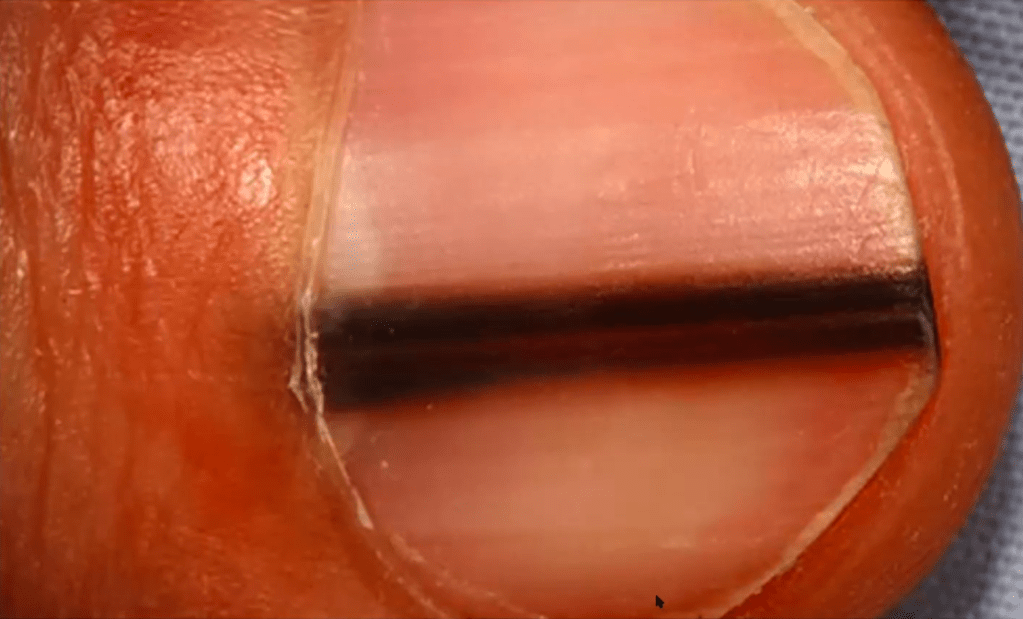
    During the afternoon session of the clinic on Thursday, a Chinese male middle-aged smoker came in for an initial consult with the doctor. While the GP was conversing with his patient for an unrelated matter, I noticed a Hutchinson’s sign of the nail on the patient’s right third toe, which was accompanied by ulceration and partial nail plate destruction. Imagine if the patient had worn closed-toe shoes. I would not have picked it up. Thank God I happened to be observant. So, what is Hutchinson’s sign of the nail?

    As discussed in an earlier blog post on eponyms, eponyms are ubiquitous in medicine. It particularly doesn’t help when the same eponym is used to refer to different phenomena within medicine, thus necessitating the use of additional clarifying identifiers. In the case of this specific “Hutchinson’s sign”, we require the additional “of the nail” to distinguish it from the following:

    • Hutchinson‘s sign of the pupil
      • A mydriatic and unreactive pupil on the same side of the body as an ipsilateral intracranial mass
    • Hutchinson‘s sign of the nose
      • Vesicles on the nasal tip, the lateral aspects of the nose, both of which may precede the development of herpes zoster ophthalmicus, also known as ophthalmic zoster or ophthalmic shingles
      • NB: herpes zoster ophthalmicus is different from herpes zoster oticus, which is the entity perhaps better known by the eponymous ‘Ramsay-Hunt syndrome’)
    Pin on Studies
    • Hutchinson triad, a triad pathognomonic of congenital syphilis which consists of interstitial keratitis (NB: keratitis refers to inflammation of the cornea; the word “interstitial” reminds us that it is specifically the stromal layer, the thickest of the five layers of the cornea, which is inflammed), malformed teeth (which includes Hutchinson incisors and Mulberry molars), and sensorineural hearing loss

    We have the late Sir Jonathan Hutchinson to thank for all the above eponyms. Anyway, a positive Hutchinson’s sign of the nail should raise one’s suspicions for a subungual (‘ungium‘ is the Latin word for ‘nail’; by extension, ‘subungual‘ refers to ‘underneath the nail‘) melanoma, a subtype of acral lentiginous melanoma, which itself is a type of malignant melanoma.

    For readers who are not in the medical field, this can all sound like Greek. So, for the sake of accessibility, let’s first establish a basic mental model about skin cancers. When we talk about skin cancers, we can categorise them as non-melanomas (NMSC; cancers grouped under this term are considered benign simplistically because they are much less likely than malignant melanomas to spread and have serious adverse effects on the patient) or malignant melanomas. There are many different types of malignant melanoma, of which the more common ones include superficially spreading melanoma, nodular melanoma, lentigo maligna, and acral lentiginous melanoma. While homing in on the acral lentiginous type of melanoma, let’s try to understand some of the big words here.

    The word ‘acral’ is defined as ‘of or belonging to the extremities of peripheral body parts’. The word ‘lentiginous’ comes from the word ‘lentigo’, which is a dermatological term used to describe a small pigmented lesion that is clearly demarcated from surrounding healthy skin. I find the following elaboration on ‘lentiginous’ from Wikipedia quite helpful and educational:

    It is a harmless (benign) hyperplasia of melanocytes which is linear in its spread. This means the hyperplasia of melanocytes is restricted to the cell layer directly above the basement membrane of the epidermis where melanocytes normally reside. This is in contrast to the “nests” of multi-layer melanocytes found in moles (melanocytic nevi). Because of this characteristic feature, the adjective “lentiginous” is used to describe other skin lesions that similarly proliferate linearly within the basal cell layer.

    Wikipedia

    Acral lentiginous melanoma accounts for about 5% of all melanomas, and is more common in Asians and dark-skinned populations. Predilection sites in acral lentiginous melanoma include unsurprisingly (as the word ‘acral’ suggests) the palms, soles, the nail bed, and the mucous membranes. The following image is an example of Hutchinson’s sign of the nail, which constitutes the classic clinical appearance of the subungual subtype of acral lentiginous melanoma. According to the AMBOSS Knowledge library, Hutchinson’s sign of the nail is a dark linear patch, which arises from the proximal base of the nail bed and widens with time. Although this clinical sign isn’t an infallible predictor of a subungual melanoma, this is sufficiently concerning to me to warrant a referral to the dermatologist.

    The above is similar to what I saw on Thursday afternoon. This concerned me, and thus I notified the GP about it. When he saw it, he confirmed my suspicion that this was indeed likely to be Hutchinson’s sign of the nail. He then promptly told the patient that he needed to consult a dermatologist to further manage this possibility of a subungual melanoma. There is a chance that what the patient has isn’t subungual melanoma, and I hope it isn’t but if it is indeed subungual melanoma, then at least having it promptly seen and managed by the dermatologist should render the prognosis more favourable.

    “Good call”, the GP remarked to me.

    I have never been more proud of myself. This encounter has reaffirmed my decision that was made more than three years ago to embark on a journey to become a medical doctor.

    I hope my contribution as a medical student on Thursday potentially saved someone’s son, husband, and father.

    NL
    23 October 2021

  • 03(02): There’s more to it than “just exercise more”

    Today is the last day of the 1-week-long ICOPE (Integrated Care of Older Persons) component of my Family Medicine posting. While I spent my time at the community hospital (specifically at St. Andrew Community Hospital from Monday through Thursday), today was spent entirely at home, where I participated in the following lectures virtually via Zoom:

    1. Intro to Rehabilitation Medicine (0900-0930)
    2. Deconditioning and Orthopaedic Rehabilitation (0930-1030)
    3. Brain Injury Assessment & Rehabilitation (1100-1200)
    4. Spinal Cord Injury Rehabilitation (1400-1600)
    5. Exercise Prescription (1600-1630)

    Pretty long day of just being in front of the screen.

    As you might guess from the title, I would like to share my thoughts on the ‘Exercise Prescription’ lecture I had the privilege of attending. Though it was only half an hour, I felt that it was such a great and practical lecture. The lecturer, Dr Yen Jia Min, introduced us to how exercise can be classified into four types. It was fascinating to hear of the theory and evidence that underlie exercise recommendations for adults. In this blog post, I would like to share my main takeaways from that lecture.

    We are all quite familiar with the general non-pharmacological management of countless chronic conditions. Such non-pharmacological management also plays a significant role in, by extension, the promotion of good health. When the management is non-pharmacological, the principle is invariably to modify one’s lifestyle, and that manifests in multiple ways: engaging in exercise, cessation of smoking and alcohol (the protective effect of moderate amounts of alcohol consumption against cardiovascular disease incidence is deemed by some to be dubious), and ensuring good nutrition. In this blog post, I will be focusing on the specific lifestyle modification of exercising.

    Doctors, allied health professionals, and well-meaning peers often tell patients that they have to “just exercise more” to be healthier. In my opinion, telling people to just exercise more without supplementing such vague advice with personalised details on how one should go about doing it is problematic because is not constructive. It is 2021, and virtually every human being in any given developed country would know that exercising is beneficial to one’s health. It’s been drilled into our heads by countless health promotion campaigns. So, to tell patients (or even one’s friends who are generally healthy) that they just need to exercise more risks triggering the perception that they are being infantilised.

    Imagine being good-intentioned and then being met with: “Duh! Everyone knows that exercise is good. You don’t have to tell me that. I know that. Do you think I’m a little child who doesn’t know that?”

    When the person on the receiving end of such vague advice feels that he is being infantilised, this could make him resist the idea of exercising even more. This is because transitioning from a state of not exercising enough to commencing an exercise routine (or exercising more) after hearing that vague advice to “just exercise more” would superficially lend credence to the notion that one didn’t know that earlier. Yes, I know. In such a scenario, it would indeed be objectively better to start exercising, but do bear in mind that human beings aren’t totally rational. They have feelings too, and I’m sure the typical person doesn’t like being infantilised, or being on the receiving end of vague ‘common sense’ advice, particularly if it’s unsolicited.

    With that being said, it is thus important to ensure that the person who requires such advice is receptive to hearing advice regarding lifestyle modification in the first place. Then, to ensure that the advice is personalised and contains the relevant details, it is important to elaborate on the nature of the exercise. This is where today’s 30-min lecture has been rather helpful. Let me share with you what I learnt.

    Incorporating the FITTP acronym in the context of establishing an exercise prescription

    This is so important precisely because systematically incorporating the FITTP acronym would allow one to elaborate on the nature of the exercise. This allows a goal to be much more clearly-defined, and allows one to know if one has met the goal or not. It also allows the goal to be tweaked as needed.

    The FITTP is: Frequency (number of days in a week), Intensity (mild, moderate, and severe), Time (how long is each session going to be?), Type (what type of exercise is this), Progression.

    Something that I quite liked was when Dr Yen shared that there are generally four types of exercise. I did not know this previously. The four types of exercise are:

    • endurance (aerobic) exercise
    • resistance or strength exercise
    • stretching exercise
    • balancing exercise

    I have heard of aerobic exercises and resistance exercises previously but I did not know that exercise could be neatly classified into four categories. This is a useful structured framework for both doctors and patients to think about exercise. During the lecture, Dr Yen remarked, “If you can only remember one thing, but forget everything else about this lecture, please remember this table”. Here is the table:

    Please pay particular attention to the first two rows of the table! The recommendations for aerobic and resistance exercises apply to the typical adult and it would behove us to try to adhere to it as much as possible (good for you if you can exceed the minimum recommendations)! At least currently in medical school, everyone seems to know about the 150 minutes of moderate-intensity aerobic exercise per week recommendation. However, what doesn’t seem to be as well known is the recommendation on resistance training: moderate-intensity resistance exercise involving all major muscle groups for at least two days a week.

    Both aerobic exercise and resistance exercise are important components of the physical activity guidelines for adults. This table outlines the physical activity guidelines for adults in the United States. Nevertheless, the recommendations are highly similar for that of Singapore.

    Another useful learning point from this second table is how the 150 minutes of moderate-intensity exercise is equivalent to 75 minutes of high-intensity exercise. Recall earlier the ‘I’ in the FITTP acronym. The intensity of exercise can be graded as mild, moderate, or high/vigorous.

    In making exercise prescriptions, one of the most common questions that we would likely face is, “How do we gauge the exercise intensity?” That’s a good question, and a good rule of thumb we can use is as follows:

    • Mild-intensity exercise = can sing and talk
    • Moderate-intensity exercise = cannot sing, but able to talk
    • High-intensity exercise = cannot talk, let alone sing (if you can still talk, try harder lol; you’re not there yet)

    It’s also important to remember that the guidelines as given above are appropriate for the typical healthy adult. If one, for example, has a chronic disease such as osteoarthritis, then the recommendations may have to be tweaked slightly and personalised for the individual. In a patient whose knees are implicated in osteoarthritis, it is important to still engage in aerobic exercise. However, running would not likely be recommended. Instead, activities which do not result in much mechanical impact on the knee (e.g. cycling, swimming) could be recommended.

    One last thing that I want to talk about is the issue of ‘exercise progression’ (c.f. the ‘P’ in FITTP).

    The above is one of the slides in the lecture and I think it’s useful. Important points include how in the case of resistance exercise, increasing repetitions is preferred to increasing load. It’s also important to note that progression in exercise isn’t just about the frequency of the exercise. The intensity and duration of each session can also be varied.

    In sum, I enjoyed this afternoon’s lecture on exercise prescription thoroughly. It taught me a lot about exercise and as such, I now have a much clearer mental framework about exercise that would prove beneficial not just in my own personal life, but also in interactions with my patients, friends, and colleagues where elaborating on the nature of exercise is both solicited and warranted.

    I hope you have found this post useful!

    NL
    8 October 2021

  • 03(01): Takeaways from drafting a patient’s chronic care plan

    On Friday, I concluded my three-week stint at Queenstown Polyclinic as part of the ten-week Family Medicine (FM) posting of the third year of the NUS MBBS undergraduate curriculum (i.e. Phase III). There were various assessment components associated with this three-week stint, one of which was the ‘patient care plan’ that each medical student was expected to complete.

    I decided to craft a care plan for an 86-year-old woman whom I had the privilege of encountering during the polyclinic attachment. I could spend time talking about all the various aspects of her care but for the purposes of this post, I would like to talk about how I have witnessed first-hand the importance of managing chronic diseases, and knowing the various nuances in the current guidelines so that we can deliver evidence-based care for the good of our patients.

    Singapore’s population is ageing, and it is indeed staggering to see for myself the sheer proportion of patients who visit the polyclinic (particularly for chronic consults) who present with a personal medical history of the common chronic diseases: hypertension, diabetes mellitus, hyperlipidaemia, osteoarthritis. Unfortunately, the statistics on the predicted trends on the prevalence and incidence of these diseases paint a bleak picture.

    As the average life expectancy increases (age is a classic non-modifiable risk factor for many chronic diseases) and the proliferation of the modern diet (which is generally unhealthy, processed, and laden with added sugar, particularly high fructose corn syrup) continues without bounds, both the prevalence and incidence of these chronic diseases are going to rise.

    Why is this a concern? Let’s take one of the chronic diseases, diabetes mellitus (DM), for example. In the case of DM, complications can be classified as acute (hyperglycaemia symptoms, and hypoglycaemia symptoms secondary to DM therapy) and chronic. Chronic complications can be classified as microvascular (e.g. diabetic retinopathy, diabetic neuropathy, diabetic nephropathy) and macrovascular (stroke, acute coronary syndrome, peripheral vascular disease). In addition to the decreased quality of life experienced by the individual in view of all the potential complications, there is a real tangible cost to society: the cost of the medical services and resources deployed to diagnose DM, manage DM, etc. How can we keep healthcare costs reasonably low without compromising on accessibility and quality? This problem is exacerbated by the fact that Singaporeans aren’t keen on having children (c.f. data from Singapore’s 2020 census). So, where exactly are we going to find the means to pay for the increasing healthcare expenditure associated with an ageing population?

    I have heard a lot about how prevention is better than cure, and that we need to win the war on diabetes, etc. These concepts are great. However, they can be rather abstract if one is not affected by these chronic diseases or personally knows loved ones, peers, friends, and colleagues who are affected by these chronic diseases. Having seen so many patients and their journey with chronic diseases has made me come to the realization that indeed, prevention truly is better than cure. It’s much more cost-effective too. But even if one has been diagnosed with a chronic disease, all hope is not lost. This is because chronic diseases can be managed!

    In the specific case of the 86-year-old patient I had encountered, I had the following takeaways:

    1) There is a lot more to target control than just adhering to the doctor’s management plan. Positive health outcomes are not guaranteed even if patients adhere to the plan established by their doctors, and this is because there are other factors that are (at least in 2021) beyond the control of both the patient and the doctor. Despite being 86yo, and having reported dietary indiscretion, her glycaemic and lipid control are excellent. She isn’t exactly on intense drugs, and she doesn’t even do home blood pressure monitoring (HBPM). In stark contrast, I have seen many patients who are younger than her. These patients may be more disciplined in their lifestyle habits, adhere more to the doctor’s management plan, are on stronger drugs, and still do not achieve values as good as her. As such, genetics plays a huge role. As with virtually all major diseases, the interplay between genetics and environmental factors is significant and we must always bear that in mind. If patients have sincerely tried their best and are still unable to meet certain health targets, we should graciously accept the situation for what it is and not fault them for things beyond their control. On the other hand, having favourable genetic disposition is not an excuse for poor adherence to the prescribed management plan.

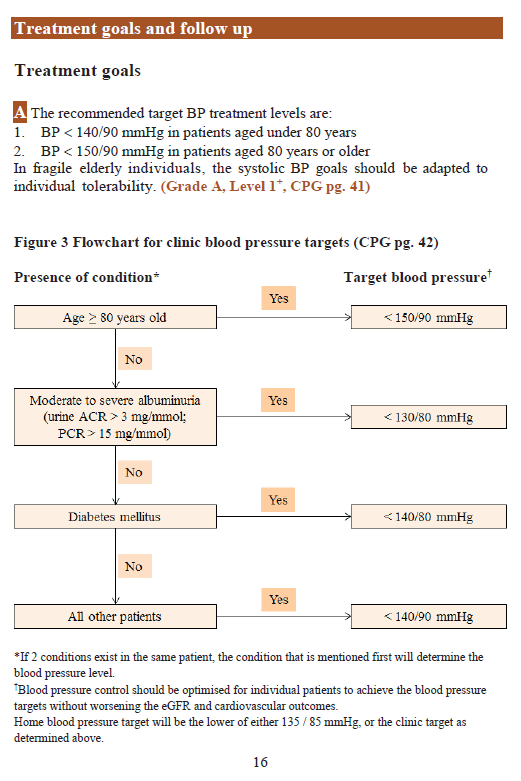
    2) I have learnt the importance of personalised targets for particular subset of patients. For example, in patients who are aged 80 years or older, the blood pressure target is no longer as strict and becomes 150/90. The age-associated BP target change takes precedence.

    Screenshot of page 16 from the summary card of MOH Clinical Practice Guidelines on Hypertension

    As for the hypothetical patient’s ideal HbA1c target, although we like to throw the 7% number around a lot out of convenience, the reality is that the ideal HbA1c target should be individualised to the patient’s biodata, DM history, and comorbidities. As such, with the 86-year-old patient’s profile, an appropriate target would be an HbA1c% target of 7.5%. The HbA1c% target may be as low as 6.5% in young and healthy patients while it may be 8.0% in very old patients with highly advanced DM. So, chronic management of DM requires a multidisciplinary holistic management centred around patient education to meet individualised glycaemic targets with non-pharmacological and pharmacological means while simultaneously managing complications and comorbidities. The same reasoning (i.e. in the previous sentence of this paragraph) could be applied to other chronic diseases; just change the phrase ‘individualised glycaemic targets’ to something relevant for the chronic disease in question.

    In summary, this case, and the process of putting together the care plan for the 86-year-old patient as a practice exercise have constituted an excellent opportunity for me to understand first-hand the reality of chronic disease management in Singapore. It is certainly not easy at all, particularly if one truly wants to ensure that the management plan is personalised in the name of evidence-based practice. As mentioned earlier, the trends on diabetes prevalence (and similarly for other chronic diseases) don’t look particularly promising. As such, for most of us who will be doctors in the primary care setting, we need to be mentally prepared to manage an ever-increasing proportion of patients with chronic diseases.

    NL
    26 September 2021