pianist and medical doctor

Tag: vol04

  • 04(17): Why and how I lost 10 kg in 5 months, and successfully sustained it; lessons learnt, and next steps

    It’s finally here.

    The blog post which some have been requesting. Aptly, it is being published on New Year’s Eve. I hope this encourages and inspires you to consider realistic fitness and health goals, particularly if you’re one who sets New Year Resolutions.

    For those just interested in the rough ‘before’/’after’ photos and only want an overview of the progress, head to the bottom of this post.

    PRECIPITATING AND PREDISPOSING FACTORS FOR THE DECISION TO LOSE WEIGHT

    Let’s go back to the beginning.

    I enlisted on 5 January 2016, and ORD-ed in November 2017. I finished my BMT in March 2016, after which I was posted to 48 SAR 1st COY where I trained as a tank operator (specifically as a driver of the L2SG main battle tank, but I also underwent training operating the weapon systems of the main battle tank, and how to load the rounds).

    Within my unit, I was always considered by many to be slightly above average (for my running, at least) in my physical fitness parameters. My company had around 50-60 servicemen and for the 2.4 km run component of the IPPT, I would normally be among the first five to complete the run.

    In May 2016, I was required to take the IPPT shortly after being transferred to 48 SAR/1st COY. On this occasion, I achieved my all-time personal best for the 2.4 km run: 9 min 39 sec.

    Fast forward to November 2017, when I completed my mandatory full-time NS. After a three-month break, I then commenced my medical studies in Australia in Feb 2018.

    You see, back when I was studying in Australia, I pretty much lived independently. I had my own bedroom in a house which I shared with other occupants. I did my own groceries and had much greater freedom regarding my gastronomic choices. I was quite disciplined with what I bought – adhering to a diet that many would dismiss as boring. I would pretty much eat the same thing every day (eg muesli, full-cream milk, either salmon or steak, and a ton of eggs). I would pretty much never buy any snacks/dessert during my grocery runs.

    As such, my weight had hovered between 61-62 kg for more than 2 years (I had studied in Australia for a grand total of slightly over three years: from Feb 2018 to May 2021).

    When I first returned to Singapore due to the medical school transfer in AY21/22, I arrived in Singapore in end-May 2021. Largely due to a complex interplay of different reasons (e.g. reduced autonomy over the food I ate as I no longer settled my own groceries and chose what I wanted to eat at home, the constant ubiquity of highly processed food in my fridge at home, less flexibility over my eating hours due to a persistent family tradition of eating together for dinner as much as possible, larger-than-average portion sizes for home meals, easy access to fatty and oily foods from the coffee shop across the road), my weight dramatically increased as soon as I returned to the little red dot. Grappling with the transition in the different medical school learning environments, it was all too easy to rely on food as a constant stream of quanta of solace.

    Since I returned to Singapore in end-May 2021 for good to continue my medical studies in YLLSoM, the exit permit I previously possessed that had hitherto exempted me from all annual reservist IPPT obligations officially become null and void. As such, when I birthday came around last November, I was informed by MINDEF that I ought to complete my IPPT within the fresh “window”. Such a window (time period) is personalised for every reservist personnel and commences whenever it is the serviceman’s birthday. Officially, at least for MINDEF, a person’s birthday is measured by when the person’s actual birthday passes, and not when the calendar year changes.

    In June 2022, when I took the mandatory IPPT, the score that I obtained was 84, a mere 1 point from gold. By many people’s standards, passing the IPPT when it has been half a decade since the last IPPT attempt as an NSF is a fantastic result, let alone doing well enough for the monetary incentives. However, I wasn’t contented with a mere ‘pass with incentive’, or mere Silver. The result stang so much because I was so close to Gold (achieved at a minimum of 85 points).

    It’s not a regular 1-point difference. The one-point difference was ultimately due to the fact that I had run 10:21 for the 2.4km run instead of the required 10:20 (given my combination of scores for the push-up and sit-ups stations) for the Gold Award. As such, for my first reservist IPPT attempt, I clinched a Silver award at 84 points. However, because I didn’t clinch the Gold award, I only received a $300 incentive (for Silver) instead of the typical $500 incentive (for Gold). Can you believe that?

    Losing out on $200 due to a 1-second difference!!

    Tragic, isn’t it?

    This was certainly the precipitating factor for my decision to initiate my journey of intentional, sustainable weight loss with the aim of reducing total body fat percentage.

    In retrospect, missing out on Gold wasn’t all too bad. After all, it was the wake-up call that I had to lose weight. To illustrate the effect of body weight on running speed, a cursory Google search would reveal that for each pound (about 0.45 kg) of body weight lost, you can run a mile by 1-2 seconds faster than that of your current speed on average for the same effort expended.

    However, to give even more context, this miss on the Gold acting as the triggering factor occurred on a background of a progressive discomfort and uneasiness that I experienced over the fact that I was technically in the ‘overweight’ category (my peak recorded weight was 71.5 kg in Feb 2022; for an Asian of height 173 cm, this corresponds to a BMI of greater than 23.0, which means I’m overweight), a label which I did not like on myself (not only because I had never been overweight, but also because of the dire acute and chronic complications that generally being overweight had on my constitution). One thing that too many people in Singapore aren’t aware of is that Asians have a higher risk of cardiovascular complications at any given BMI compared to the typical Caucasian whose ethnicity constitutes the majority in influential countries such as the US, UK, Canada, Australia, or New Zealand.

    Guess which ethnicity the World Health Organisation (WHO)’s BMI guidelines are catered towards?

    Beyond BMI, the same can also be said of another anthropometric measurement: waist circumference.

    A well-known limitation of BMI is that it doesn’t consider the varying contributions of the different components of one body’s weight (mass due to muscle, fat, water), and therefore should be interpreted with caution, particularly in pregnant individuals or individuals who have a unusually significant lean mass (e.g. bodybuilders). Compared to BMI, waist circumference is a better surrogate marker of one’s body fat distribution and one’s risk for cardiovascular disease. WHO’s guidelines for the waist circumference threshold for truncal obesity are: 102 cm and 90 cm in men and women respectively.

    As with the example of BMI earlier, the 102/90 figures apply to the typical Caucasian and provides spurious reassurance to people of Asian ethnicity. The corresponding thresholds for truncal obesity in the population in Singapore, which have been previously determined from Asian-specific epidemiologic studies, are more conservative: 90 cm and 80 cm for men and women respectively. It certainly wasn’t reassuring to know that at one point, my waist circumference was 86 cm, just a mere 4 cm away from the abdominal obesity threshold for males.

    The message was clear.

    These personalised anthropometric measurements were of great concern and certainly necessitated prompt action.

    As such, on 26 June 2022, I officially endeavoured to rectify my dietary habits and exercise habits (or lack thereof). The following sections will reveal how exactly how I went about doing this.

    HOW EXACTLY THE PROCESS OF WEIGHT LOSS TRANSPIRED (INCLUDING MISTAKES TO AVOID)

    As someone who was embarking on a process of weight loss for the first time, there was clearly room for improvement in terms of how I started the journey on Day 1. These were issues with the very start. Therefore, if you yourself want to lose weight while following the general trajectory I took, I highly suggest you address the following issues to have a smoother and more satisfying experience:

    • Not having a reliable weighing scale.

    A reliable weighing scale is an important tool for tracking progress in a weight loss journey because it allows a person to accurately measure and monitor his weight. This information can be used to gauge the effectiveness of a weight loss plan and make any necessary adjustments. For example, if a person is following a calorie-controlled diet and exercising regularly but the scale is not showing any changes in weight, they may need to reassess their plan and make adjustments in order to see progress. On the other hand, if the scale is showing consistent weight loss, it can be a motivating factor that helps a person stay committed to their weight loss goals. With the manual mechanical scale that my family had for aeons, it was hard to track progress, particularly when one has doubts regarding the accuracy of the scale itself.

    • Not taking the steps to minimise interday variability in weight due to factors that are easily mitigated.

    The most accurate way to track one’s weight day-to-day is to measure one’s weight on the electronic scale the first thing after waking up in the morning (after completely emptying one’s bladder and clearing one’s bowels, and before consuming any food or liquid whatsover), with all accessories, jewellery, garments, and undergarments removed.

    Any deviation from what I have described in the paragraph above will most likely lead to an unncessary increase in interday variability in weight, which makes progress tracking more challenging than it needs to be.

    • Not using an app for weight and calorie tracking from the very start.

    With an app such as LoseIt (which I only started using a few days after commencing the weight loss journey), I was able to have visual overview of my progress, and this motivated me to persist with what worked for me. A comprehensive outline of the benefits of using the app such as LoseIt to facilitate weight loss is beyond the scope of this blog post, but in essence, it aided me greatly. I tracked my calories, my macros, and received encouraging reminders of the milestones I had attained.

    • Not taking adequate ‘before’ photos.

    I should be grateful that I at least have a photo of myself (taken on 26/6/22) that was taken around the time I decided to lose weight. It’s certainly better than nothing. There are many people who don’t even have a single photo around the time that they decide to start their weight loss journey, and this makes accurate comparison (via a before-after) challenging.

    Nevertheless, if I could do things all over again, I would definitely take more photographs. Clearer photographs. Photographs of myself from the hips and up, and in the side, frontal, and back views. This way, the ‘before’/’after’ transformation would certainly be more inspiring and motivational.

    • Not tracking progress via photos at regular time intervals and consistent photo conditions.

    It was only on 5/11/22 that I realised that the progress photos weren’t taken on regular intervals, and that it could be improved. As such, starting on 5/11/22 (Saturday), I would take a progress photo every Saturday using the front camera of my phone, with the photograph being in the dimensions of a square shape, with the visage being centered appropriately, with the lateral canthi of both eyes at the level of the 2/3 way up within the centre subsquare (when dividing the entire square photograph into nine equally-sized subsquares), and with the inferior border of the middle subsquare corresponding to the level of the subnasale. The facial expression is also kept consistent as much as possible (you can see a smile plastered on my face!).

    Such standardisation as described in the above paragraph may appear excessive at first glance. However, when these photos are compiled into a specific album on one’s phone, it’s actually remarkable when one swipes left and right and instantly appreciates even subtle changes (made possible because the position of the face and all the relevant features are kept constant as much as possible!). In fact, outlining all these specifications for my progress photos is precisely what facilitates easy comparison between the progress photos that you’re about to see in the section below!

    OVERVIEW OF WEIGHT LOSS JOURNEY + BEFORE/AFTER PHOTOS

    In sum (particularly for those of you who just scrolled all the way down here to see the visual transformation), I made the decision to start losing weight on 26/6/22. On that day, a Sunday, I had gone to Tenya Orchard Central for lunch and had my ‘before’ photo taken.

    On 1/7/22, I decided to ‘up’ my game by formally tracking the nutritional content of my meals and my weight, in order to better document my progress. However, the manual nonelectric scale I had at home was both imprecise and inaccurate. As such, I went to Decathalon Waterway Point to grab a simple and affordable electronic scale at about SGD 16 (cheaper than the ones from even retail pharmacies) a few days later. On 1/7/22, I also started tracking my calories on an app called LoseIt!. Starting on 5/11/22, I started taking progress photos at a consistent time interval (every Saturday).

    Key milestones:

    71.5kg (26/6/22 – date of ‘before’ progress photo) > 70.5 kg (1/7/22) > 67.4 kg (1/8/22) > 64.6 kg (1/9/22) > 62.6 kg (1/10/22) > 62.1 kg (1/11/22) > 61.5 kg (12/11/22) > 62.6 kg (10/12/22 – date of ‘after’ progress photo).

    Apart from cropping the individual photos to a square shape and putting the watermarks, these photos are unedited, and have not been tampered in any way.

    THE EFFECT OF THE WEIGHT LOSS, AND LESSONS LEARNT

    Following the weight loss, I became a totally different person from the person I was in June 2022 and the few months preceding it. Mobility was enhanced. Running felt more enjoyable. My sleep improved slightly. My mood and self-confidence has flourished, and life is simply more interesting and enjoyable. Life’s just easier when you’re healthier, fitter, and more attractive.

    Despite attaining my weight loss goal, I continue tracking my weight every morning religiously, and also still track my macros, and calories to a reasonable extent as this is excellent way to remain conscious of what I’m consuming. These are great habits that I hope to sustain indefinitely. After all, for any fat loss to be permanent, there needs to be some permanent and lasting change in one’s lifestyle habits. Bad habits need to be eradicated. Good habits need to be established.

    Oftentimes, people embark on ambitious ‘detox’ programmes or fad diets that last a few weeks only to do a complete 180 and return to their old ways after the temporary programme ends. Under such circumstances, it should thus be no surprise when one regains all the weight one lost during whatever temporary programme one was on.

    It’s hilarious how along the way, many people (including quite a few fellow medical students, one nurse in NUH, one of the admin staff in NUS, one surgical resident) couldn’t help but point to me that I had lost weight (particularly people I hadn’t seen in a while). Those are some of the greatest encouraging reminders of what I have accomplished and never fail to write glee on my face. When other people notice and also feel compelled to explicitly tell you, that’s when you know that it’s significant. Of course, I’m sure there are also more who noticed but chose not to point it out for fear of committing a faux pas.

    Overall, the weight loss journey has been quite humbling. Often, doctors tell patients to ‘lose weight’ as a first-line noninvasive approach for the management of a variety of chronic metabolic conditions (see my previous blog post where I explored the role of weight loss in the management of osteoarthritis). While this advice is generally sound, it’s too easy to rattle it out of habit and without any conscious regard for how challenging it can actually be. This may be discouraging for patients who have already heard this advice repeatedly but nevertheless find it very challenging to lose weight.

    This personal journey that I undertook will certainly be paramount in helping me empathise with my future patients when advising them to lose weight.

    Indeed, as supported by the various guidelines, sustainable weight loss with the goal of reducing total body fat is achieved by sustaining a net caloric deficit, while still ensuring adequate macronutrient intake and appropriate amounts of resistance training and cardiovascular activity. The highly personal weight loss journey has etched this cardinal rule of weight loss into my mind forever.

    WHAT’S NEXT

    After that glorious run of a cut, I made the transition to a brief period of eating at maintenance (i.e. having neither a net caloric surplus or deficit in order to maintain weight, with the proportion of lean muscle and body fat remaining the same during maintenance), followed by a controlled ‘bulk’ (i.e. striving for a slight caloric surplus accompanied by adequate daily protein intake (0.82 g/lb of body weight) to facilitate muscle hypertrophy).

    I realised that if I wanted to get even fitter, healthier, stronger, and look even better, I had to incorporate consistent resistance training into my life. As such, on 6/12/22, I started checking out various gyms (aided by the guidance of my youngest brother who had already been consistently doing strength training for about four months) in the vicinity of my residence and soon realised some limitations. Many fairly basic gyms (particularly in most condominiums) lack barbells, which are required for the classic compound exercises: deadlifts, squats, bench press, and overhead press.

    While chest press and shoulder press machines exist in virtually all gyms, they are suboptimal compared to barbells because they do not activate the required stabiliing muscles to the same extent. Additionally, the weight increment intervals on the machines are far larger, which makes tracking incremental linear progress via weights more challenging.

    Fortunately, after some research, I managed to locate a reasonably priced gym near my residence that has barbells, and the relevant bench press stations and squat rack.

    As such, on 26/12/22, I officially began a structured beginner’s strength training programme. Looking forward to reporting both visual and numerical progress/results in a year’s time. Stay tuned!

    Nic
    31 Dec 2022

  • 04(16): Why 1 kg weight loss takes away 4 kg-equivalent of stress from the hip – a tango between medicine and Newtonian mechanics

    INTRODUCTION

    It has been a while (about 1.5 months) since my previous blog post, in which I discussed a medical condition where the patient sheds ‘crocodile tears’. Well, that condition (Borogad syndrome) is pretty esoteric, and I wrote about it largely only because I wanted to share some fascinating trivia I had encountered in my casual reading.

    In contrast, for the sake of this blog post, I would like to share something which I feel is important and clinically relevant. I only learnt this after participating in a tutorial which I attended a few days ago. It was a didactic tutorial held on 23 Nov, Wednesday, and it was led by Emeritus Consultant A/Prof Low Boon Yong, an orthopaedic surgeon who works at Changi General Hospital (CGH), a hospital within the SingHealth cluster.

    Just to provide some context, my fellow clinical groupmates and I are currently on our orthopaedic surgery posting (our third major clinical posting as part of the curriculum for third-year undergraduate medical students at NUS). The focus of the tutorial was that of essential knowledge pertaining to the hip that medical students are expected to possess. It was evident to me, at least, that A/Prof Low is indeed highly knowledgeable even as he briefly walked us through an extensive amount of background information prior to even broaching the hip per se. He shared with us the implications of human beings being bipedal, the advantages and disadvantages of being bipedal, a short segment on the Neanderthals, the mechanism of how losing 1 kg of body mass takes away 4 kg -equivalent of pressure from the lower limb joints, and a conceptual understanding on what constitutes an antalgic gait.

    It is beyond the scope of this blog post to elaborate on everything that A/Prof Low covered. So, I will only be elaborating on what I deem to be the highlight of the tutorial. It is valuable knowledge and deserves to be shared.

    All credit for the explanation of the mechanism of the stress/pressure offloading to A/Prof Low, and do kindly consider any error (if present) to be mine.

    WHY EVEN CONSIDER THE EFFECT OF WEIGHT LOSS?

    Before we even get to the mechanism as to why 1 kg of weight loss leads to a disproportionate reduction in equivalent pressure from one’s lower limb joints, it is necessary to discuss why we may even need to consider the effect of 1 kg of weight loss.

    The reality is that intentional weight loss remains the cornerstone of the management of virtually all chronic metabolic diseases such as obesity, essential hypertension, dyslipidaemia, and diabetes mellitus (along with all its associated acute complications, chronic microvascular complications, and chronic macrovascular complications). Moreover, intentional weight loss remains one of the key strategies which many rely on to boost their level of physical attractiveness, an objective which is desirable by many in society.

    The prevalence of obesity has been steadily increasing, and this constitutes a worrisome threat to the fiscal viability of healthcare systems around the globe. The obesity epidemic is thus perhaps more appropriately termed the obesity pandemic, as it doesn’t just affect developed countries such as the United States, the United Kingdom, or Australia, where highly processed foods, high fructose corn syrup, artificial sweeteners, excessively salty, fatty, and oily foods all abound.

    Even our island home hasn’t been spared. According to a press release by MOH in 2014, “Singapore’s obesity prevalence increased 0.7 percentage point a year since 2004 to reach nearly 11% in 2010, only one percentage lower than the global average obesity prevalence of 12%.” I’m not sure what the latest figures are, but given that it’s 12 years on from 2010, I’m certain that the prevalence of obesity is greater than the already-dismal 11%.

    For the past few decades, the obesity pandemic has not spared developing countries due to the far-reaching tentacles of globalisation. In fact, the affliction of the obesity pandemic in developing countries is often harsher due to the dearth of relevant health and food safety regulations, thus allowing unbridled capitalism to hold the reins of the industries of local sustenance.

    With the unfettered proliferation of unhealthy diets across the globe, people are increasingly getting horizontally challenged (pardon that sad attempt to cruise along the euphemism treadmill). Obesity has numerous complications which ultimately contribute to a reduced quality of life for patients, and one such complication is the acceleration of the progression of osteoarthritis of the weight-bearing joints, which manifests clinically as progressively worsening mechanical pain.

    Osteoarthritis may be defined as a disorder characterised by chronic progressive degeneration of articular cartilage within synovial joints, resulting in the loss of joint space that is often asymmetric, and the formation of subchondral cysts. Osteophytosis (the formation of new bone and cartilage at the joint margins), sclerosis of subchondral bone, and formation of new connective tissue in the form of capsular fibrosis all occur as part of the body’s attempt at counteracting the degenerative process.

    Acceleration of osteoarthritis as a complication of obesity is unsurprising because as one might imagine: with an abnormally high body mass, there is a pathologically high amount of stress or pressure on weight-bearing joints such as the hips and knees, which increases the rate of the degeneration of these joints due to greater tendency and magnitude of the wear-and-tear associated with the articular surfaces grinding against each other.

    It is thus no surprise that when we talk about the management of osteoarthritis, for which there are nonoperative options (further classified as nonpharmacological and pharmacological) and operative options, chief among the nonpharmacological options would be intentional and sustainable weight loss, which would reduce the rate of osteoarthritis progression.

    Specifically for the typical patient (whether suffering from osteoarthritis or not) of Asian ethnicity in Singapore, this would ideally entail getting the BMI to <23.5 and ensuring that the waist circumference is also <80 cm (if female) and <90 cm (if male), as per local guidelines. Of course, what I’ve listed here is just general advice for educational purposes only. For appropriate management in your specific circumstances, please consult your doctor.

    THE MECHANISM UNDERLYING A DISPROPORTIONATE REDUCTION IN EQUIVALENT PRESSURE FROM THE WEIGHT-BEARING JOINTS OF THE LOWER LIMBS IN WEIGHT LOSS

    Now that we’ve discussed why people may even be interested in the idea of weight loss in the first place, let’s now explore the mechanism underlying a disproportionate reduction in equivalent pressure from the weight-bearing joints of the lower limb.

    A/Prof Low used fundamental physics principles to illustrate how one could arrive at a factor of 4 regarding the offloading of pressure from the weight-bearing hip joint (though a similar calculation could be modified and tailored to other weight-bearing joints of the lower limb) for each unit of weight loss.

    Consider the principle of moments which is a staple of Newtonian mechanics in any physics syllabus, whether at the O-level, A-level, or even within an introductory physics module at university. The principle of moments may be defined as follows: “the resultant torques due to a number of forces applied about a point is equal to the sum of the contributing torques”.

    From this definition, it follows that when an object is in rotational equilibrium, one can determine the relative magnitude of a particular force if the other variables are known. A/Prof Low shared with us how we can use this well-known physics principle to better understand the anatomy and mechanics of the human hip and the clinical implications of this.

    As we all know, the hip can be thought of as a ball-and-socket joint, with the head of the femur constituting the ball of the hip joint, while the acetabulum constitutes the socket of the hip joint. Whilst a gross simplification of the actual mechanics within the human body, the following framework is nevertheless sufficiently robust for both clinicians and patients alike to conceptualise the positive effect that intentional and sustainable weight loss can have on weight-bearing joints:

    • Consider a vertical plane passing through the centre of mass of the femoral head to correspond to the position of an imaginary fulcrum.
    • The gluteus medius, the main abductor of the hip, attaches to the greater trochanter of the femur.
    • The vertical plane containing the ‘average’ origin (because after all, the actual origin of the gluteus medius is not a mere simple point, but rather, a relatively large region) of the gluteus medius can be taken to be approximately some perpendicular distance ‘a‘ from the femoral capital vertical plane.
    • Next consider another vertical plane which runs through the centre of mass of the patient, which would roughly correspond to the sagittal plane of the patient.
    • Based on standard anatomic proportions, when in the anatomic position, the perpendicular distance between this new vertical plane (i.e. the sagittal plane) and the femoral capital vertical plane is roughly ‘3a‘ (i.e. the perpendicular distance between the vertical plane containing the point of the patient’s centre of mass and the femoral capital vertical plane, is approximately three times the perpendicular distance between femoral capital vertical plane and the vertical plane containing the ‘average’ origin of the ipsilateral gluteus medius).

    Do you see where I am going with this?

    Let ‘F’ represent the weight of the patient.

    Considering just the abovementioned force and distances, one can certainly mathematically determine the average force (or tension) present within a contracted gluteus medius when the patient is in balance.

    Let T represent the tension within the contracted gluteus medius in the abovementioned system. Using the principle of moments, we can construct the following equation:

    T (a) = F (3a)

    Thus, T = 3F;

    Going one step further, assuming the patient is in a state of not just rotational equilibrium (i.e. no net torque about the femoral head; constant angular momentum), but also translational equilibrium (i.e. no net force acting on the femoral head; constant momentum), we can use Newton’s third law to determine the force, Z, exerted on the femoral head.

    By Newton’s third law, for the system to be in translational equilibrium, Z = T + F = 3F + F = 4F.

    Z = 4F.

    Incredible, isn’t it?

    In fact, A/Prof Low used this relationship between the various forces and perpendicular distances to explain why the classic antalgic gait is the way it is. In an attempt to minimise the magnitude of the downward forces acting on the femoral head (which would of course be counteracted by the reactionary normal force due to Newton’s third law; note that a similar system/reasoning can be employed if the source of the antalgic gait is another part of the lower limb), the patient will ’tilt’ towards the unaffected side during the stance phase of the unaffected limb (see the second image given below, where the patient’s left lower limb is affected and presents with an antalgic gait).

    Why is this so?

    Well, when this ’tilt’ happens (see the second image presented below, which is a screen capture at 0:23 from a YouTube video illustrating antalgic gait), the ratio of the perpendicular distance between the plane containing patient’s centre of mass and the femoral capital vertical plane, to the perpendicular distance between the femoral capital vertical plane and the plane containing the ‘average’ origin of the gluteus medius, is effectively reduced (i.e. less than ‘3’ instead of approximately 3). Consequently, this would lead to a reduction in the tension within the gluteus medius (i.e. T < 3F), which would result in the sum of the downward forces on the femoral head being reduced (i.e. Z < 3F + F ; Z < 4F), which would theoretically reduce the intensity of mechanical pain on the affected ipsilateral lower limb.

    CONCLUSION

    You can probably see why I enjoyed the tutorial so much to the extent that I might even want to write an entire post on it. People who have known me for a long time know that for a rather substantial period of time, I have always wanted to pursue something related to physics (e.g. obtaining a physics degree, becoming a physics teacher). Being able to work things out from first principles fascinates me, and physics is a field where this practice routinely abounds.

    Simply put, I am absolutely enamoured with A/Prof Low’s explanation because it theoretically illustrated an experimentally confirmed relationship using fundamental first principles in physics in a manner that most people who have had even just prior secondary school-level instruction in Newtonian mechanics can comprehend.

    I consider it a privilege to have had A/Prof Low teach my colleagues and I on Wednesday, and hope you have enjoyed reading this article as much as I have enjoyed writing this!

    Nic
    27 Nov 2022 (Sun)


    DISCLAIMER: THIS WEBSITE DOES NOT PROVIDE MEDICAL ADVICE

    The information, including but not limited to, text, graphics, images and other material contained on this website are for informational purposes only. No material on this site is intended to be a substitute for professional medical advice, diagnosis or treatment. Always seek the advice of your physician or other qualified health care provider with any questions you may have regarding a medical condition or treatment and before undertaking a new health care regimen, and never disregard professional medical advice or delay in seeking it because of something you have read on this website.

  • 04(15): A medical condition in which you shed crocodile tears

    BACKGROUND

    The animated film Tarzan (1999) by Disney is one of the many animated productions that I watched fondly as a kid. The film chronicles the tale of a man raised by apes and must decide where he really belongs when he learns that he is a human. Famous soundtrack from the film include You’ll Be In My Heart by Phil Collins. In the first half of Tarzan, we are shown a scene of monkeys starting to cry, to which Jane Porter the female protagonist responds: “No, no, don’t give me those crocodile tears.“

    In common parlance, the term ‘crocodile tears’ is used to suggest that a person may not be sincere with respect to his tears or expressions of sorrow. An example sentence would be as follows: “They weep crocodile tears for the poor and disadvantaged, but are basically happy with things as they are” (obtained from Google Dictionary).

    This expression which has wended its way into our language is apparently derived from the ancient belief that crocodiles shed tears after killing their victims.

    While crocodiles can and do generate tears, there is a lack of evidence to suggest that such tears are linked to emotion. This runs in contrast to that of us humans, who can and do shed tears for a myriad of reasons. Classically, we shed tears as an overwhelming emotional response to a particular situation. This emotion could be that of joy (thus giving rise to the well-known expression “tears of joy”). This can occur when mothers hold their neonates for the first time shortly after birth, when athletes finally clinch the long-desired Olympic gold medal, when one achieves one’s desired academic performance in an exam. Of course, joy is not the only emotion that can give rise to tears. Immense sorrow resulting from receiving the news of the death of a loved one can also move someone to tears. Additionally, touching Thai advertisements, Korean dramas, and even movies such as ‘The Notebook’ that are highly popular with the fairer sex are also all known to move people to tears.

    It is challenging to determine the precise origin of this particular belief on crocodile tears, but one can see why such a belief might have propagated and stood the test of time. According to Adam Britton, an Australian zoologist and a crocodile specialist, “for an apparently remorseless creature such as a crocodile to actually weep over its victims is a memorable irony which has inspired considerable prose“.

    Let’s now see how the phenomenon has found its way within an alternative descriptive term of the eponymous Borogad syndrome, the medical condition in which one sheds ‘crocodile tears’.

    Crocodile tears syndrome

    Crocodile tears syndrome, also known as Borogad syndrome, is the shedding of tears while eating or drinking in patients recovering from Bell’s Palsy. It is also referred to as gustatory lacrimation.

    The eponymous syndrome is named after Russian neurologist F. A. Bogorad, who described the condition in a case report entitled “Das syndrom der krokodilstränen” that was published in Vrach Delo in 1928. In the words of Austin Seckersen, who offered his translation of Bogorad’s article many decades later on New Year’s day of 1979 in an article published in the Journal of the History of Medicine and Allied Sciences, “Borogad’s paper is not of easy access” and “it was written in Russian and was published at a somewhat disturbed period in Soviet history“. As such, Seckersen thought “it might be of value to produce a translation of it“.

    Pretty interesting, I must say. I wouldn’t have been able to learn about crocodile tears syndrome if not for Seckersen’s introduction and translation of Borogad’s work that was originally published a few decades earlier.

    Bell’s palsy is basically idiopathic facial nerve palsy. For a previous blog post where I discussed Justin Bieber’s relatively recent journey with facial nerve palsy, click here.

    Have a great day ahead!

    8 Oct 2022

  • 04(14): What objectively determines the physical attractiveness of a man’s face?

    Introduction

    Many in society repeat ad nauseam how it’s a person’s personality that truly matters, perhaps in an attempt by their holier-than-thou attitude to demonstrate that they transcend the reality of the ‘superficiality’ of physical features. What’s funny is that it’s almost never the people who are conventionally unattractive that say that ‘looks don’t matter’. Rather, it’s physically attractive people, or even people whose looks are average that publicly declare that ‘looks are secondary’. The reason that conventionally unattractive people are practically never the ones to say that “looks don’t matter” is that they know what it’s like firsthand to be an unattractive person. Newsflash. It isn’t pleasant. They know that looks matter.

    Take the typical obese person who is deemed conventionally unattractive for example. It doesn’t matter if the obesity was trigged by dietary indiscretion secondary to Prader-Willi syndrome, medications, or circumstances that are not reasonably within his control. Society would still stereotype him as a ill-disciplined gluttonous sloth. After all, why would anyone talk to him further to have a more holistic assessment of him when he already looks a certain way? First impressions matter a lot, and in my opinion, have particularly weighted influence on all subsequent decisions that people make.

    I urge you, dear reader, to not just pay attention to what people say, but pay attention to what people do (eg consider the basis on which people select their romantic partners, and how they actually interact with others). You may be surprised that, upon closer inspection, people don’t really practise what they preach.

    It is well established that good-looking people are treated by others better, ceteris paribus. People are more forgiving towards the misdemeanours of good-looking people. Good-looking people are shown more favours and are treated better across every domain of life. And perhaps it might frighten you to know that in many instances, those who treat good-looking people better don’t even do so consciously. People subconsciously treat good-looking people better. I would argue that this inclination to treat good-looking better is hard-wired into the human genetic code, and taps on our primal instincts.

    In the spirit of the tagline of my blog (‘musings of guileless candour’), I’ll be frank and direct. Looks matter. Physical attraction, particularly involving the face, matters in all kinds of relationships: whether at work, in one’s friendships, or one’s romantic pursuits. Anyone who says otherwise should probably snap out of his naivety.

    Furthermore, as much some people would so desparately like to believe that beauty is subjective, I am unfortunately the bearer of some discouraging news. Beauty is rather objective. The human mind, in a matter of seconds, is able to discern between the photographs of two individuals and determine whom the more attractive person is, even if one is not able to articulate precisely why one is more attractive than the other.

    Do you doubt me? Try the following: take a raw photograph each of any two randomly selected men or women (ideally of the same age, sex, and ethnicity) under similar circumstances (eg similar posture, angle, and lighting). Ask fifty randomly selected people whom they find more attractive. If beauty standards were truly subjective and indeed in the ‘eye of the beholder’, one would expect an even split among the respondents regarding whom the more attractive person is. Of course, that result would never occur in reality.

    So, what exactly makes a particular face objectively more attractive than another face? This question greatly piqued my curiosity when I first pondered on it a while back. In today’s post, I would like to share what I learnt regarding what objectively determines the physical attractiveness of faces (for the sake of this blog post, I’d be talking about a male face).

    From mere inspection of a man’s face, one can tease out a myriad of facial features. All sorts of measurements can be made: lengths, widths, shapes, ratios, angles, symmetry. However, some features are more important than others. Very important facial features include the eyes, jaw, midface, face shape, and eyebrows. Features which are not as important include the lips, nose, forehead, and eye colour.

    Once an assessment of the man’s facial features is done, consider the ‘category’ of men the evaluated man falls under. Is his face considered slightly feminine, regular, or hypermasculine? Lastly, consider the overall facial harmony of the person. At this point, you may then proceed with your attempt in devising a ‘score’ for the candidate (conventionally, people’s physical attractiveness are rated on a 1-10 scale, with 10 being absolute perfection).

    Jaw analysis

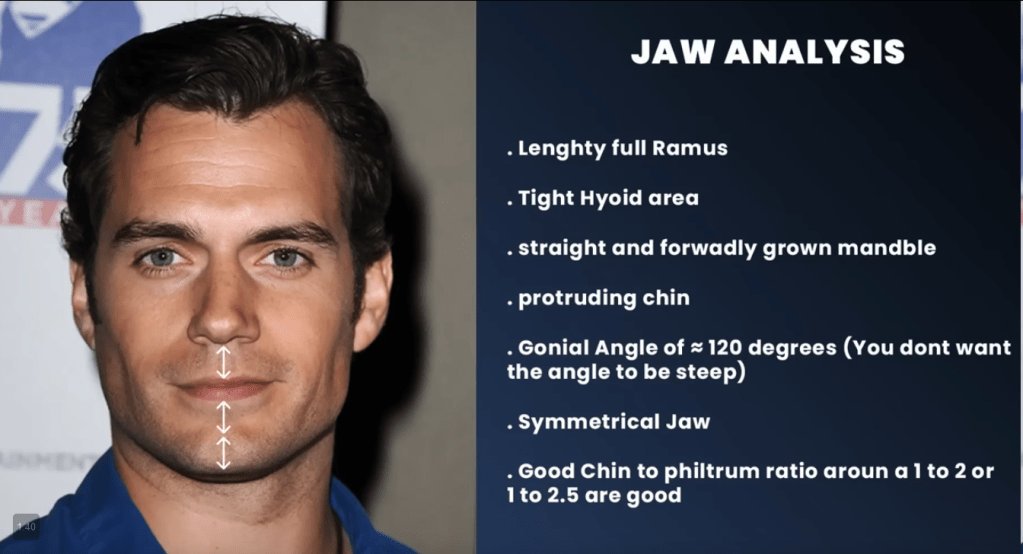
    One of the first features about a man’s face that people would note is his jawline (or lack thereof). The following illustrates a good, chiseled, and well-defined jawline. These photographs constitute the front and side profiles of none other than Henry Cavill.

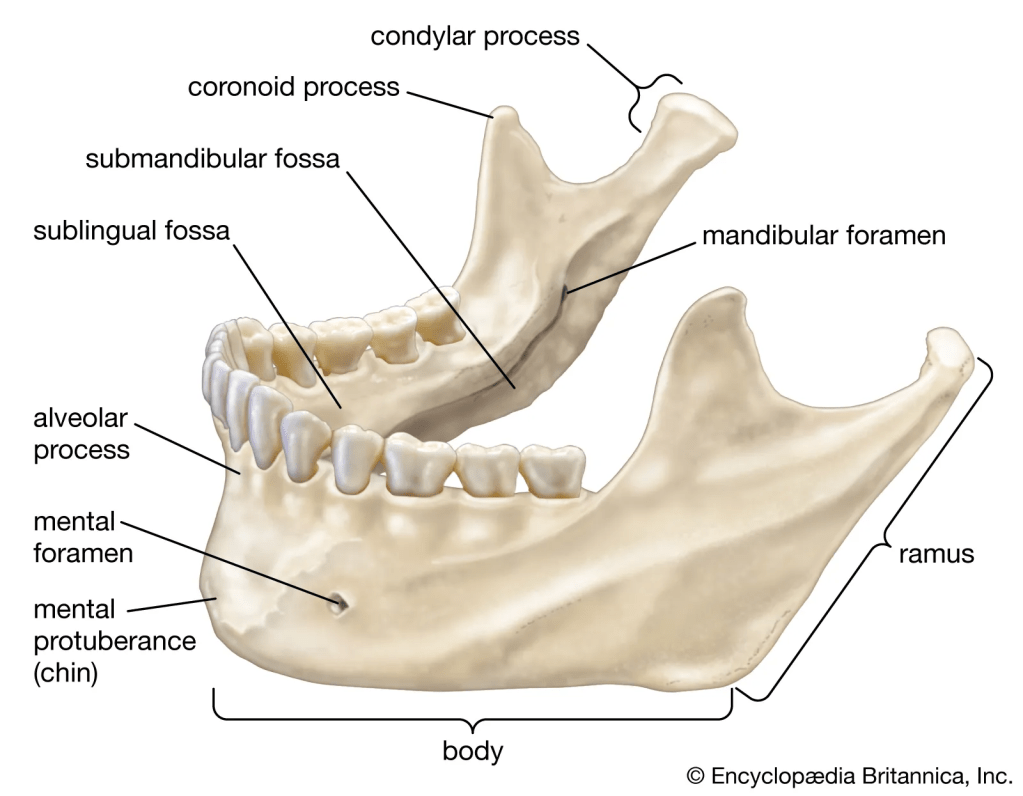
    In Cavill’s side profile, we note the presence of a lengthy ramus, which is a desirable facial feature. The term ‘ramus’ is a Latin anatomical term and may be alternatively rendered as ‘a projecting part, elongated process, or branch’. In the context of the mandible (ie the lower jawbone), the ramus refers to the posterior and partially vertical part that articulates with the temporal bone (one of the bones which constitute the skull).

    Consider the original photograph of Cavill on the left, while the photo on the right is an edited version with a shortened ramus. No prizes for guessing which photo would be perceived as more attractive.

    A lengthy ramus adds bulk and fullness to the jaw. Period. Besides one’s ramus, another facial feature of attraction is the tightness of the skin overlying the hyoid.

    In obese people who are conventionally unattractive, the excess subcutaneous fat at the hyoid area would effectively conceal the definition of the body of the mandible and cause the face to look round. On the other hand, having tightness of the skin overlying the hyoid which is seen in the above photo of Cavill demonstrates the beauty associated with having the body of the mandible well-defined.

    Next, a protruding chin is another jawline sub-feature that is attractive. The following images of Cavill best illustrate the difference been having a protruding chin and not, and this difference is night and day.

    I’ve only shared a limited selection of jaw sub-features that can be considered. The following image shows other jaw sub-features that can be considered. And this is just all under the ‘jaw’. We’ve not even covered all the important facial features!

    Midface analysis

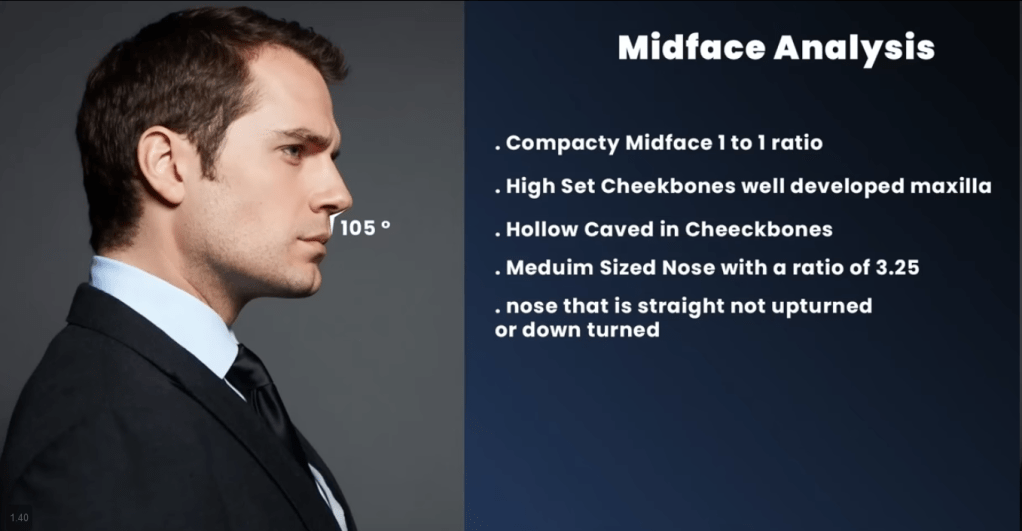
    Let’s now move on to the important sub-features of midface:

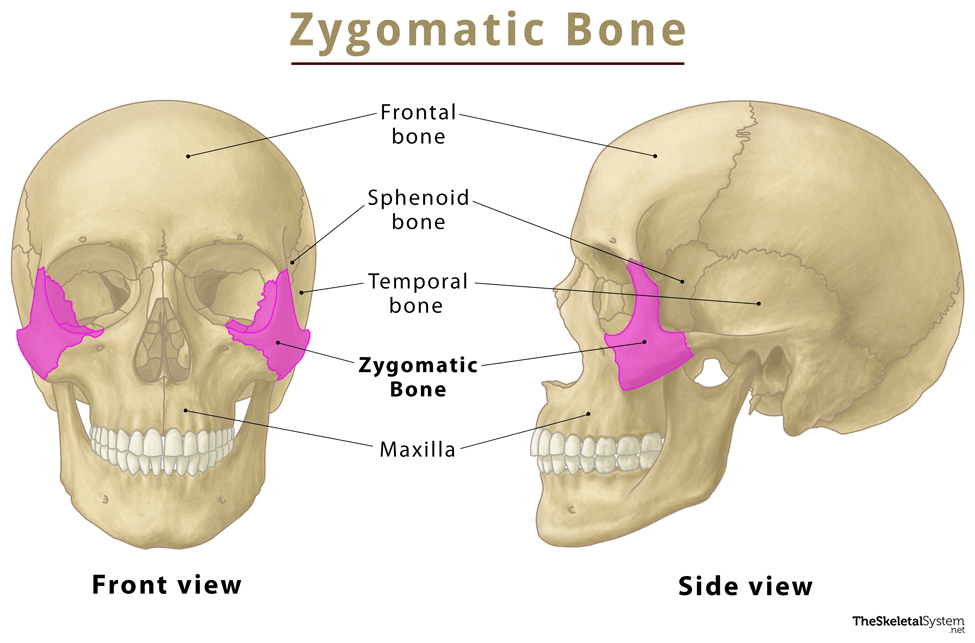
    Allow me to elaborate on some of the points mentioned in the above image regarding desirable features in a male midface. The ‘cheekbones’ constitute the layperson’s term for the zygomatic bones.

    You may frequently hear the term “high cheekbones” tossed around in magazine beauty articles and television shows. Typically, having high cheekbones means that the widest part of the face is just beneath the eyes, causing the cheek to dip in slightly beneath the bone. Particularly in people with a low body fat percentage, this dip causes a slight shadow, which further accentuates this midface sub-feature. If you go back to the earlier image of Henry Cavill, you’d see exactly this. You’d see the hollow caved-in cheekbones.

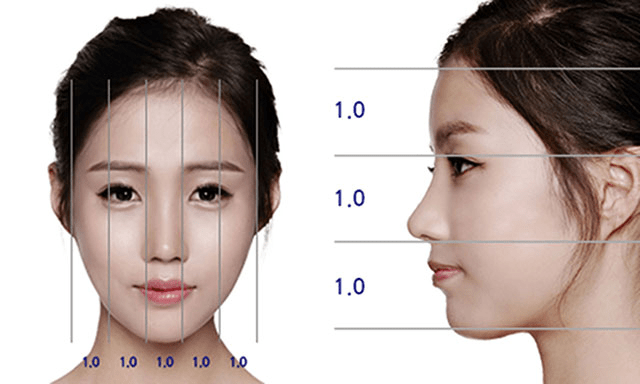
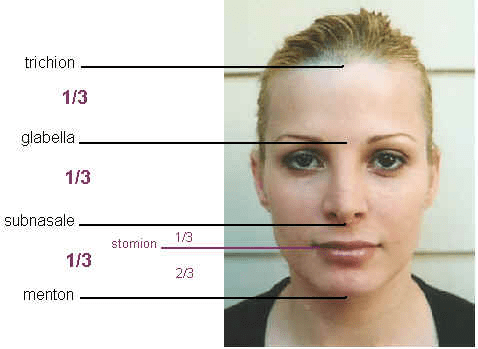
    As for the nose, it should not be too wide. Ideally, the beautiful nose is approximately a fifth of the width of the face. The following image illustrates the proportions in a female face, but the same ratios apply to men as well. In addition to the width ratios, the partitioning of the face in three different vertical segments of equal length is notable too. The distance from the trichion (the point on the skin which coincides with the intersection of the sagittal plane and the normal anterior hairline) to the glabella should be equal to the distance from the glabella to the subnasale (the point on the facial skin which represents the most inferior part of the nose), which in turn should be equal to the distance between the subnasale and the menton (the most inferior point in the sagittal plane of the chin). A picture tells a thousand words, so review the following images if you didn’t quite get what I just said!

    In fact, even for the segment bounded by the subnasale and the menton, another ideal proportion exists within it. In the image directly above, we see that the distance from the subnasale to the stomion (which represents the most superficial point of contact between the upper and lower lip along the median plane) should be half the distance between the stomion and the menton.

    Eye analysis

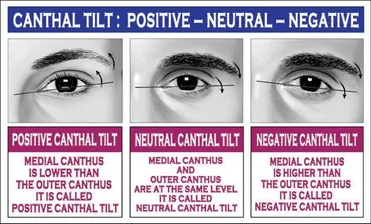
    An attractive eye would not have scleral show (i.e. you wouldn’t be able to see the bulbar conjunctiva beneath the inferior portion of the corneal limbus). Moreover, a positive canthal tilt is attractive. The following image illustrates what I mean (note that the person’s left eye is shown here):

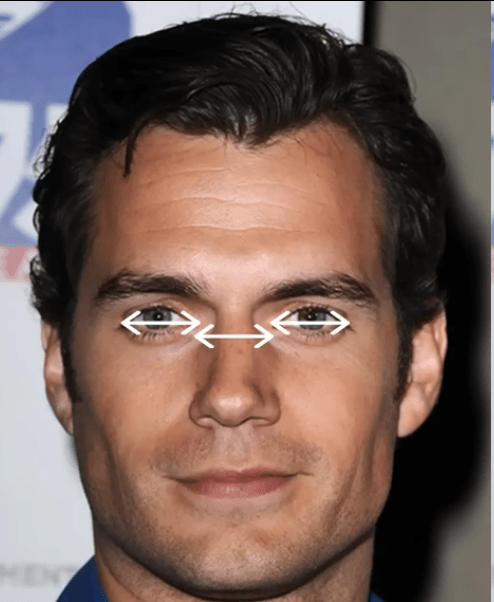
    The distance between the medial canthus of both eyes should be approximately the width of one eye:

    Eyebrows analysis

    For maximal attractiveness, eyebrows should be thick and full. They should also have a positive tilt, just as we have seen with the eyes. The eyebrows should also be close to the eyes.

    The golden ratio

    Golden ratio calculations can be used to supplement the above-mentioned analyses of different facial features in order to be as comprehensive as possible.

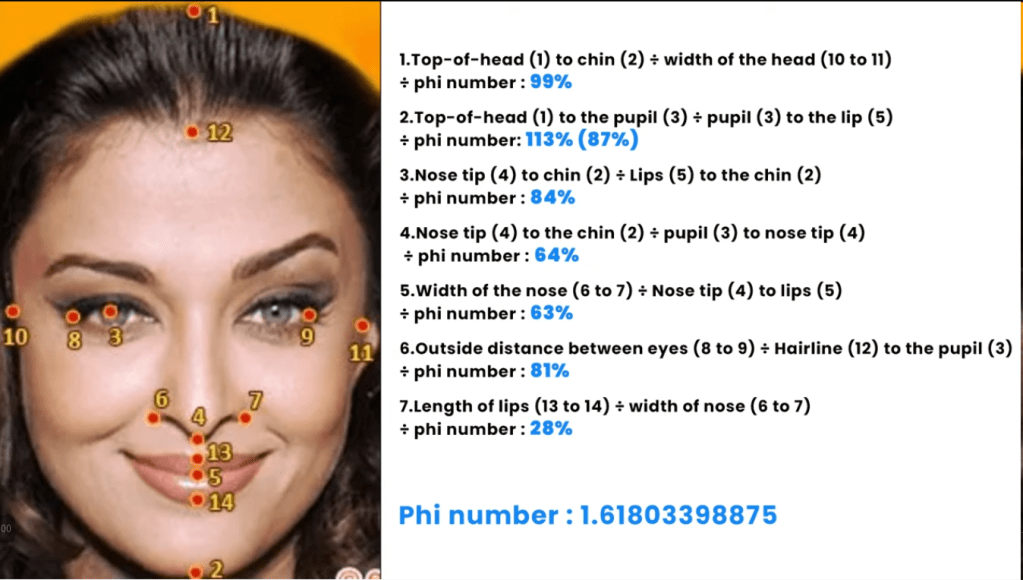
    For example, the ratio of the length to the width of your face should correspond to the golden ratio (= (1+sqrt5)/2 = 1.618…) for maximal attractiveness. For even more calculations regarding the golden ratio, consider the following image as a guide. For a particular face you select, plug the raw values into the provided formulae and churn out the answers (expressed as a percentage). A score as close to 100% as possible would suggest higher attractiveness.

    Conclusion

    A person’s facial attractiveness is more objective than most people think. If you find yourself not having some or many of the aforementioned desirable features, do not despair. The whole point of all these objective markers is to guide you in letting you know where you can improve. For instance, when you are aware of your particular face shape, you can get a particular haircut to suit it. In nearly all people, fat loss can bring out many attractive facial features (eg having a more chiseled jawline, having more prominent cheekbones with a visible inferior hollow formed by the lateral aspect of the maxillae). The countless sets of before/after images of people’s incredible weight loss journies online are a testament to this phenomenon. For those willing to undergo invasive therapy, even more options are available: hair transplant surgery, blepharoplasties, rhinoplasties.

    Some people might say that learning about all of this is so vain and that we shouldn’t even discuss these supposedly superficial things. However, in the spirit of my previous post on aesthetic medicine, I would argue yet again that learning about what constitutes an attractive face and then taking actionable steps (eg balanced diet, regular exercise) towards achieving a more conventionally attractive visage suggests that a person is committed to improving himself. This involves him putting his best foot forward in a society which is rather judgemental and unforgiving when it comes to a person’s external appearance.

    If one can take steps to make a positive tangible difference in virtually all aspects in one’s life, why not? It’s a no-brainer. Such a commitment to personal development is laudable, and should be encouraged insofar as it doesn’t adversely affect one’s mental health.

    Nic
    5 Aug 2022
  • 04(13): The secret of success according to the world’s greatest sushi chef

    Background

    What is your favourite cuisine?

    Personally, it would be Japanese (Western is a joint favourite). My love for Japanese food began at the tender age of nine, when I was granted even more daily pocket money upon advancing to being a Primary Three student at Pei Hwa Presbyterian Primary School (PHPPS). A photograph of the primary school is attached below. When I was in Primary One or Two, school sessions would occur in the afternoon, and there would be lunch and dinner at home. As for my classmates and I, we would just talk to one another and play catching in the school field.

    However, from Primary Three through Six, school sessions would occur in the morning, and it became pretty popular for my fellow classmates and I to consume food during recess time (most likely due to my peers and I now indulging in our newly-acquired increased purchasing power), in addition to the breakfast and lunch many of my peers and I would enjoy at home.

    Favourite meal at the primary school canteen

    One of my fondest memories of primary school would be that of consistently buying a particular set meal from the Japanese food stall of the school canteen during the half-an-hour recess time. The meal consisted of the following: rice, some dark brown sauce, egg, and three pieces of yakitori (Japanese skewered chicken; the Japanese words ‘yakitori’ literally translate to ‘grilled bird’). There would also be seaweed strips sprinkled over the rice and other ingredients. All of this would be presented on a translucent rectangular tray, from which I would partake of the scrumptious food.

    Sushi

    Since that first exposure to Japanese food (at worst, a simulacrum of it), I have gone on to try other aspects of Japanese cuisine as the years passed. In particular, I stumbled upon sushi, a huge component of Japanese cuisine that is responsible for the cuisine’s widespread appeal. Sushi is an element of Japanese cuisine that I deeply relish, and it is precisely what I will talk about more in this post.

    At least in the local context, authentic Japanese sushi is rather pricey as proper ingredients which are as fresh as reasonably possible, of excellent quality, often have to be imported directly from Japan. This contributes to the steep price of authentic Japanese sushi.

    The overwhelming ubiquity of ‘fake’ wasabi

    Just take wasabi as an example of the sheer value of ‘proper’ ingredients in the art of making sushi.

    The overwhelming majority of so-called ‘wasabi’ served in restaurants does not contain any real wasabi. Such ‘fake’ wasabi is manufactured from a blend of Western horseradish, mustard flour, cornstarch, and green food colouring (the green colouring is required to convince people into thinking they’re consuming ‘real’ wasabi, which is actually green in colour). Many who think they know what wasabi tastes like have never actually tasted the real stuff, unless they have gone to top-of-the-line omakase restaurants such as Shoukouwa, or other places which serve real wasabi.

    Unlike ‘fake’ wasabi, ‘real’ wasabi paste is obtained by grating the rootstalk (the technical term in botany for this would be ‘rhizome’) of the wasabi. When one grates real wasabi, the volatile compounds that confer the real wasabi its distinguished taste begin to disintegrate within minutes. That’s why real wasabi paste tastes best when it’s freshly grated. Wasabi is also considered challenging to grow, and this characteristic contributes to the vegetable’s high price. On the other hand, ‘fake’ wasabi is cheap and has a long expiration date.

    Fake wasabi has a strong taste that overwhelms any delicate fish taste on the sushi. It delivers a strong blast of spiciness that comes from the mustard flour (recall the few basic ingredients that I mentioned above regarding what constitutes ‘fake’ wasabi). On the other hand, ‘real’ wasabi accentuates the delicate taste of fish in the sushi we consume. Real wasabi is not spicy. Rather, the taste of real wasabi is more like the aroma of spiciness but without the pungent punch of the mustard flour in the fake wasabi.

    Sushi (cont.)

    It’s not just the ingredients which are considered in the art of making authentic sushi. The expertise required for making authentic sushi needs to be considered too. Proper sushi-making is an art where knowledge is possessed only by a limited number of highly skilled sushi chefs. They have skills which are rare (even rarer outside of Japan). Coupled with the high demand for authentic sushi, anyone who has undergone an introductory economics class can tell you that the potent combination of a ‘low supply and high demand’ would result in the partaking of authentic sushi being a costly activity.

    As a mere college student who isn’t swimming in multigenerational wealth, the hope of being able to enjoy authentic sushi regularly is but a distant dream. The fiscally prudent option, and what seems to be a reasonable compromise between quality and price, would be to settle for much more affordable mainstream sushi restaurants. While the experience at mainstream restaurants can never rival that of top omakase restaurants, it allows many Singaporeans the opportunity to still enjoy sushi at reasonable prices, which in my opinion, is still a great thing overall.

    Moderately inauthentic sushi is still better than not having any sushi at all.

    Jiro Dreams of Sushi

    The thing which even inspired me to write about Japanese cuisine, and sushi in particular, was a documentary I had watched yesterday afternoon entitled “Jiro Dreams of Sushi”.

    This documentary was released in 2011. As the documentary begins, we are greeted by the soothing melody of the first movement of Tchaikovsky’s Violin Concerto in D Major, one of my favourite pieces of classical music.

    When this well-known piece of classical music finally comes to a halt in the documentary, we hear the first words of the legendary sushi master, Jiro Ono.

    “Once you decide on your occupation, you must immerse yourself in your work. You have to fall in love with your work. Never complain about your job. You must dedicate your life to mastering your skill. That’s the secret of success and is the key to being regarded honorably.”

    Jiro Ono, 96-year-old sushi chef

    Jiro Ono is the Japanese chef and owner of Sukiyabashi Jiro, arguably the best sushi restaurant in the world. The restaurant can only seat up to ten people at any given time, and had earned three Michelin stars every year since 2007 until the year where it stopped receiving reservations from members of the public. Reservations are now only available to previous regulars, people with special connections, or people who book their reservations through the concierge of a luxury hotel. Sukiyabashi Jiro is no longer officially a three Michelin star restaurant because one of the guiding principles in how Michelin stars are awarded is that the eatery must be available to members of the general public.

    In the documentary, we hear from Jiro’s older son:

    “The techniques we use are no big secret. It’s just about making an effort and repeating the same thing every day. There are some who are born with a natural gift. Some have a sensitive palate and sense of smell. That’s what you call “natural talent”. In this line of business, if you take it seriously, you’ll become skilled. But if you want to make a mark in the world, you have to have talent. The rest depends on how hard you work.”

    Yoshikazu Ono, the older son of Jiro Ono

    One of the most well-known food critics in Japan speaks of Jiro, “He repeats the same routine every day. He even gets on the train from the same position. He has said that he dislikes holidays. The holidays are too long for him. He wants to get back to work right away. It’s unthinkable for most people.”

    The food critic later goes on to say (the bolded text in this paragraph and the following three paragraphs all constitute quotes by this food critic), “A great chef has the following…attributes: first, they take their work very seriously and consistently perform on the highest level; second, they aspire to improve their skills; third is cleanliness…; the fourth attribute is impatience; they are not prone to collaboration; they’re stubborn and insist on having things their own way…”

    “In France, the first Michelin guide was published in 1900. Michelin inspectors look first for quality. Next they look for originality, and finally they look for consistency. Jiro’s restaurant easily meets their standards. A perfect three-star Michelin rating means it is worth making a trip to that country just to eat at that restaurant.”

    “When Jiro got three stars, everyone was astonished. There are only 10 seats there! The restroom is outside the premises. There’s not another three-star restaurant in the world like that. But the Michelin investigators say, “No matter how many times you eat at Jiro’s, the sushi there is incredible.” They said that three stars is the only rating adequate for the restaurant.”

    “Always look beyond and above yourself. Always try to improve on yourself. Always strive to elevate your craft”.

    The climax of the documentary occurs towards the end of the documentary when it is revealed in the words of the food critic that during the first year that the restaurant was checked by Michelin, Jiro Ono didn’t make sushi for Michelin even once. Yoshikazu was the one who made sushi for them. Clearly, if Jiro permitted, Yoshikazu was skilled enough to take over the restaurant if circumstances called for it.

    Lessons for us

    Jiro Ono’s life is simply fascinating. I’ll quote him again:

    “Once you decide on your occupation, you must immerse yourself in your work. You have to fall in love with your work. Never complain about your job. You must dedicate your life to mastering your skill. That’s the secret of success and is the key to being regarded honorably.”

    His words are applicable beyond the domain of making sushi, and are incredibly inspiring.

    In my case, the question of whether medicine is the field I should have chosen to come to with the benefit of hindsight is no longer an important or relevant one. The reality is that I decided to apply for medical school with the best available information to me at the time, and here I am. I had decided that I wanted to graduate with a medical degree and procure gainful employment which would ideally capitalise on the skills I would have acquired over the course of the undergraduate degree programme.

    According to the advice of Ono, I should now immerse myself in medicine and what it takes to be a successful medical student. I have to fall in love with being a medical student. What Ono may be trying to drive across is that such passion and love for what one does comes with becoming better at what one does in the context of a positive feedback loop. This ties in well with the advice given by Cal Newport in his influential career advice book, So Good They Can’t Ignore You.

    Moreover, regarding Ono’s advice on not complaining about one’s job, though I have not graduated from medical school and started working as a doctor, I can identify moments in which I have lamented about certain aspects of being a medical student. Often, such lamentations are not constructive. A more meaningful thing to do is working diligently and humbly at improving my skills. Hopefully and ideally, this would manifest as me becoming more competent with each passing day.

    I consider myself fortunate to have encountered such advice while still a student, even before I have entered the unforgiving working world. But even if you, dear reader, are already working, fret not. This advice is still highly relevant.

    Whether we’re still in school or working, let’s focus on getting better at what we do. Don’t complain about our school or work.

    As long as we do the above with consistency over the span of the many decades which we shall dedicate to mastering our craft, I’m confident that we will have a better shot at attaining success and being regarded honourably, just like Jiro Ono.

    Nic
    29 June 2022

  • 04(12): Aesthetic medicine – does it deserve such a bad rap?

    Background

    Yesterday, I went to get a haircut and while I was en-route to the barber, I encountered a sign which advertised the list of aesthetic services offered by a GP clinic, which itself was a member of a chain of GP clinics. Interestingly, aesthetic medicine isn’t recognised as a specialty or subspecialty in Singapore. Doctors who attempt to market themselves as an ‘aesthetic surgeon’, ‘aesthetic physician’, or a similar title will have to face various penalties as this would be deemed unethical by the Singapore Medical Council.

    Anyway, on the topic of specialties, as a mere medical student, it’s still rather premature to hone in specifically on a single specialty. After all, this isn’t the US where medical students are required to pick their specialty early on. In Singapore, doctors have the flexibility to slowly discover where their interests and aptitude lie. In tandem with the advice given by senior medical students and doctors, I have decided to keep an open mind regarding what I might find myself doing in the future. Besides, as someone who is about to advance to Year 4 of medical school, there are still so many specialties that I have yet to gain exposure to in the form of clinical rotations.

    As such, besides ophthalmology, I possess a broad interest in many other areas including, but not limited to: family medicine (including aesthetic medicine), internal medicine (cardiology, dermatology, endocrinology, infectious diseases, medical oncology, neurology, nuclear medicine), pathology, radiology, radiation oncology, and otorhinolaryngology.

    In this blog post, I would like to talk specifically about aesthetic medicine. The perception of aesthetic medicine by the general public doesn’t seem to be a positive one. Most people seem to view aesthetic medicine as an exploitative field where practitioners are so fiscally oriented to the extent that it is borderline sickening.

    A late doctor’s thoughts on life, wealth, success, and happiness

    The thoughts of the late Dr Richard Teo Keng Siang (1972-2012) have amplified such a perception. You can read his thoughts on life, wealth, success, and happiness here, a webpage which offers a transcript of a speech he delivered a few months before his passing. The webpage also offers an embedded YouTube video of his speech, which was recorded eight months after he had been diagnosed with terminal lung cancer.

    For those among us who have chosen not to read the entire transcript or watch the video, the essence of Dr Teo’s speech is as follows:

    As a person from a below-average family background, he was told by the media and his peers that happiness is about success, and that success is about being wealthy. So, Dr Teo made it his goal to become wealthy. Dr Teo was a brilliant student who excelled academically, even in medical school. After graduating from medical school, he obtained a traineeship in ophthalmology, and was also awarded a research scholarship to develop lasers to treat the eye. In the process, he was able to obtain two patents: one for developing the relevant medical devices, and one for developing the lasers. Despite attaining various impressive academic accolades, he realised that these per se did not bring him any wealth. Once his MOHH bond was completed, he left for the private sector (specifically, to practise aesthetic medicine) because he decided that ophthalmology training was taking too long, and that there was much more money to be made in the private sector. He became very rich from practising aesthetic medicine. However, one day, he presented with back pain and approached his colleague at SGH for an MRI just to rule out spondylolisthesis and other ominous conditions. Unfortunately, the results of the MRI scan and subsequent investigations were not reassuring as Dr Teo had hoped. Dr Teo was eventually diagnosed with terminal lung cancer, and given a prognosis that many patients would deem highly unfavourable. He finally opines that true happiness doesn’t come from serving yourself, and that we ought not to let society tell us how to live. We ought not to let the media tell us what we’re supposed to do. We have to decide whether we are working solely for our own benefit, and/or whether you are going to make a difference in the lives of others.

    This speech by Dr Richard Teo is so well-known that I have encountered his story on three separate occasions. I remember hearing about Dr Richard Teo for the first time when I was preparing for my GCE O Level exam in my final year at Maris Stella. That was in 2013. As for the second time, I encountered it via a link that a fellow friend who was a medical student shared on her Facebook profile (this was before I deleted my Facebook account for good). Lastly, I also remember hearing it for the third time during my church’s Watchnight service on 31 Dec 2019, where the pastor shared Dr Teo’s story in an attempt to emphasise the point that much of the material possessions that we can indulge in are truly ephemeral in the light of eternity.

    With such a story to top it off, it is therefore no surprise that some people feel that aesthetic medicine is the epitome of unbridled capitalism, where people who are insecure about their physical appearance (particularly those of the fairer sex) are mere cash cows to be milked till their udders are sore. Some people even go to the extent to say that providing aesthetic services is not really medical practice. However, in my opinion, even after all that Dr Teo had said in his speech, such perceptions of aesthetic medicine are too harsh. They are too one-sided and fail to offer a balanced perspective of what aesthetic medicine has to offer.

    A careful reading of the transcript of Dr Teo’s speech would allow one to realise that aesthetic medicine is neither evil nor exploitative per se. What’s more critical is your intention that undergirds your practice of aesthetic medicine, which will manifest in your attitude towards patients, and consequently, how you treat them.

    Aesthetic medicine can offer individuals the opportunity to put their best foot forward in this society which places such an undue emphasis on one’s external appearance (like it or not). This can give patients greater self-confidence, allowing them to fulfill their potential even as they wend their way through society.

    Thus, in this blog post on aesthetic medicine, I would like to take the opportunity to briefly introduce some examples of aesthetic services that may be offered in a GP clinic. This is in no way an attempt to promote any specific clinic. Rather, undergoing the process of writing this blog post would mean that I would need to acquire a basic understanding of each of the procedures that is advertised. Ultimately, I hope to have a better understanding of those aesthetic services as aesthetic medicine is a future area of practice that I’m considering. Additionally, as an inquisitive person, it brings me great joy to learn more about things that pique my curiosity. It brings me great joy to engage in writing, and sharing what I’ve learnt with you, dear reader.

    The following image is a photograph I took of the sign:

    I shall attempt to briefly describe how each procedure within Section 6 (highlighted in pink) works, based on the readings I have done for this blog post. Note that there’s going to be some overlap between the sections as the listed bullet points are not mutually exclusive.

    Laser Hair Removal

    Laser hair removal is a procedure which involves shining a laser on the region with the unwanted hair. The light is absorbed by the melanin (a dark pigment) in the hair. Within the melanin, the light energy is converted into heat, which damages the follicles that produce the hair. This in turn impairs future hair growth. The effect isn’t permanent, though such laser hair removal effectively delays hair growth for a long time. Any hair that grows out subsequently may be shorter and thinner than before.

    Whitening & Pigmentation Treatment

    Skin whitening can be achieved via chemical peels, or IPL (intense pulsed light therapy). Chemical skin peels will be discussed in a later section.

    As for IPL therapy, which is also known as a photofacial, it is a non-surgical modality for one to improve the colour and the texture of the skin. IPL uses the energy from photons to target a certain coloured pigment on your skin. When the particular region of skin is heated, the body gets rid of the unwanted cells in that region, and that gets rid of the thing you’re being treated for. Unlike lasers, an IPL device sends out more than one wavelength of pulsating light. As such, IPL can treat a range of skin conditions at the same time.

    Nevertheless, you can’t have your cake and eat it too. Due to the use of several wavelengths at a relatively gentle intensity on your skin, multiple sessions are normally required for the desired results to be achieved. After IPL, you may look younger because your skin tone is more even. And since the light doesn’t hurt other tissue, you can get better quickly.

    As for pigmentation, the skin can either be hypopigmented or hyperpigmented. Hypopigmentation refers to having skin that is lighter than your overall skin tone. Conversely, hyperpigmentation refers to having skin that is darker than your overall skin tone.

    There are many modalities that can be employed to treat hypo- or hyper-pigmentation. These include dermabrasion, chemical skin peels, laser skin peels, and IPL.

    Laser Surgery for Moles/Warts/Lumps

    Moles, warts, and lumps are typically harmless, and patients often want them removed or at least reduced in size for cosmetic reasons. One way of achieving this is via laser surgery. However, at least for moles, lasers (which are typically CO2 lasers) are only used for small moles. This is because for larger moles, the laser would not be able to penetrate deep enough to eliminate the pigmented cells that give rise to the moles.

    Microdermabrasion

    Remember how I mentioned ‘dermabrasion’ earlier? Well, that is different from microdermabrasion. Dermabrasion is an exfoliating technique that uses a rotating instrument to remove the outer layers of skin, and as you can imagine, this is most often requested for the facial region. Immediately following dermabrasion, treated skin will display some of the cardinal signs of inflammation such as rubor (reddening) and tumor (swelling). Note that I’m not actually suggesting that a neoplasm would form as a result from dermabrasion! It’s just that the Latin word ‘tumor’ is used to refer to ‘swelling; oedema’! The skin that grows back after dermabrasion is usually smoother.

    As you may have guessed from the terms, microdermabrasion is a less aggressive form of dermabrasion. Microdermabrasion is a noninvasive cosmetic procedure which involves the doctor spraying or rubbing fine crystals onto the skin with a wand that gently exfoliates the surface, removing the top layer. The complications aren’t severe as that of dermabrasion (e.g. there’s no bleeding in microdermabrasion); however, the results of microdermabrasion unfortunately aren’t as spectacular as that of dermabrasion.

    Chemical Skin Peel

    Chemical peels work by having a chemical solution is applied to the skin to remove layers of the skin, revealing the underlying skin. There are three types of chemical skin peels: light, medium, and deep. As we go from light to deep, the thickness of the skin that is ‘peeled’ off increases. For the light skin peel, only the epidermal layer is peeled off. However, for the deep chemical skin peel, both the entirety of the epidermis and the dermis are peeled off. After the skin peel is done, the new skin underneath is often smoother, appears less wrinkled, and may have less damage.

    Note that deep chemical skin peels are really rather invasive and nowadays, they are increasingly done less in favour of laser resurfacing, which we shall soon cover in the next section.

    Laser Skin Peel & Resurfacing

    Laser resurfacing treatment involves the emission of beams of light (this is basically what a laser is) to penetrate the skin and target either pigment, haemoglobin, or water in the skin. Depending on what is targeted, different skin abnormalities can be addressed. When pigment is targeted, age spots, sun spots, and dark spots can be reduced. When intradermal haemoglobin is targeted, erythema (reddening), scars, and stretch marks can be reduced. When intradermal water is targeted, wrinkles and fine lines can be reduced.

    Radiofrequency

    Radiofrequency skin tightening involves the doctor using a handheld device that is connected to a machine that creates radio waves. They will pass the device over your body to apply radio waves to your skin. The radio waves are exothermic, and this stimulates the production of more intradermal collagen and elastin. This treatment also speeds up cell turnover, and as such, the skin gets firmer and thicker over time. The process can take about an hour, depending on how much skin you are having treated. The treatment will leave you with minimal discomfort. You may see these treatments called by the brand names Thermi, Exilis, Profound RF, and Thermage, among others. The ‘Therm-‘ prefix that you see in some of these brand names should remind you that the radio waves are exothermic!

    Botox & Skin Fillers

    We have come to what is arguably one of the most famous aesthetic services: Botox.

    Botox is the brand name for botulinum toxin, which is a substance that is produced by the bacterium Clostridium botulinum and a few other related organisms. As the name suggests, this toxin is toxic! Specifically, the toxin is toxic to the nerves. It prevents the release of the neurotransmitter acetylcholine (ACh) from axon endings at the NMJ (neuromuscular junction), thus causing flaccid paralysis. When people are infected by this organism, and experience flaccid paralysis, the disease they are said to have is botulism. It’s similar to how when people are infected by a related organism, Clostridum tetani, they are said to have tetanus.

    Unlike the experience in botulism, where the infective bacterium is rampant in the body and affecting all sorts of nerves via the unbridled spread of the botulinum toxin, Botox treatment is administered meticulously by the doctor. In Botox treatment, small amounts of the toxin are carefully delivered to specific regions via fine-needle injections.

    Based on the pathophysiology of botulism, it’s not hard to see how Botox treatment can reduce wrinkles. With the administration of Botox on the face, signals (the neurotransmitter ACh) that cause the facial muscles to contract are blocked. Temporarily, at least, this would reduce the wrinkles around the eyes and on the forehead.

    Fractional CO2 & Resurfacing Laser

    See the above point on Laser Skin Peel and Resurfacing.

    Antioxidant Treatment

    Antioxidant treatment can entail a process known as iontophoresis, which is a process of transdermal drug delivery by use of a voltage gradient on the skin. Molecules are transported across the stratum corneum (the most superficial layer within the epidermis) by electrophoresis and electro-osmosis and the electric field can also increase the permeability of the skin.

    Think of iontophoresis as basically priming the skin for receiving the antioxidant (the increased skin permeability would mean increased absorption of the antioxidant). This is one solution to the perennial challenge that cosmeceutical companies face, which is to develop products that can penetrate well enough into the human skin.

    Let’s talk specifically about Vitamin C (ascorbic acid), a well-known antioxidant. When iontophoresis is used in combination with vitamin C, absorption is effectively expedited (once again, due to the iontophoresis-induced increased skin permeability). Transdermal delivery of vitamin C via iontophoresis would improve superficial pigmentation issues such as freckles, spots, and acne.

    Conclusion

    There is a wide variety of aesthetic services that are available at many GP clinics. It is intellectual sloth to simply paint broad strokes of aesthetic medicine as an arena in which the udders of insecure cash cow patients are milked in the name of unfettered profit maximisation. Doctors who provide aesthetic services are often unfairly stereotyped as greedy and exploitative.

    At least through the lens of a member of the general public who is also a medical student, I opine that aesthetic medicine appears to possess tremendous potential as a means by which people can heighten their self-confidence, and allow them to put their best foot forward in a world which can be rather critical of people’s external appearances.

    Moreover, the practice of aesthetic medicine isn’t confined within the four walls of a physical clinic. Excellent patient management is anchored in good patient education, which in the context of aesthetic medicine would include educating the patient on the importance of having, as a baseline, a skincare routine. I challenge you to find me a single doctor who doesn’t think that consistent application of moisturiser and sunblock (even for patients without any known dermatological conditions) is good practice.

    Let’s be more open-minded and remember that health, as defined by the World Health Organisation, is ‘a state of complete physical, mental and social well-being and not merely the absence of disease or infirmity’.

    Nic
    21 June 2022
  • 04(11): Justin Bieber – a case study on facial nerve palsy and basic neurolocalisation

    Introduction

    During my first week of the IM (Internal Medicine) rotation almost a year ago, I remember being asked by a doctor to perform an examination of a particular patient’s cranial nerves. The patient had been diagnosed with Ramsay-Hunt syndrome. That encounter left an impact on me.

    Now, whenever I encounter the eponymous syndrome or read about facial nerve palsies in my medical studies, I never fail to be reminded of that patient.

    In this article, I share how I was recently reminded of that patient yet again.

    This morning, I entered my school’s medical library for my own self-study and decided to do some quick casual browsing through today’s copy of “The Straits Times” to start the day. I chanced upon a headline that caught my attention: “Justin Bieber recovering from virus, says surgeon“, as seen by the photograph I have taken of the print article I read:

    Justin Bieber? Who?

    Bieber rose to fame in the late 2000s, where uploaded YouTube videos of the precocious teenager doing some casual singing went viral and allowed him to jump-start his singing career. He is most well-known for the song ‘Baby’ which become a global hit. Whilst a secondary school student at Maris Stella, I remember that song being played nearly everywhere – in malls, etc. The song was also a means by which Bieber received a seemingly substantial amount of criticism by all sorts of people. I’m not sure whether it’s still the case, but I believe that the official music video for ‘Baby’ was the most disliked video on YouTube by absolute dislike count metrics (before YouTube officially removed videos’ public dislike count).

    The matters of Bieber don’t particularly concern me and I am neutral about his life and craft. He neither appeals to me nor attracts my disdain. In terms of music, I am simply interested in other genres of music: classical, and movie soundtrack, for example. However, it’s easy to understand why Bieber has become a target of a significant amount of online vitriol.

    Bieber is a classic example of someone leveraging online fame to cement financial success. This perhaps stokes jealousy in the hearts of many young men throughout the world who secretly aspire to achieve what he has: fame and fortune. Some people are of the view that Bieber has supposedly attained such fame and fortune because of his sheer luck and that he doesn’t actually possess the raw talent to warrant the success that he has attained.

    I don’t think Bieber’s station in life is particularly admirable, and I wouldn’t want to be in his shoes if given the choice, but the reasons for this view will not be elaborated in this article. I merely wish to introduce Bieber to readers who may not be familiar with him. He shall be the subject of our brief study on facial nerve palsies and basic neurolocalisation.

    Understanding facial nerve palsies, and a simple exercise on neurolocalisation

    The published photograph, along with a short video uploaded by Bieber himself, suggests that he has right-sided facial paralysis. This is evident from the fact that in the published photograph, Bieber is unable to close his right eyelid, suggesting the likely failure of the right orbicularis oculi muscle (the muscle responsible for allowing you to close your eyelid voluntarily) to contract. We also note a mildly asymmetrical smile that is raised on the left side of Bieber’s face, and the loss of the horizontal creases on his right forehead. These are classic features of an ipsilateral facial nerve (CN VII) palsy. In this case, Bieber has a right-sided facial nerve palsy.

    In fact, we can go one step further and determine more precisely where along the neuroaxis the lesion is located. One of the first few questions we can ask ourselves in the process of neurolocalisation is whether the lesion is an upper or lower motor neuron lesion.

    In the case of Bieber, since there is forehead involvement, his facial nerve palsy is likely due to a lower motor neuron lesion (i.e. anywhere including the facial nucleus, and the entirety of the course of the facial nerve). This is because the upper division of the facial nucleus receives bilateral upper motor neuron innervation (i.e. in a typical focal upper motor neuron lesion resulting in a CN VII palsy, the forehead muscle function would remain intact because it receives bilateral UMN innervation).

    Aetiology of Bieber’s right-sided facial nerve palsy

    In a useful set of slides I was shown by one of my clinical tutors for my Internal Medicine posting, two questions were posed to the reader regarding the approach to neurolocalisation:
    – 1) Where is the lesion?
    – 2) What is the lesion?

    Now that we seem to have reached the limits of precision regarding the level of the lesion responsible for Bieber’s clinical presentation at the present time, the next natural step in our journey of arriving at a provisional diagnosis is determining the aetiology of the lesion. This can be achieved by considering the remainder of the history that was taken of Bieber, and the findings of any physical examination that was performed on Bieber.

    Given that Bieber seems to have been diagnosed with Ramsay-Hunt syndrome (as stated in the print article), also known as herpes zoster oticus, it is not unreasonable to assume that he may have also presented with right-sided hearing loss, and/or a painful vesicular erythematous rash in and/or around his right ear.

    Note that herpes zoster oticus is different from herpes zoster ophthalmicus, a condition I mentioned in a previous blog post last year. As you might imagine, both conditions are subtypes of herpes zoster, the technical term for shingles, which in turn is a disease caused by the reactivation of the varicella-zoster virus (VZV) that would have previously infected the patient. Shingles is known for manifesting as a painful vesicular erythematous rash. In herpes zoster oticus and herpes zoster ophthalmicus, such a rash may appear on the ear, or the nose respectively.

    Let’s explore what Ramsay-Hunt syndrome entails a bit more. While the zoster rash and the facial nerve palsy are classic features of Ramsay-Hunt syndrome, other symptoms and signs may be present in a patient that has been diagnosed with Ramsay-Hunt syndrome. These include, but are certainly not limited to: vertigo, hearing impairment, change in taste, dry eyes, and dry mouth.

    I’m not able to confidently explain why a CN VII lesion leads to vertigo and hearing impairment as the affected corresponding functions correspond to CN VIII – the vestibulocochlear nerve. Nevertheless, if I were to hazard a guess, manifestations of vertigo and hearing impairment could be due to some focal lesion affecting both CN VII and CN VIII under circumstances where either both cranial nerves are in particularly close anatomic proximity or the threshold for the precipitation/formation of a space-occupying lesion that compresses both nerves is reduced.

    What I find easier to account for are the symptoms of dry mouth and dry eyes. It is known that taste to the anterior two-thirds of the tongue is achieved through the nervous innervation by the chorda tympani, a branch of the facial nerve. Thus, ageusia secondary to facial nerve palsy is certainly a possibility in Ramsay-Hunt syndrome. Moreover, CN VII is associated with parasympathetic fibres which are responsible for the stimulation of the sublingual and submandibular glands. So, I can imagine how a CN VII lesion might result in a patient having dry mouth. A similar mechanism exists for how these parasympathetic fibres which are associated with the facial nerve also innervate the lacrimal gland. As such, in a facial nerve palsy, I can also imagine how a patient might experience dry eyes.

    Of course, as a disclaimer, please don’t take what I have said in the preceding paragraphs as gospel truth. My knowledge of neuroanatomy and physiology will pale in comparison to what you’ll find in proper textbooks and the words of senior doctors and researchers. I’m merely voicing out my thought process and sharing how I think about certain conditions with the limited contextual knowledge I currently possess. There is no paucity of researchers out there who have devised hypotheses and proposed mechanisms for the above signs and symptoms – sophisticated hypotheses and mechanisms that are grounded in a more holistic, comprehensive, and nuanced understanding of neuroanatomy and physiology than what a mere medical student can possibly recall off the top of his head.

    Concluding message

    It’s been a while since I made a blog post. I hope to post more frequently and regularly. Anyway, I hope this short and simple case study involving a recent example of a celebrity’s circumstances has allowed us to learn about medical content in a more interesting way. This would probably be most helpful for medical students who are also fans of Bieber (though I’m sure they would be disappointed that Bieber has found himself in this predicament).

    Nic
    13 Jun 2022

  • 04(10): The finale of a global challenge that was held in London, and sightseeing in the city

    Background & Introduction

    **Scroll to the bottom of this post for a tl;dr summary if you’d rather not read the details!**

    In perhaps the first quarter of 2021, I encountered a fellow Singaporean medical student’s retweet on Twitter. The retweet promoted an online event, specifically a global competition for medical students, that had been organized by one of the world’s pre-eminent academic publishing companies – Elsevier. The event was entitled “ClinicalKey Student Global Challenge (CKSGC)”. In addition to publishing an entire array of journals, which is the core business of what Elsevier does, Elsevier has also ventured into other areas, and has developed products which facilitate medical education for medical students, doctors, and researchers.

    In an article I had gotten published in SMA News in July 2021, I talked about how I had used the ‘Complete Anatomy’ app for iOS as a primary learning resource for anatomy. The ‘Complete Anatomy’ app had been developed and successfully marketed with the help of Elsevier, and this app is just one of many innovative products that Elsevier has developed. ClinicalKey, like Complete Anatomy, is an innovative product and constitutes a clinical resource for medical students and doctors that had been developed by Elsevier. CKSGC is essentially a marketing campaign for the ClinicalKey product.

    A few weeks after that medical student’s retweet, my medical school sent an email to its current students: telling us of the existence of a competition for medical students. As it turned out, this was the same event which that same medical student had promoted. Given that I had now heard about this competition from two independent sources, I couldn’t help but feel that I was on to something legitimate and that I needed to check this out to satiate my curiosity.

    Some of you may be wondering who that fellow Singaporean medical student is. Well, at least at the time the retweet was posted, he was a student. He is now a junior doctor (given that he was a member of the class of 2021 at NTU LKCSoM). This person is none other than Aaron Goh. Aaron and I are similar in that he was born in the same year as me and as such, we had taken our final high school-equivalent exams in the same year. He didn’t do the GCE ‘A’ Level though. He was an alumnus of Anglo-Chinese School (Independent), better known as ACS(I) locally, and he had done the International Baccalaureate Diploma Programme. We had actually connected with each other on Twitter back then (this was way before I permanently deleted my Twitter account) due to our shared interest in ophthalmology.

    To the best of our knowledge, we were the only two students from Singapore who were engaging with medical students, doctors, and researchers from all around the world (though mainly from North America) on ophthalmology-related stuff on social media.

    But perhaps most notable is the fact that he had actually participated in CKSGC’s inaugural run in 2019. I’ll give the details soon, but in essence, Aaron had cleared the initial stages of the global challenge, and was a finalist, which meant that he earned the right to participate in the global finale which was held in London in 2019. He ended up going on to be a member of the winning team (named “Happy Red Blood Cells”; presumably due to the colour of the scrubs they were issued for the event) of the entire global challenge, So, it was also an interesting coincidence that for the second run of the event (the finale of this second run was supposed to be held in November 2021; however, it was postponed due to the unforeseen developments in the COVID-19 pandemic) which I participated in, my team was issued scrubs of the same colour – fuchsia. We also coincidentally named our team after a type of cell (though the previous winners’ team name had no influence on our decision to name our team after a type of cell). However, instead of naming our team after erythrocytes, we called ourselves “The Astrocytes”. Like Aaron’s team, our team then went on to win the global challenge.

    What exactly is Elsevier CKSGC ’21 and how were the 16 finale participants selected?

    The structure of the Elsevier CKSGC is as follows: four question rounds (Rounds 1-4), one video submission round (Round 5), and the finale where finalists, Elsevier staff, and panel of content experts come together at some location in the world where Elsevier has a major presence.

    How it works for the initial question rounds is that to be eligible for the next round, you need to either score full marks on the current round, or score at least 10% more than your previous round’s score. Each round has 25 questions which vary in difficulty level and are written in the style of USMLE (United States Medical Licensing Examination) questions. As you might imagine, the latter criterion is easier to achieve than the former. Each round needs to be completed within 40 minutes. According to the official rules, everyone clears Round 1 successfully and advance to take Round 2 by default.

    The four question rounds commenced on 17 April 2021, and lasted for four weeks. When each new round commenced each week, the questions went live for three days, and students were able to access results and additional learning materials as they progressed.

    People who clear round 3 successfully are known as quarter-finalists. People who clear round 4 successfully are known as semi-finalists.

    For the relatively low proportion of students who clear all four question rounds, they would get the opportunity to undergo a video round, where these semi-finalists would submit a four-minute video recording of themselves in which they would answer three questions on the topic of leadership in medicine. All the semi-finalists who submit their videos would have their videos reviewed by an expert panel.

    For the Elsevier CKSGC ’21, the expert panel consists of, in no particular order, Dr Ted O’Connell, Dr Ryan Pedigo, Dr Hao-Hua Wu. It may consist of other people that I’m not aware of, but these are the people whom I know for sure are on the panel.

    In each video, CKSGC participants need to provide their responses to three questions pertaining to leadership in a medical scenario. Each member of the expert panel judges each participant’s response to the questions, giving a numeric score for each prompt. The mean of all the panel members’ assigned numeric scores for the prompt is then calculated. Lastly, a candidate’s final ‘numeric score’ for the video round is determined via some form of average of the average numeric scores obtained for each of the three prompts. Participants are ranked in order of their final ‘numeric score’ for the video, and the top students with the highest scores would be selected as finalists.

    In total, 15 finalists were chosen from among the pool of 7,500+ medical students from 100+ countries who had participated in the Elsevier CKSGC ’21. A similar challenge that was specific to India had been held, and the winner for that country-specific challenge was Ms Mitul Suhane. She had won the Grand Prize of the ClinicalKey Student India National Challenge 2021. Though she hadn’t participated in the CKSGC to become a finalist in the traditional manner, the fact that she was the Grand Prize winner of her country-specific challenge meant that she received a ‘Golden Ticket’ and this automatically qualified her for the CKSGC finals. As such, with the inclusion of Mitul, there would be 16 participants for the Elsevier CKSGC ’21 finale.

    London – Day 1 of 5 – 21 April 2022 – Thursday
    I departed Singapore on 20 April 2022, 2330 hrs and arrived in London at Heathrow Airport on 21 April 2022, 0555 hrs. It was great. Thursday was a day to ease in into things. Elsevier had actually allowed me to fly in to London one day earlier than most other participants given that I was coming from Singapore via a long 14-hour flight, given that the first official component for the finale would be the meet-and-greet at a bar that would occur at 2:45 pm on 22 April 2022.
    I was picked up by a driver from Heathrow Airport and fetched to Travelodge London City. During non-peak hours, the journey would take around 30 mins. However, at the time we actually made the journey, the roads were congested and the navigation app predicted that we would take over 1.5 hours to get there. As it turned out, when I tried to give my details to the counter at the lobby of Travelodge London City, I realised that I had arrived at the wrong Travelodge branch. However, by the time I went outside of the Travelodge building to notify the driver in an attempt to get him to drive me to the correct location, I realised that he already vanished. The correct Travelodge branch was an 18-min walk away. Although I was advised to just book a cab there (I was promised reimbursement) by the point of contact, I figured that I’d just walk the distance. It was good exercise anyway. I didn’t have much stuff with me too. All I had to carry was just my simple carry-on bag and my check-in luggage that weighed about 8 kg.

    When I reached the correct Travelodge, it was still too early for checking into my room (the standard check-in time was 3 pm). So, I decided to deposit my luggage with the counter and headed off for lunch at Dishoom Shoreditch, which had been recommended by someone who had been to London and enjoyed the food there. At Dishoom, I ordered the Garlic Naan + Mutton Pepper Fry (which came with three types of spices as seen in the saucers in the image below) + Chocolate Chai (which to my pleasant surprise, is refillable).

    For the rest of the afternoon, all I did was sightseeing. I didn’t use public transport and instead got around purely on foot and ended up walking 20k steps (according to the ‘Health’ app on iOS).

    For this first day, I visited some landmarks. The first place I decided to head to Tower Hill, followed by Tower of London. Then, I saw the beautiful Tower Bridge, which I learnt was not London Bridge!

    I saw the actual London Bridge later that day, and found it quite underwhelming. It’s the former bridge that’s more iconic! We can only blame the popular nursery rhyme (‘London Bridge is Falling Down’) for this highly prevalent misconception. Later on, I visited the ‘All Hallows By The Tower’ church, the oldest church in the ‘City of London’.

    I signed in the church’s visitor book on 21 April 2022, Thursday. Be sure to also do so if you’re gonna visit London too!

    I then walked to St. Paul’s Cathedral, the venue of the wedding of Prince Charles and the late Princess Diana. They had gotten married in St. Paul’s instead of the more traditional Westminster Abbey because the former could accommodate a greater number of guests that they wished to invite. Isn’t the dome of the church simply magnificent?

    Once I was done visiting St. Paul’s, I walked back to the vicinity of London Bridge. Look at the following photograph – a panaromic shot of London Bridge with The Shard (tallest building in the UK, standing at just above 300 m) in the background. Wouldn’t you agree that it’s underwhelming compared to Tower Bridge?

    It was at point that I decided that I had done enough and that I wanted to rest for the day. So, I made my way back to Travelodge London Central City Road. I passed by the Bank of England along the way. I had dinner at Travelodge, and took the rest of the night off.

    London – Day 2 of 5 – 22 April 2022 – Friday

    I woke up early. I had a buffet breakfast at my accommodation, and began my morning walk to King’s Cross Station (3 km away). I mostly walked along City Road, and passed a number of notable locations. Early on in my journey, I passed by the residence of John Wesley. Wesley was the leader of the Methodist movement, which ultimately gave rise to the Methodist denomination of Christianity. In fact, the largest and oldest Methodist church in Singapore is named after him: Wesley Methodist Church. Futher along my way on City Road, I soon encountered Moorfields Eye Hospital.

    It would be a dream come true if I could work or conduct research here in some capacity in the future given my current interest in ophthalmology. Moorfields Eye Hospital, together with the UCL Institute of Ophthalmology, is the oldest and largest centre for ophthalmic treatment, teaching, and research in Europe. According to the hospital’s Wikipedia article page, the hospital will apparently be relocating to a new location near King’s Cross railway station and that the present building has been sold to private developers.

    Dr Vivian Balakrishnan, Singapore’s Minister for Foreign Affairs since 2015, had worked here from 1993 to 1995 as a senior ophthalmology registrar, where he had subspecialised in paediatric ophthalmology. It was after he completed his stint here that he returned to Singapore and was appointed a consultant ophthalmologist at SNEC and NUH. Many well-known people in ophthalmology are associated with Moorfields in one way or another. Another example I can cite is that of the late Dr Robert Marcus Gunn, who had worked as a house officer at Moorfields. He was a Scottish ophthalmologist after whom the eponymous Marcus Gunn pupil (a clinical sign that may be seen in patients with multiple sclerosis or severe retinal disease) is termed.

    Soon, I arrived at the famous London King’s Cross station.

    London’s King’s Cross station is one of the busiest train stations in the whole of the UK, and is also well-known for being the filming location of the first of the Harry Potter movie series, where the ‘Platform 9 3/4″ had been featured. Adjacent to King’s Cross is St. Pancras International Station (see the following image), the London terminus for the international high-speed railway service to continental Europe.

    I walked a bit within St. Pancras International Station and found two public pianos. I tried playing both of them but unfortunately, the keys’ action on both pianos were in a pretty terrible state. It’s this way probably due to the lack of maintainance and the fact that it is subject to the wide variation in temperature and humidity on all days throughout the year. The fact that London has four seasons does not help at all.

    Soon, I left St. Pancras and headed to the nearby British Library.

    Then, I walked to Great Ormond Street Hospital (formerly known as the Hospital for Sick Children). One of the reasons I had decided to visit this place was that my mentor (who has had a significant impact and influence on my life) had undergone specialty training here many decades ago. The hospital is closely associated with University College London (UCL) and in partnership with the UCL Great Ormond Street Institute of Child Health, which is adjacent to it, is the largest centre for research and postgraduate teaching in children’s health in Europe. Think of it as the Moorfields of the paediatric realm.

    From what I had seen at the entrance of the hospital, I learnt a number of things: 1) that Elizabeth II had visited the hospital in 2002 to commemorate the hospital’s 150th anniversary as part of the Golden Jubilee celebration of her accession (she was coronated in 1952 after all).

    NB: As a brief summary to those who aren’t familiar with the concepts of jubilees, a golden jubilee is a celebration of a 50th anniversary. Silver, ruby, diamond, sapphire, and platinum jubilees correspond to 25th, 40th, 60th, 65th, and 70th anniversaries respectively. Elizabeth II is the first British monarch to have had a sapphire and platinum jubilee.

    Moreover, did you know that Sir James Barrie, the novelist and playwright best known for the creation of Peter Pan, actually donated the copyright of Peter Pan to the hospital? It is thus not totally surprising that Peter Pan-related statues can be found at the hospital entrance.

    After this, I walked to the British Museum, the world’s oldest national public museum. It was established in 1753, 23 years prior to the ratification of the US Declaration of Independence.

    Following the stop at the British Museum, I walked to Piccadilly Circus (this hyperlinked website mistakenly writes that the statue that surmounts the Shaftesbury Memorial Fountain is that of Eros, when the statue is actually that of Anteros). Here is a photograph is of me at the fountain. Piccadilly Circus is basically the London-equivalent of Times Square. Pretty cool.

    After Piccadilly Circus, I walked to nearby Trafalgar Square, a public square in central London.

    This is a photograph of me and Nelson’s column in the background. Constructed in the 1840s, the column is a monument in Trafalgar Square to commemorate Admiral Horatio Nelson, who died at the Battle of Trafalgar in 1805.

    Also within Trafalgar square is the National Gallery that was founded in 1824. Majestic, isn’t it?

    After this, I decided to walk towards Buckingham Palace and had a photo taken at Admiralty Arch. Its construction had been commissioned by Edward VII in memory of his mother, Queen Victoria. The Latin inscription says: In the tenth year of King Edward VII, to Queen Victoria, from most grateful citizens, 1910.

    Then, as I was en-route to Buckingham Palace, I spectated the Changing of Guard which was happening.

    The photograph is that of me and both Buckingham Palace and Victoria Memorial in the background.

    Look at the crowd! I’m sure it was worse than this pre-COVID. And this isn’t even the peak period! And this was on a Friday – not even a weekend!

    After Buckingham Palace, I walked all the way to Westminster Cathedral.

    One of the things I appreciate about having learnt basic Latin previously is that I can make out random neat inscriptions. The inscription reads: Lord Jesus, King and Redeemer: by your blood, save us! Do you see the Latin word ‘sanguinem’ there? It’s whence we get our English words ‘sanguine’ and ‘exsanguinate’.

    It’s important not to confuse Westminster Cathedral with Westminster Abbey. One church is Roman Catholic, and the other is Anglican! After the former, I walked to the latter. Westminster Abbey is one of the UK’s most notable religious buildings and the traditional place of coronation and a burial site for English and British monarchs. Since the coronation of William the Conqueror in 1066, all subsequent monarchs have had their coronation at Westminster Abbey.

    After Westminster Abbey, I walked towards Elizabeth Tower (commonly known to the general public as ‘Big Ben’). In my readings, I learnt that the tower had actually been originally named simply as ‘Clock Tower’ and had been renamed ‘Elizabeth Tower’ in 2012 as part of the Queen’s Diamond Jubilee Celebrations (do you remember that little mini tip on jubilees I gave earlier? hahaha). Strictly speaking, the term ‘Big Ben’ is a nickname for the large central bell at the top of the tower that chimes on the hour. Big Ben is surrounded by four smaller bells which chime every 15 minutes.

    I was very fortunate to be visiting London in end-April 2022 as the renovation for Elizabeth Tower is almost complete. For the past five years, it has actually been undergoing significant maintainance, which meant that for most of the past five years, a significant proportion of the exterior of the building, and the clock mechanism was shrouded in scaffolding. Thus, I am grateful for the present opportunity to view the entirety of Elizabeth Tower in all its splendour. To protect the hearing of the on-site workers and for practicality’s sake, the routine chiming of the bells has also been halted except on special events such as New Year’s Eve.

    It’s such an iconic symbol of London, and I would argue that it’s even more well known than Tower Bridge. Show anyone an image of Elizabeth Tower, and he’ll know it’s London.

    Here’s me crossing Westminster Bridge and having a photograph of me and Elizabeth Tower taken from another angle.

    From Westminster Bridge, one can see the London Eye.

    This was my last stop on my sightseeing journey for Friday morning. I had walked so much (25k steps on the whole of Friday according to my ‘Health’ app; I hadn’t used any form of public transport in the UK by this point as I had not been issued my Oyster card with 10 pounds of stored value by the Elsevier staff). After this, I headed to a nearby Japanese restaurant where I enjoyed delicious Osaka street food at OKAN South Bank. Specifically, I opted to partake of the ‘Okan Special Okonomiyaki’.

    After the main course, I decided to have the Matcha Basque Cheesecake for dessert. It was absolutely delicious and satiating – both the main course and the dessert.

    Finally, it was time to attend the first official event of the leadership summit, the main reason I had come to London. It was a meet-and-greet session at a pub – Smiths of Smithsfield. The following photo is that of me and the other participants in the finale.

    What a great day this was. Simply unforgettable.

    London – Day 3 of 5 – 23 April 2022 – Saturday

    The participants and I walked from our accommodation to Elsevier’s London office at 125 London Wall. Here is a photograph of us checking in at the lobby of the office.

    They had prepared for us a wonderful breakfast. Incredible.

    Just look at that wall. How often is it the case that one’s name can be found on a wall?

    After breakfast, we had an ice-breaker activity, followed by a short break, where we were all offered decadent chocolate and vanilla cupcakes. There were other miscellaneous activities, and the day ended with an ‘Amazing Race’ where each group of four would go to various landmarks within London based on certain clues…

    At the end of the Amazing Race, my team walked the Millennium Bridge (as seen in this photo). Straight ahead in the photo is St. Paul’s Cathedral. Millennium Bridge is so named because it opened in June 2020. According to its Wikipedia article, “Londoners nicknamed it the “Wobbly Bridge” after pedestrians experienced an alarming swaying motion on its opening day. The bridge was closed later that day and, after two days of limited access, it was closed again for almost two years so that modifications and repairs could be made to keep the bridge stable and stop the swaying motion. It reopened in February 2002”

    My team didn’t win the Amazing Race. Nevertheless, I still had a highly enjoyable time in the evening as all gathered back at a pub. As someone who abstains from alcohol, I would either only consume cold water or apple juice at most. I did help myself to the canapes, the fries, and other food though. Absolutely sumptuous dinner.

    London – Day 4 of 5 – 24 April 2022 – Sunday

    This was the day of the finale. Exciting. Early in the morning, we were transported by bus to a location somewhat far away – the University of Greenwich! Please note how ‘Greenwich’ is pronounced. Many people pronounce it wrongly!

    In the following photograph, the scrubs I am wearing were issued by the Elsevier team. Each team of four had its own corresponding colour of scrubs. My team happened to be assigned scrubs of the fuchsia colour. And yes, look how large that wall is. It’s just incredible.

    This is my team of four (we named our team “The Astrocytes” because of some of the team members’ interest in neurology and how we “reach for the stars”).

    This photograph is that of me and Aaron (the person from whom I had first heard about this event):

    After the finale, we were transported back to London where we had an early dinner at a pub. This was where it was announced that my team had won the finale.

    I was pretty ecstatic as I wasn’t expecting the win at all. In fact, just making it to London on a fully-sponsored trip had already fully exceeded my expectations. Anyway, allow me to share some of the few photographs that I had taken.

    The following is that of me talking to Dhruv Tuteja (a medical student from India) and George Garratt (a medical student from the UK; he’s studying at the University of Leicester).

    A photo of George and I. I enjoyed talking to him a lot throughout on this trip.

    This is Mitul Suhane. She’s a medical student from AIIMS (All India Institutes of Medical Sciences) Raipur, one of the top medical schools in India. She topped the entire Elsevier CK Student National Challenge in India in 2020.

    A photo of Dhruv, George, Mitul, and I:

    Lastly, I managed to have a photo taken of me and Dr. Hao-Hua Wu, a final year orthopaedic surgery resident at UCSF, and one of the members of the expert panel that had assessed the video submissions (if you remember what I had said earlier). He had gone to Penn (an Ivy League school) for medical school. Really brilliant person. It was actually on this fateful Sunday afternoon/evening, from talking to him, that I learnt more about the book publishing process and his journey of co-authoring multiple books. In fact, he’s currently working on coauthoring a book on leadership in medicine with this year’s ClinicalKey mentors: Aaron and Maria (another person who was on the same team as Aaron in CKSGC ’19).

    On that evening, I met with my parents for dinner at a Vietnamese restaurant. And yes, my parents were in London at that point. They had arrived in London a day after I did and departed a day after I did.

    London – Day 5 of 5 – 25 April 2022 – Monday

    Well, all good things come to an end. Finally, the day had come for me to depart London.

    For lunch, I went to Flat Iron (a dining venue that had been recommended to me by someone who had been to London some years back), a steakhouse near my lodging. I took a direct bus there with my parents because they simply refuse to walk there! I had lunch with my parents, and I must say that I enjoyed the experience a lot. Over there, I ordered the ‘Flat Iron Steak’, not that there were many alternatives LOL.

    What made the dining experience unique was that at the conclusion of our meal, we were handed these mini metal cleaver trinkets, similar to the ones that you would play with at a game of Monopoly. I’ll leave you to read for yourself how it works in the following image.

    The ice cream was amazing! The original plan was actually to head to a ‘Greedy Goat Ice Cream‘ shop, an independent stall within Borough Market that sells ice cream made with goat’s milk. Well, as it turned out, Greedy Goat was closed on that Monday. It all worked out in the end.

    After the ice cream, I got the opportunity to further experience the London public transport system for what it is. Having been born and raised in Singapore, I was quick to notice many aspects of the underground rail system that were pretty lacklustre compared to what I was accustomed to. However, it would not be totally fair to criticise the London rail system because it is after all the world’s oldest rail network. They have had to modernise and work from infrastructure that is pretty old. On the other hand, in the city-state, we have had the opportunity to learn from the mistakes made by other countries and construct a world-class transport system in the modern era with the assistance of the latest technology. This reminds me of the opening paragraphs of Francis Scott Fitzgerald‘s magnum opus, The Great Gatsby, where the narrator recounts the advice that he had been given by his father: that whenever he feels like criticising anyone, he should remember all the people in the world that haven’t had the advantages he has had.

    Eventually, I boarded an arranged transport vehicle (along with a fellow member of “The Astrocytes” who also had to be at the airport at around the same time as me) opposite Travelodge at 4:30 pm. My flight’s departure from Heathrow was scheduled to occur at 8:50 pm.

    We both sat in the rear passenger seats and had an enjoyable 1.5-hour conversation as we travelled to the airport. This was the final photograph I took in London. After this photo, we parted ways as she headed to Terminal Three while I remained in Terminal Two.

    My short stay in London has been a highly memorable one, and I will certainly cherish all that I’ve learnt and experienced here for the remainder of my life!

    Nic
    2 May 2022


    Tl;dr – A summary of my 5D4N experience in London

    I had chanced upon information on an event entitled “Elsevier ClinicalKey Student Global Challenge” that was being promoted on Twitter by a friend. A few weeks later, I received an email from my medical school which informed its medical students of the existence of that same event. So, given that I had obtained information about the event from two independent sources, I decided to satiate my curiosity by visiting the event’s website. The event was essentially a competition amongst current medical students from all around the globe. The first run had occurred in 2019, and is expected to run annually. However, last year’s run was the second run instead of the third because the 2020 run was suspended in view of the pandemic. I decided to participate in the competition, and made it through all four multiple-choice-question rounds, and successfully cleared the video round, which earned me a ticket to the world finale, which would be held in London in April 2022. The finale took place over a weekend. There were four teams consisting of four people each. My team was named “The Astrocytes” given some of our team members’ interest in neurology and how we ‘reach for the stars’. Our team turned out to be champions!

    I had departed Singapore on 20 April at 2330 hours, arrived in London on 21 April at 0600 hours. I then departed London on 25 April at 2050 hours, and arrived in Singapore on 26 April at 1655 hours. In addition to the official leadership summit that had occurred over the weekend, I did some sightseeing as it was my first time in the UK. I visited many famous attractions and had an enjoyable time. In sum, the Elsevier CKSGC 2021 provided me the opportunity to network with many brilliant medical students, mentors, and doctors from all around the world. They shared stories of their incredible journeys and their insights, which I deeply appreciate. To say that some of their stories was inspiring is such a sheer understatement. They make me want to become the most successful person I can be, a person who can be a significant positive influence in whatever domain he finds himself in.

    This has been an incredibly fulfilling experience, and I hope to stay in touch with the people I met at this leadership summit, even as we go about attaining professional success in our separate ways.

  • 04(09): Evolving views on social media

    The main body’s text was originally published on 27 April 2022. However, my views on social media yet again and with respect to that, I published an update (on 1 May 2022) that can be found at the bottom of this post.

    Frequent visitors to my site would notice that just a few days ago, I updated my website’s main page to include a number of icons which are essentially hyperlinks to my profile on various social media platforms. This is almost a complete departure from my previous stance which I held for a relatively decent amount of time (about 14 months), where I had been highly sceptical of the utility of social media platforms. Why the sudden change, you may ask?

    Background

    I’m on a journey of being intentional about my use of these platforms in view of my desire to engage in deep work as part of the ongoing pursuit of the deep life. To better comprehend the aforementioned italicised terms, check out two books by Cal Newport: Deep Work and Digital Minimalism. Both books have significantly shaped my views on how we ought to lead our digital lives, and work in a world where constant distraction and fragmented attention spans are the norm.

    I had first gotten to know about Cal Newport’s views in December 2020 through a YouTube video where he had given a TED talk entitled “Quit social media”. I found his arguments so convincing that I made a radical decision to permanently delete my accounts on many social networking sites. At that point in time, I had never made an Instagram account; so, there was nothing to delete. I permanently deleted my decade-old Facebook account, and my Twitter account. Since I took those actions, I’ve remained sceptical of the utility of social media, given the widely-known adverse effects that it can have on individuals’ mental health and productivity at work and school. I was simply of the opinion that the drawbacks associated with social media use far outweighed their benefits.

    An epiphany that I had after attending a leadership summit

    However, my experience at a leadership summit in April 2022 has caused my views on this matter to evolve. I realised that I might have blindly taken Cal’s words as gospel truth and that trying to replicate what Cal does in his own life to a tee isn’t something I should necessarily do; we both lead rather different lives after all. At the summit, I had conversations with the other participants on this matter. I have also learnt of their journeys more broadly, and how social media played a part in their professional success. Strategies for professional success should be personalised. It was incredibly inspirational. As such, my views on social media platforms have now become more balanced and nuanced. Does this mean that I regret espousing certain views in the past or executing certain actions? No. The actions of the past have contributed to the person I am today. If anything, this just demonstrates that the process of learning and growing is a journey. For the sake of enhancing my ability to network, seize opportunities, and attain professional success, I now opine that social media can (but whether it should ought to depend on one’s specific circumstances) be used in a manner that allows me to capitalise on its benefits while minimising its drawbacks.

    The only reason I even participated in the leadership summit in the first place was that I first encountered information pertaining to it on Twitter. If I hadn’t possessed a Twitter account at that point in time, it is likely that I would have missed out on the opportunity of participating in the event that ultimately enabled me to attend the leadership summit. In my next blog post, I will elaborate on the specific details on how this occurred.

    The key to taking advantage of the benefits of social media while avoiding its downsides lies in intentionality, self-awareness, and discipline. For instance, two people can have an Instagram account but use it in absolutely different ways. One person could be responding instantly to virtually every minor notification and squandering his time on scrolling through news feeds mindlessly. On the other hand, another person could carefully curate the list of pages he follows and remain intentional and disciplined when using the platform.

    As such, since the conclusion of the leadership summit, I have decided to re-establish my long-foregone social media presence (e.g. creating an Instagram page and recreating a Twitter account a few days ago) as I now firmly believe that judicious and intentional use of social media platforms can allow me to put my best foot forward and help me maximise my professional success by establishing my personal brand. With that said, I’m not sure how active I’d be on these other platforms though. For now, I mostly use those platforms as a way of redirecting people back to my personal website, which is my hub for my CV, blogging, and other information pertaining to me.

    My views on social media will likely continue to evolve, but for now, I’m happy with what it’s currently at. I’m constantly learning. Please reach out to me if you have other perspectives that you would like to share.

    Nic
    27 April 2022


    [UPDATE on 1 May 2022: Well, it’s been almost a week since I decided to start maintaining accounts on Facebook, Instagram, and Twitter. Today, I decided to permanently delete/deactivate my accounts on these three platforms. If all goes smoothly, then my accounts on these three platforms will be permanently deleted with effect from 31 May 2022. I think I’m going to revert to my initial stance after all.

    The great thing about having had this week of experimenting with social media is that I am able to more objectively assess first-hand the benefits and disadvantages associated with social media use, as the initial hype associated with the weekend when the leadership summit had occurred would have dissipated.

    So far, these platforms have not been able to persuade me to use them for the long-term. Perhaps, my mind will change for good some time in the future, but now is certainly not that time. These social networking sites have to be able to convince me that the benefits they offer significantly outweigh their current baseline stance as sources of mindless entertainment before I decide to turn to them again.

    Some people might ask, “But Nic, what about the example you gave regarding being able to participate in the leadership summit in the first place because you encountered the information on Twitter first?” Well, the thing about that is that in reality, my medical school still reached out to me with information pertaining to that event. So, strictly speaking, I would have still heard about that event even without having a Twitter account. But even if my medical school hadn’t circulated such information, I would argue that I would still be be better off without Twitter and social media in general in the long run. This is because we must be wary of the any-benefit mindset (a concept I elaborated on in a previous blog post where I shared my favourite snippets from Cal Newport’s Digital Minimalism) that is becoming increasingly prevalent in today’s society.]

  • 04(08): Notable snippets from a second read of Cal Newport’s “Digital Minimalism”

    Last night, I completed my re-reading of Cal Newport‘s “Digital Minimalism”. The book is incredibly relevant to practically every soul whose life involves the use of, to any extent, devices such as smartphones, computers, etc.

    I realised that when I had read the book for the first time last July, I failed to note down some of my favourite snippets of text along the way for the entirety of the book. I had stopped halfway. As such, I recently decided to commit to reading the book again, and this time, I would note the snippets I found to be the most interesting and insightful (note that any bolded text and the capitalisation of whole words constitute emphasis which are mine), which I hope you can benefit immensely from:

    PART 1: Foundations

    1-1. A Lopsided Arms Race

    Seemingly small environmental factors create large changes in behaviour:
    – Wearing a red shirt on a dating profile will lead to significantly more interest than any other colour.
    – If your name is easier to pronounce, you’d advance faster in the legal profession.

    Tech companies encourage behavioural addiction via two ways:

    1. Intermittent positive reinforcement

    As Harris notes, the notification symbol for Facebook was originally blue, to match the palette of the rest of the site, “but no one used it.” So they changed the color to red—an alarm color—and clicking skyrocketed.

    2. Drive for social approval

    1-2. Digital Minimalism

    Digital minimalism may be defined as “a philosophy of technology use in which you focus your online time on a small number of carefully selected and optimized activities that strongly support things you value, and then happily miss out on everything else.”

    —

    The so-called digital minimalists who follow this philosophy constantly perform implicit cost-benefit analyses. If a new technology offers little more than a minor diversion or trivial convenience, the minimalist will ignore it.

    —

    Notice, this minimalist philosophy contrasts starkly with the maximalist philosophy that most people deploy by default—a mind-set in which any potential for benefit is enough to start using a technology that catches your attention. A maximalist is very uncomfortable with the idea that anyone might miss out on something that’s the least bit interesting or valuable.

    —

    …the best digital life is formed by carefully curating their tools to deliver massive and unambiguous benefits. They tend to be incredibly wary of low-value activities that can clutter up their time and attention and end up hurting more than they help. Put another way: minimalists don’t mind missing out on small things; what worries them much more is diminishing the large things they already know for sure make a good life good.

    Digital minimalism works because of its three core principles:

    Principle 1: Clutter is costly.

    Digital minimalists recognize that cluttering their time and attention with too many devices, apps, and services creates an overall negative cost that can swamp the small benefits that each individual item provides in isolation.

    When people consider specific tools or behaviors in their digital lives, they tend to focus only on the value each produces.

    More often than not, the cumulative cost of the noncrucial things we clutter our lives with can far outweigh the small benefits each individual piece of clutter promises.

    Principle 2: Optimization is important.

    An argument for Principle #2: The return curve

    Principle 3: Intentionality is satisfying.

    The Amish, it turns out, do something that’s both shockingly radical and simple in our age of impulsive and complicated consumerism: they start with the things they value most, then work backward to ask whether a given new technology performs more harm than good with respect to these values.

    —

    What Laura describes modestly as smugness is almost certainly something more fundamental to human flourishing: the sense of meaning that comes from acting with intention.

    —

    Pulling together these pieces, we arrive at a strong justification for the third principle of minimalism. Part of what makes this philosophy so effective is that the VERY ACT OF BEING SELECTIVE about your tools will bring you satisfaction, typically much more than what is lost from the tools you decide to avoid.

    —

    The sugar high of convenience is fleeting and the sting of missing out dulls rapidly, but the meaningful glow that comes from taking charge of what claims your time and attention is something that persists.

    1-3. The Digital Declutter

    A nontrivial number of people ended up aborting this process before the full thirty days were done. Interestingly, most of these early exits had little to do with insufficient willpower—this was an audience who was self-selected based on their drive to improve. More common were subtle mistakes in implementation. A typical culprit, for example, was technology restriction rules that were either too vague or too strict. Another mistake was not planning what to replace these technologies with during the declutter period—leading to anxiety and boredom. Those who treated this experiment purely as a detox, where the goal was to simply take a break from their digital life before returning to business as usual, also struggled. A temporary detox is a much weaker resolution than trying to permanently change your life, and therefore much easier for your mind to subvert when the going gets tough.

    —

    The three steps of the digital declutter process:

    Step 1. Define your technology rules

    Step 2: Take a 30-day break

    – With this in mind, you have duties during the declutter beyond following your technology rules. For this process to succeed, you must also spend this period trying to rediscover what’s important to you and what you enjoy outside the world of the always-on, shiny digital. Figuring this out before you begin reintroducing technology at the end of this declutter process is crucial. An argument I’ll elaborate on in part 2 of this book is that you’re more likely to succeed in reducing the role of digital tools in your life if you cultivate high-quality alternatives to the easy distraction they provide.

    – For many people, their compulsive phone use papers over a void created by a lack of a well-developed leisure life.

    Step 3: Reintroduce technology

    – …for each optional technology that you’re considering reintroducing into your life, you must first ask: Does this technology directly support something that I deeply value? This is the only condition on which you should let one of these tools into your life. The fact that it offers some value is irrelevant—the digital minimalist deploys technology to serve the things they find most important in their life, and is happy missing out on everything else.

    – Once a technology passes this first screening question, it must then face a more difficult standard: Is this technology the best way to support this value? We justify many of the technologies that tyrannize our time and attention with some tangential connection to something we care about. The minimalist, by contrast, measures the value of these connections and is unimpressed by all but the most robust.

    – If a technology makes it through both of these screening questions, there’s one last question you must ask yourself before it’s allowed back into your life: How am I going to use this technology going forward to maximize its value and minimize its harms?

    – …many attention economy companies want you to think about their services in a binary way: either you use it, or you don’t. This allows them to entice you into their ecosystem with some feature you find important, and then, once you’re a “user,” deploy attention engineering to overwhelm you with integrated options, trying to keep you engaging with their service well beyond your original purpose

    PART 2: Practices

    2-1. Spend Time Alone

    …solitude is about what’s happening in your brain, not the environment around you. Accordingly, they define it to be a subjective state in which your mind is free from input from other minds.

    —

    Solitude requires you to move past reacting to information created by other people and focus instead on your own thoughts and experiences—wherever you happen to be.

    —

    Kethledge and Erwin detail many benefits, most of which concern the insight and emotional balance that comes from unhurried self-reflection.

    —

    “All of humanity’s problems stem from man’s inability to sit quietly in a room alone,” Blaise Pascal famously wrote in the late seventeenth century.

    —

    Harris is concerned that new technologies help create a culture that undermines time alone with your thoughts, noting that “it matters enormously when that resource is under attack.” His survey of the relevant literature then points to three crucial benefits provided by solitude: “new ideas; an understanding of the self; and closeness to others.”

    —

    Harris argues, perhaps counterintuitively, that “the ability to be alone . . . is anything but a rejection of close bonds,” and can instead affirm them. Calmly experiencing separation, he argues, builds your appreciation for interpersonal connections when they do occur.

    —

    Even though iPods became ubiquitous, there were still moments in which it was either too much trouble to slip in the earbuds (think: waiting to be called into a meeting), or it might be socially awkward to do so (think: sitting bored during a slow hymn at a church service). The smartphone provided a new technique to banish these remaining slivers of solitude: the quick glance.

    —

    Solitude Deprivation: A state in which you spend close to zero time alone with your own thoughts and free from input from other minds.

    —

    For one thing, when you avoid solitude, you miss out on the positive things it brings you: the ability to clarify hard problems, to regulate your emotions, to build moral courage, and to strengthen relationships.
    —

    Three practices that you can engage in to spend more time alone: 1) Leave your phone at home; 2) Take long walks; 3) Write a letter to yourself

    – The key is the act of writing itself. This behavior necessarily shifts you into a state of productive solitude— wrenching you away from the appealing digital baubles and addictive content waiting to distract you, and providing you with a structured way to make sense of whatever important things are happening in your life at the moment.

    2-2. Don’t Click Like

    He now believes “we are interested in the social world because we are built to turn on the default network during our free time.”

    —

    The problem, then, is not that using social media directly makes us unhappy. The key issue is that using social media tends to take people away from the real-world socializing that’s massively more valuable.

    —

    PRACTICE: Don’t click “Like”
    – Finally, it’s worth noting that refusing to use social media icons and comments to interact means that some people will inevitably fall out of your social orbit—in particular, those whose relationship with you exists only over social media. Here’s my tough love reassurance: let them go.

    PRACTICE: Consolidate texting.
    – This practice suggests that you keep your phone in Do Not Disturb mode by default.
    – When you’re in this mode, text messages become like emails: if you want to see if anyone has sent you something, you must turn on your phone and open the app.
    – There are two major motivations for this practice. The first is that it allows you to be more present when you’re not texting. Once you no longer treat text interactions as an ongoing conversation that you must continually tend, it’s much easier to concentrate fully on the activity before you. This will increase the value you get out of these real-world interactions. The second motivation for this practice is that it can upgrade the nature of your relationships. When your friends and family are able to instigate meandering pseudo-conversations with you over text at any time, it’s easy for them to become complacent about your relationship. These interactions give the appearance of close connection (even though, in reality, they’re far from this standard), providing a disincentive to invest more time in more meaningful engagement.

    PRACTICE: Hold conversation office hours

    2-3. Reclaim Leisure

    As the MIT philosopher Kieran Setiya expands in his modern interpretation of the Ethics, if your life consists only of actions whose “worth depends on the existence of problems, difficulties, needs, which these activities aim to solve,” you’re vulnerable to the existential despair that blooms in response to the inevitable question, Is this all there is to life? One solution to this despair, he notes, is to follow Aristotle’s lead and embrace pursuits that provide you a “source of inward joy.”

    —

    The value you receive from a pursuit is often proportional to the energy invested.

    Leisure Lesson #1: Prioritize demanding activity over passive consumption.

    In a culture where screens replace craft, Crawford argues, people lose the outlet for self-worth established through unambiguous demonstrations of skill. One way to understand the exploding popularity of social media platforms in recent years is that they offer a substitute source of aggrandizement.

    In the absence of a well-built wood bench or applause at a musical performance to point toward, you can instead post a photo of your latest visit to a hip restaurant, hoping for likes, or desperately check for retweets of a clever quip.

    Leisure Lesson #2: Use skills to produce valuable things in the physical world.

    —

    Leisure Lesson #3: Seek activities that require real-world, structured social interactions.

    —

    PRACTICE: Fix or build something every week.

    PRACTICE: Schedule your low-quality leisure.

    – …schedule in advance the time you spend on lowquality leisure. That is, work out the specific time periods during which you’ll indulge in web surfing, social media checking, and entertainment streaming. When you get to these periods, anything goes. If you want to binge-watch Netflix while live-streaming yourself browsing Twitter: go for it. But outside these periods, stay offline.

    – There are two reasons why this strategy works well. First, by confining your use of attention-capturing services to well-defined periods, your remaining leisure time is left protected for more substantial activities. Without access to your standard screens, the best remaining option to fill this time will be quality activities. The second reason this strategy works well is that it doesn’t ask you to completely abandon low-quality diversions.

    2-4. Join the Attention Resistance

    PRACTICE: Embrace slow media

    PRACTICE: Dumb down your smartphone

  • 04(07): Earth without art is just ‘eh’

    Earth without art is just ‘eh’.

    This year, the 73rd NUS Medical Society Arts & Culture Directorate has put together the 2022 HeARTbuzz Art Exhibition and its theme is “Pneuma: Breath of life”.

    The Ancient Greek word πνεῦμα (‘pneuma’) means “wind, breath, spirit” and wends its way into our modern lexicon, manifesting itself in terms such as pneumonia or even more esoteric medical terms such as pneumoperitoneum, pneumothorax, and the ludicrously bombastic synonym for silicosis which I’m not even going to bother attempting to spell. It’d be an experience more catastrophic than the volcanic eruption that the word vaguely alludes to.

    As set out by the organisers of “Pneuma: Breath of life”, the art exhibition aims to “construct an exhibition of our joys, our angst, our tenacity, our motives, our zeal and our empathy.” It encourages us to look “through the lens of the protagonists of it all – people”.

    I have found this academic year challenging in various aspects (the academic workload; losing the once-held autonomy associated with independent living – something that I had enjoyed for a whole 3.5 years whilst residing in Adelaide; I have fond memories of Adelaide – the reduced population density, the weather, a more close-knit environment, and would love to return one day). As such, I appreciate having such outlets of expression which provide me with the occasional quantum of solace amid the arduous curriculum.

    I was glad to learn that my work entitled “From a Distance” was accepted and featured by the Arts & Culture Directorate for this exhibition, along with the various works by seven other medical students. The works will be on public display this week and tomorrow will be the last day of public display at the foyer of MD6 – Centre for Translational Medicine.

    There will apparently be prizes for the crowd-favourite works. If you are there in person and enjoy my work, you are welcome to vote for it via the QR code found there. Voting closes on Saturday.

  • 04(06): An unexpected appreciation for my piano arrangement of “The Road Ahead”

    What a pleasant surprise to receive this in my inbox (see the following attached screenshot of the email correspondence that has been partially redacted).

    Yishun Health (consisting of Khoo Teck Puat Hospital 邱德拔醫院, 90 Yishun Central and Yishun Community Hospital) had their Teachers’ Appreciation Day on 1 March to demonstrate their thanks for the indispensable role that the medical, nursing, and allied health faculty play in the clinical education of our nation’s future doctors, nurses, and allied health professionals. These events are useful reminders to never take our clinical educators for granted.

    On a personal note, I am grateful for the many senior medical students and doctors I have encountered along my medical journey who have pointed out the gaps in my medical knowledge. Many encounters were uncomfortable and unpleasant. Nevertheless, is it not only through at least some degree of discomfort that one can grow?

    Comfort and growth cannot coexist.

    Isn’t that what the notion of “leaving one’s comfort zone” alludes to?

    Anyway, just being able to play on the ivories for the event was a double reward unto itself. I am glad I could be a part of the event.

    To the Teachers’ Appreciation Day Organisation Committee, thank you once again for the kind words. I look forward to being involved in similar events in the future!


    NL
    7 March 2022

  • 04(05): A revitalised urge for discipline in one’s pursuit of the deep life

    NB: This was adapted (mainly refinements on grammar, sentence structure, and a few additions to content) from a physical diary entry I made today.
    —
    Today, I experienced a renewed urge to become truly disciplined again with respect to my academic work – to work on my Anki reviews (ensuring that they are completed promptly every single day). The number of review cards I had to do today was actually higher than the typical daily amount because I had let the reviews pile up over the past few days (not a good habit). Nevertheless, I’m glad I got it done once and for all earlier this afternoon.

    It’s incredible how positive habits can quickly morph into an unrecognisable mess if one does not continuously reflect on and examine one’s life, one’s goals, and if one is not intentional and true to oneself in all that one does. In my experience, the inability to maintain the positive habit that was previously established isn’t typically due to a hero-to-zero descent into chaos. The decline is typically gradual and progressive. Think of a cancer that is slow-growing and typically presents in the terminal stages (e.g. pancreatic cancer).

    It begins with the subtle lies you tell yourself. If I were to broadcast on a loudspeaker to a crowd of 5,000 of your peers the kind of internal monologue you have in your mind consistently, I’m sure it would be incredibly embarrassing. “Cringe” is the word that teenagers would employ to describe the scene. This is precisely why the author of the bestseller Atomic Habits, James Clear, advocates actually voicing out a significant action you’re about to do before actually doing it.

    When applied in the context of a bad habit, you will begin to realise how ridiculous it sounds. For example, suppose you’ve just finished dinner. Let’s suppose that you’re in my shoes and you have to lose 2 kg to get back into the ‘normal’ Asian BMI range (i.e. <23.0) but at the same time, you’re craving for some Häagen-Dazs Rum & Raisin-flavoured ice cream. In this scenario, imagine having to say the following out loud with everyone else at the table being able to hear you: ‘I am going to eat ice cream I am craving for right now even though I don’t like how it makes me feel 30 minutes after eating and even though I am trying to lose weight‘. Only after saying this aloud will you be granted permission to partake of the ice cream.

    You’d feel like a complete imbecile!

    That’s the whole point. This is one of the strategies that can be used to eliminate bad habits.

    So, what happens instead when you choose not to voice things out loud but choose instead to host an internal dialogue?

    I say ‘dialogue’ instead of ‘monologue’ because the image that I have conjured in my mind is something similar to that of the characters in the show Tom and Jerry, where it’s quite common to have an ‘angel’ and a ‘devil’ version of the character positioned on either side of the character. These imaginary versions of the character would give the actual character conflicting advice (which is for simplicity’s sake, often dichotomised as ‘good’ and ‘bad’).

    “It’s ok if you do XYZ. Doing this on one occasion wouldn’t hurt”. Then, on the second day, you tell yourself, “You already broke the streak, you might as well indulge in the bad habit today too”. Thus begins the downward spiral into the abyss.

    It’s so easy to deceive yourself. I remember how on one particular day in the past, I would just disable the Review Heatmap add-on in Anki to avoid having to see the soul-crushing work that I needed to do in the midst of the other things that were going on in my life. I used to be so proud of the streak when life was more smooth-sailing.

    However, halfway through my General Surgery posting, I got so discouraged with all the stuff I needed to deal with that I think I basically lapsed in my habit of making Anki cards for newly encountered content. I also lapsed in my habit of diligently and consistently completing my Anki review cards every single day. Having encountered this, it was not a surprise that my Anki review streak eventually came to an end. Although the streak came to an end, I think it’s good that I at least had enough decency to not do a token ‘one review card’ on days where I would choose to skip the reviews just so that I could superficially maintain a theoretical streak.

    I’ve been using Anki since June 2019, when my then-senior in medical school (who’s now a doctor), first introduced me to how I could use Anki seriously.

    For too long, I’ve been procrastinating and letting things snowball intermittently (mostly because the streak had been broken a while back and I would deceive myself by telling myself it was alright that I break a new ongoing X-day streak because the previous 702-day streak was broken anyway). I have had too many days where I’ve not done the reviews I was supposed to do.

    Today is the day this garbage stops.

    So, the question you may have is: what makes you so confident that today will be any different from the other days in which you lapsed, Nic?

    That is a fair question, given that after all, I have lapsed in my commitment do working diligently multiple times (my inability to reliably continue the 702-day Anki review streak is just one of a few manifestations of the lapse in the focus intensity and engagement duration dedicated to my pursuits). For that fair question, I have the following response:

    This sudden urge to start becoming disciplined arose from seriously and deeply contemplating my long-term life goals (in terms of my health, my relationships, my future family plans, my crafts, and my academic performance as a student which will significantly influence my career trajectory) during a dedicated focused session this afternoon where I was just alone in my air-conditioned room without my phone or any form of digital technology. I decided to engage in this reflective exercise after having watched a few video clips from the recently-established YouTube channel of Cal Newport over the past week. During the reflective exercise, I was thinking about the vision of the deep life that I envision for myself.

    I’m not sure if Cal is indeed the first person to devise the term ‘deep life’, but he is certainly the first and only person I know who uses it so extensively. The deep life is a concept that requires a lot of unpacking. I’m not able to do that over here, but I encourage you to click on the above hyperlink. That linked blog post made in 2015 is one of many blog posts made by Cal on the concept of the ‘deep life’. To read more elaboration on what is meant by the deep life, just do a simple Google search ‘Cal Newport deep life’. There are plenty of articles on his blog which has been running continually since the mid-2000s for your perusal.

    It’s quite exhilarating, really.

    As I envisioned the Nic I wanted to become years from now, I could not help but brim with excitement. Attaining the deep life at that state and living the deep life to get to that state look indeed promising.

    After that wonder of a reflective exercise, I decided to commit to completing the day’s Anki reviews with the utmost concentration. Overcoming the initial inertia to even start completing this catch-up review session was brutal. The whole session was mentally exhausting, but fulfilling nevertheless. This is what active learning is supposed to be like. Cognitively demanding. Like a muscle getting trained.

    The feeling you get when you realise you’ve reviewed the final card in the review pile is similar to the post-run high associated with all-out sprinting the last 100 m of the IPPT 2.4 km run. The sheer intensity with which I worked this afternoon on my Anki reviews and on the reflection exercise was reminiscent of the 2012-2013 period, when I was an Upper Sec student in Maris Stella.

    The two years that I spent in Maris Stella from 2012-2013 as an Upper Sec student were some of the most fulfilling and enjoyable years of my life. It was one of the most productive periods of my life. It was when I most diligent and focused in all that would help me attain excellence in the GCE ‘O’ Levels. It was a pity that the momentum didn’t carry on to my time in JC.

    You would imagine that upon transferring to NUS Medicine Year 3 in May 2021, I might make a firm commitment that I would give my very best from that point on, right? It’s a natural transition point after all. Such a huge transition – flying all the way back to my homeland in the midst of a pandemic – transferring medical schools.

    Things are easier said than done though. When I first started my clinical postings (Internal Medicine at SGH), I felt so overwhelmed and lost, and this was probably exacerbated by the fact that I was a transfer student. I didn’t have the same background as the other fresh Year 3 students. I was used to different conventions. Even overseas medical students who had transferred into NUS Year 2 at least got to spend a year integrating into the local system before starting clinical postings. Most importantly, they got to undergo the CSFP (Clinical Skills Foundation Programme), something that I totally didn’t get to undergo.

    To be quite frank, I still feel lost (thankfully to a reduced extent compared to that of the start of the academic year as a Year 3 student). It is precisely this feeling of being lost and the lack of a cohort-wide consensus on a specific effective study strategy on how to overcome all the various components of the clinical phase of medical school that made me feel overwhelmed and discouraged. One frustrating component is the process of learning physical exam manoeuvres, particularly for the sake of school tests. Broad outlines may be similar, but there are essentially limitless variations to how physical exams can be done. I’ve even heard conflicting information and advice dispensed by senior doctors.

    My view on the disgruntling variation in the physical exam manoeuvres has evolved to the point where I opine that the most practical approach for us time-limited students is just to settle on a reasonable initial template and just stick with it relatively firmly, and only modifying it or value-adding to it if there is a relatively compelling reason to do so. You don’t have to necessarily incorporate any minor change that some random doctor tells you to (unless that doctor will be supervising you for assessments over a period of time). I suspect that most of the time, such recommendations on the minor changes are made on the sole basis that the suggested revised version is simply what that particular random doctor is accustomed to.

    Virtually the same sequence of steps and the same format for doing things should consistently be used in order to get those proper practice hours up. Note the emphasis on same. This is important because if there are always constant minor adjustments to the sequence, then there will never be one particular sequence which one is truly confident in executing. Can it also then be really considered true deliberate practice if there’s always some variation beyond random error?

    Well, enough on physical exam manoeuvres .

    In sum, as I reflect on the short video clips and various blog posts by Cal Newport concerning the deep life and my specific vision for what I want to achieve in my projected version of the deep life, I have experienced this strong renewed urge to give my best in the various domains (which I have personally defined for my specific circumstances and future; you are also free to define what and how many domains are important to you) of life I want to excel in.

    This post has largely focused on the domain of being a current medical student and a future doctor as it is in this domain that I most strongly feel this renewed urge after this afternoon’s reflective exercise. Fortunately, there are also some spillover effects on the domains that I’ve defined for myself: my health, my relationships, my future family plans, the musical domain, and the domain of writing).

    The rest of medical school isn’t going to be easy at all. In fact, I will be facing some rather daunting exams pretty soon, but the sheer thought of getting better progressively, day after day, from periods of intense focused studying is deeply appealing. Being able to and choosing to dedicate a significant proportion of one’s time to deliberately hone one’s skill at a particular craft and then being able to eventually perform at an increasingly greater level seems incredibly exciting and fulfilling.

    For many, this is precisely what injects a ton of meaning into their lives. I see this in my journey of going from a beginner-level pianist to an ATCL-level pianist. Being able to reach a certain level of competency in piano playing over the years has given me immense satisfaction. It manifests when I am able to play piano pieces that I absolutely would not be able to play if I had not put in all the time and effort over the years. Words cannot describe the joy I feel when I learn the final bar of a challenging piano piece. The same could be said of athletes (e.g. when you see your personal best run timings slowly improve as you put in the hours of focused training). The same could also be said of students who dedicate the time and effort into a particular extra-curricular activity over the years, and getting familiar with and competent enough to be involved in the international arena (e.g. representing Singapore in the Odyssey of the Mind World Finals).

    If my writing has failed to relay a tone of optimism and elation for what the future holds, then I shall state it here explicitly:

    I’m absolutely bubbling with exuberance for what the future has in store for me.

    NL
    20 Feb 2022

  • 04(04): A letter to 6-year-old Nic

    Dear 6-year-old Nicholas,

    I am you from the future, specifically 24-year-old Nic. It must be freaky and overwhelming to receive this letter. In fact, the contents of this letter may be a little challenging to understand at your age, so don’t be afraid to ask Dad and Mom to help explain some of its contents to you. It’s the first time I’m writing a letter to my past self, and despite it only working on the first paragraph so far, I can’t help but feel what a cathartic experience it’s going to be.

    24 years old. Yes. Can you believe it? You do actually become an adult eventually – taller, bespectacled, and certainly not as chubby as you currently are.

    A full-fledged adult (though you’d not have started working yet as you would still be in medical school). I know how much you are looking forward to becoming an adult – having greater autonomy, being taller, etc. People aren’t kidding when they tell you to enjoy yourself while you were in primary school though. You’d eventually progress to secondary school, junior college, enlistment, and university. At all these stages, numerous people would tell you to enjoy and be appreciative of where you are currently at, and there’s a reason for it.

    While we adults do finally possess the things we so looked forward to as a child, we also do end up having to adopt responsibilities and deal with matters that are entirely foreign to your current world. It’s not something you simply could have fathomed. I’m sure you have heard of adults use terms such as “DSA, university, portfolio, CV, resume, BTO, marriage, citizenship status, insurance, and migration” in their conversations. Dad and Mom may have explained to you roughly what these terms mean, but they are still probably too abstract.

    At this point, the burning question you have is probably a general “So how would I be like 18 years from now?” Let me jump straight to it. You are very privileged to be born in the family that you are born in. 18 years later, assuming things proceed as normal and that you do not sincerely apply what you will learn from the contents of this letter, then you will at least find yourself as a third-year medical student in NUS (as a 6yo boy reading this in 2004, it might feel superfluous to have the state the name of the university given that medicine can only be done locally at NUS; nevertheless, there will eventually be two other local medical schools in Singapore).

    I know you are starting to hear the words of countless people who are older than you: they constantly ask you to study hard for the sake of your future. It must feel annoying to constantly have to hear that, and this is before primary school has even started for you. All you want to do is go to the playground to play catching, and you wonder why there is a need to be so caught up with this notion of ‘studying’ that adults keep talking about. Trust me, you’ll keep hearing such advice, and it’s only going to get more prevalent as the PSLE draws near (the examination might feel distant but it will come soon enough). I used to find such advice annoying too (you are me after all hahaha), but it was only as I got older that I realised that it was indeed so critical all this while. Grades truly are so paramount in this society which places such a great emphasis on one’s academic history.

    If you really do receive this letter, please take it seriously. This isn’t Uncle Ronson, or Uncle Eric. This is not a random adult who is giving you the same old generic advice. This is me – Nic. You. You from the future. I know how you felt at 6yo. I know all the thoughts that you had (and will soon come to have).

    As I reflect on my life and where I’m at, I can’t help but feel there was just so much unrealised potential. So I’m writing this letter to you from a position of “here’s all the things you can do so that you would become so much more than what you would be if you just let things course the way they would”.

    And if (and when, hopefully) you do take my words in this letter seriously, do continuously re-read this letter as you trudge through the arduous journey of life. Read this before each major exam in primary school (CA1, SA1, CA2, SA2). Read it two months before the PSLE. Read it after the death of your maternal grandmother in 2006. Read it before each piano exam.

    With all this being said, let me launch into the advice that can be categorised as general, specific dos, and specific don’ts:

    GENERAL

    1. Be grateful for your background. Nic, you have no idea how fortunate you are to be born in Singapore. Seriously. Of all the regions in the world that you could have born in (e.g. South Sudan, India, Sri Lanka, Indonesia, Afghanistan, Pakistan, North Korea), God has mercifully and graciously allowed you to be born in Singapore as a Singapore citizen, into a family with wonderful parents. Dad and Mom are both intelligent, educated, fiscally comfortable, and enjoy a good marriage. Unfortunately, this is not the norm at all for families worldwide. Our parents and their circle of friends do not constitute a representative sample of society. You are also ethnic Chinese, the majority ethnicity in this city-state. Fortunately or unfortunately (depending on whose perspective you’re adopting), this is a privilege that you have, and it would be a shame if you did not capitalise on it. Statistically, and based on historical data, your family background allows you to take advantage of many opportunities that some of your peers simply will not have. Be grateful.
    2. Take your academic performance seriously. Amount of studying done = Time spent studying * Intensity of Focus. In all that you do regarding your academic work, you can work on those two components – time spent, and focus intensity. The former is self-evident. You need to put in the hours on something that is cognitively demanding and involves deliberate practice. What’s more tricky is the latter component. To focus intensely on something means to avoid distractions and concentrate solely on the task as much as possible for the duration of focus. This means working alone, and not even leaving your seat to grab a glass of water at an extreme. Do not have distracting toys, games, or other items on your study table when you are trying to focus. You most certainly shouldn’t try to do your homework while trying to watch television at the same time. One concept that I’ll emphasise over and over again is how we as human beings simply aren’t wired to multitask and still deliver at peak cognitive performance. Whenever we are distracted and do something else, we suffer a decrease in cognitive performance, and it takes a while for us to recover from such context-switching. When this happens multiple times (e.g. checking one’s phone or email every six minutes, even if it’s just for 10-15 seconds each time) over what would otherwise be a study/learning session of intense focus, the value of the session is lower than what it would otherwise be. People drastically underestimate the adverse effects of multitasking on one’s cognitive performance. If you are able to do this consistently: getting your study duration up, and having intense focus on an activity that is cognitively demanding and involves deliberate practice, you will then be one of the top performers in primary school and beyond.
    3. Have proper eyecare habits. Go outdoors more and get more sunlight! If you have to do near work, ensure that the time spent is purposeful and that you still have good practices such as adhering to the 20-20-20 rule (i.e. every twenty minutes, glance at something twenty feet away for about twenty seconds). Work on the modifiable risk factors of myopia. If you are fortunate enough, you may not have to wear glasses if everything goes alright. Nevertheless, given that our parents have myopia, and that myopia is partially hereditary, some degree of myopia is to be expected. At the very least, change what you can, and I’m almost certain that the severity of your myopia can be minimised.
    4. Start exercising! If all the benefits of an arbitrary duration of exercise could somehow be replicated by the consumption of a single drug, a single pill, a chemical substance, I have no doubt that it will go on to be the best-selling pill of all time. It’s good to start exercising early. Start training for the 5-station NAPFA tests that you will start to undergo in P3 (I think). It would be fantastic if you could consistently get ‘Gold’ each time you do the test.
    5. Be kind to others. There is a difference between being assertive and being unkind. Appreciate the difference, and you will go further in life.

    SPECIFIC DOs

    1. Take learning of the piano seriously. Seriously, Nic, you don’t know how fortunate and blessed you are to have Teacher Helen as your piano teacher. For goodness’ sake, she has two grands in her house – a Steinway and a Kawai. Piano lessons with her aren’t cheap. Dad and Mom have done their part in accepting your initial request to begin piano lessons and have gone the extra mile to engage such a fantastic piano teacher. Do your part by practising diligently. You could become a concert pianist if you start taking piano seriously.
    2. Take the learning of Mandarin Chinese seriously. You are disadvantaged in the sense that none of your family members communicate via Mandarin Chinese at home. The only exposure you have will therefore be your Mandarin classes in school and the Chinese tuition classes that your parents will make you undergo. During the limited time you have in these classes, focus on the material and ensure that you do any required pre-reading, preparation, and homework to get the most out of the learning opportunity.
    3. Read The Straits Times and more books (especially Chinese literature). Books, in theory, represent the accumulated wisdom of the author, and everyone who has preceded him. A book is an incredible source of knowledge. For something to be published in the form of a book, you can be sure that it would need to add (at least from the perspective of the author) value to the lives of its reader. It would have to undergo many iterations of edits and revisions before the published work finally ends up in your hand. Books are wonderful. As you read books, you can potentially avoid making the same painful mistakes as others by reading about others’ lessons and what they learnt from it. You can learn about what to do and what to avoid. But most importantly, as an incoming primary school student, reading the newspapers and books enable you to have a firmer grasp of language. Your vocabulary will become more sophisticated. With the positive effects of reading compounded over a long stretch of time, you will be glad you started this. You vocabulary will become incredibly robust and versatile, and you will become far more articulate than I even currently am. A fantastic English teacher, Mrs Ivy Lee, will start recommending you to read the papers in Primary Six. Her advice is great. But you don’t have to wait till P6 starts to begin it. Start now. Read the books at home. Don’t just leave them on the bookshelf.
    4. Ask Dad to make a Gmail account for you in a few months. Gmail is going to be open to the general public on 1 April 2004, a few months after you start primary school. Get Dad to teach you how to access the Internet, and make a Gmail account for you, and ask him to register “nicholas@gmail.com”, or “nicholasloh@gmail.com” ASAP. If you don’t make the email accounts fast enough, these emails are just going to be registered by other people around the world. If those two emails aren’t available for registration, then just do “nicholascloh@gmail.com”.
    5. Start establishing positive daily habits. Wake up early in the morning and do not engage in any kind of alarm-snoozing. Sleep early. Be consistent with your morning and evening routine.
    6. Take CCA in primary school seriously. Try to get involved in a CCA where you can represent the school in competitions and events. Attain some kind of award or do some kind of volunteering activity so that you can have something to show for the time and effort that you have put into the CCA. If the achievements are significant enough, it might even help in getting into certain choice secondary schools via the DSA if your PSLE score isn’t good enough (but of course, this shouldn’t be an issue if you seriously take the advice of studying).
    7. Have excellent conduct and try to get the gold ‘Model Student’ badge consistently. Seriously. It’s all part of that quest to be that ideal student – one who excels academically, excels in conduct, and excels in physical fitness. Do everything well. One of the ways I suspect people are able to get the gold ‘Model Student’ badge is by having a track record of leadership appointments in primary school. So whenever an opportunity arises, do express your interest to be a class monitor, carry books to the staff room, and be a prefect. Pick the front row seats and be engaged in the class activity as much as possible. Yeah, you will soon come to realise that there will be primary school students who will wear neck ties. They are prefects.
    8. Treat Aunty Yati, your current domestic helper, and all subsequently employed domestic helpers with respect. They are human beings too, not your personal servants. Get a glass of water yourself. Have meaningful conversations with them, and you might even be able to pick up the basics of Bahasa Indonesia.
    9. Ask Dad to help you create a fresh Word document on a piece of software known as Microsoft Word. Start documenting all your achievements and accomplishments (to come). It will be useful when you need to submit applications for various scholarships, awards, appointments, bursaries throughout your education journey.
    10. Make extensive use of the homework diary or the daily planner that is issued by the school at the start of each academic year. They are incredibly helpful for keeping track of things.
    11. Make use of the tennis racquets and tennis balls we have at home; use the tennis courts at the condominium, and learn it well. It’s good to have at least one sport that one engages in. Tennis is a great way to socialise with one’s peers and keep fit.
    12. Make use of the swimming pools we have at home. Get good at swimming. Don’t just play in the pool and have fun in the water. Practise the swimming strokes that you will be taught by Uncle Jimmy and Uncle Francis, who are swimming teachers that Dad will soon engage.
    13. Whatever you do, put your mind to it, and focus intensely. As a follow up to the earlier point on academic performance, this advice of focussing intensely applies not just to academic work, but virtually any activity you engage in. The way to get the most out of something is to focus on it intensely.

    SPECIFIC DON’Ts

    1. Don’t ask your parents to get you a phone just because many of your peers will start having one in P3-P5. There’s simply no good reason for a primary school student to have a phone in the mid-2000s. Life was much simpler then. Delay getting a phone as much as possible. Why sign yourself up for a great potential source of distraction after all? Once again, focus on your studies.
    2. Avoid the television (except the evening news on Channel Five) as if it were the plague. Watching television is such a passive activity, and there is little learning value in that, particularly if one is watching cartoons for entertainment. In time to come, Mrs Ivy Lee (if you do get her as your English teacher) will ask you to watch the evening news on Channel Five. This should be the only time you watch television. For this specific news programme, pay attention to how the news anchor pronounces and enunciates his words. Use the news anchor as your role model for how you should speak in your everyday conversations. This will all pay off at the PSLE English and beyond. Apart from this English evening news programme, please avoid watching the television.
    3. Don’t create a Facebook account when you are P5 even though it will seem like a cool thing to do. At P5, you technically aren’t allowed to make a Facebook account anyway. For most people, the cons associated with social media use far outweigh the benefits. Even if you do find yourself having to use it eventually, please ensure that you use it intentionally (e.g. for communicating on a class group page) instead of squandering your time on Facebook games such as Mafia Wars, Backyard Monsters, etc.
    4. Do not associate with the negative influences in your class. It is commonly said that you will be the average of the five people you most associate yourself with. Choose the people whom you associate with judiciously.
    5. Do not do silly and foolish things in class. Don’t make those paper pellets to be shot with rubber bands, catapults, ‘G2 guns’, stapled erasers, or even those satay sticks that can be shot dangerously with a stapler. Don’t participate in the activity of passing chain letters around. It’s not going to do you any good. You’re just asking for trouble. Pay attention in class, focus on learning the content well, and excelling in your studies.
    6. Don’t make fun of or bully anyone.
    7. Don’t play video games. Don’t even start! They are not a productive use of your time. Practise the piano, do tennis, swimming, running, read books, or study instead.
    8. Don’t slouch in your seat. Adopt a good posture as much as possible.
    9. Don’t read books in a dimly-lit environment. This would likely accelerate any myopia progression.
    10. Don’t bother with the various Chicken Essence and Bird’s Nest concoctions. Tell Dad and Mom to save their money. You will see advertisements of these products at the various bus stops: with top students posing with these substances. There will be these words in a huge font: “My Choice!” In retrospect, these advertisements were so predatory and certainly preyed on many parents’ insecurities regarding their children’s academic performance to the extent it must have compelled these parents to purchase such products. Singaporeans would do the most ridiculous of things – anything which superficially seems to offer a glimmer of hope of getting their children’s grades up. I’m glad such advertisements eventually disappeared for good.
    11. Avoid unhealthy food and drinks. It’s unhealthy to munch on Sour Cream & Onion potato chips straight from the packet while watching ‘Cartoon Network’ and lying sideways on the sofa like a sloth. Please don’t let that become you. Also, don’t ever start the daily routine of getting 500-ml sugared drinks at the end of each recess period in school. Never consume those 500-ml POKKA Green Tea, Ice Lemon Tea, and Chrysanthemum Tea bottled drinks.

    Well, I suppose that’s a decent amount of stuff for now.

    I wonder how you are feeling right now, Nic. Perhaps a little bit of assurance that despite all the uncertainty that you’re imagining (two, three, or even four years from now), you would still end up as a student – in a course which society happily labels as safe, stable, and prestigious? You have no idea how willing I am to seize an opportunity to relive my life from the start of primary school given what I currently know. I don’t have that opportunity. However, if this letter somehow reaches you, then you do. Though you don’t have my vivid experiences and memories of the events that occurred from 6yo onwards, you nevertheless have the next best thing – the opportunity to vicariously experience what I did through the words of this letter.

    Do not let the knowledge that you will be a third-year medical student at NUS at the age of 24 make you complacent. This is not a get-out-of-jail-free card for you to neglect doing your homework or neglect your responsibilities in primary school and the years to come. On the contrary, I urge you to consider how much more you could be if you would just internalise all the general and specific points of advice I have listed. Superficially, just letting things go as normal (as though you’ve never encountered this letter) and constantly succumbing to instant gratification seems to be a reasonable alternative given that you know where you’d be in about 18 years. However, there have been many bends, kinks, and painful moments, and consequences, and I wouldn’t want you to have to undergo what I did.

    If you follow my advice in this letter down to a T, I am certain that when you actually turn 24, you will be absolutely superior to me in every conceivable way – a more filial son, a more proficient musician, a healthier individual, a better runner, a more academically brilliant individual, a more articulate person, a kinder person, a person who gets along more easily with others.

    For now, you have the benefit of youth. Please don’t lend further credence to the notion that youth is wasted on the young. You have the opportunity to change things, and I hope to be your beacon. You are at the age where people still ask, “What do you want to be when you grow up?” I suspect that’s why people love interacting with children so much, and why I am quite keen on having children of my own in the future, God willing. Children represent potential and possibilities – a mould that can be shaped, a malleable metal. It’s almost like having a second shot at life – a chance to restart a game that wasn’t well played the first time.

    I’d probably write another letter to an older you soon (perhaps to 12-year-old Nicholas who has just received his PSLE results). But either way, if you do receive this letter, please know that I’ve put so much thought into crafting this, and I hope you would live each day meaningfully, intentionally, and purposefully in order to maximise your potential.

    Yours sincerely,
    24-year-old Nic from the future 🙂

  • 04(03): Comparison is the thief of joy

    How the quote ‘Comparison is the thief of joy’ originated

    “Comparison is the thief of joy”. This well-known quote is attributed to the 26th US President Theodore Roosevelt (1858-1919). Attached below is an image of him (taken from Wikipedia [1]).

    Variations of this advice are common as well. In the US, a particularly well-regarded place to hike is the Appalachian trail – where the Appalachian Mountains are. Hikers on that trail apparently have the motto, “Hike your own hike”.

    Even within secondary school, I remember how the teacher for my Physical Education classes would tell us that whenever we enter the gym, we should “leave our ego at the door”. His main objective in putting such advice forth is that safety issues are more likely to crop up if people leave their egos unchecked in the gym. For example, a man may injure himself at one of the stations within the gym in an attempt to impress other people when trying to do something beyond what his current physical capabilities can bear.

    After all, in the gym, comparisons are certainly more objective. Dumbbells all have a specific weight associated with them. With all the numerical figures or size of objects being prominently displayed (e.g. heavier dumbbells are larger in size) for many of the stations within the gym, making comparisons with that other people is simply too easy. While easier said that done, individual users of the gym should indeed “leave their egos at the door” and focus on how they can become better than the person they were yesterday, and not compare with other people unproductively.

    With that said, comparing oneself with others is not always a bad thing. It is appropriate in at least the following circumstances: I once came across a video online (the last time I checked it on YouTube, it was entitled “A Little Girls [sic] Lesson In Fairness”). It was a segment from a movie where a father gives advice to his daughter.

    The most memorable line of that short segment of the movie was when the father says to his daughter that the only time we should look into our neighbour’s bowl is to determine if they have enough, not to see if we have as as much or less than them. In the direct form, here is the quote, at least from a cursory Google search:

    “The only time you look in your neighbor’s bowl is to make sure that they have enough. You don’t look in your neighbor’s bowl to see if you have as much as them.” – Louis C. K.

    Such a fantastic quote.

    How I was recently reminded of it by my Clinical Group EnRICH mentor

    I’m not sure if this is a new initiative but on my first clinical rotation as a third-year medical student at YLL, my clinical group was assigned an EnRiCH mentor. According to the NUS website [2], “EnRICH is a longitudinal mentorship program which aims to complement the students’ five-year medical curriculum by supporting the students’ professional development through:

    • Fostering personal and professional relationships with peers and mentors
    • Nurturing the NUS values of Respect, Integrity, Compassion, and Humility (Thus forming the RICH)
    • Developing self-mastery and resilience”

    My EnRICH mentor is a paediatric emergencies consultant at NUH. When asked by one of our CG mates if she had any advice for us, the quote “Comparison is the thief of joy” was what she told us. How apt.

    This is medical school after all. Medical school in Singapore. Medical students here are generally ambitious, diligent, possess type A personalities, and engage in many CV-enhancing/portfolio-enhancing side projects (e.g. volunteering, a side business, research) in addition to their main role of training to become safe and competent junior doctors.

    Listening to the various student presentations at Saturday’s WHBS Research Day event

    Despite only having been in YLL for about seven months, I have found myself making comparisons with many of my peers: not to see if they “have enough in their bowl”, but comparing to see if “I have as much as them” on numerous occasions.

    While I rationally am aware that such a mindset and approach is unproductive, I still succumb to it anyway. I wonder if it’s because the tendency to compare oneself with others is an inherent characteristic in human beings that is virtually impossible to eradicate.

    Anyway, I would like to share a specific example of how I had to deal with these comparisons that I made in my mind.

    On Saturday morning (29 Jan 2022), we had the Research Day by the Wong Hock Boon Society (WHBS), where various medical students had the opportunity to present their research to panellists of judges which consisted of established medical doctors and/or scientists. The event took place from 0830-1330 over Zoom.

    There were multiple breakout rooms, and each breakout room had multiple groups presenting their projects. For each project presentation, a panel of judges in the breakout room would evaluate the project on a points system.

    Dealing with feelings of inadequacy and combatting negative thoughts

    One thing that should be understood by the general public (or anyone that wishes to know more about how medical school works) is that engaging in research is generally not mandatory in most medical schools (particularly undergraduate medical schools). My perspective is that, at least in the context of Singapore, the goal of medical school is to produce functioning junior doctors at the end of the half-a-decade factory production line in order to ensure that our healthcare system is kept functioning.

    Even at Flinders (a graduate-level medical school), where students had to complete a mandatory ‘Advanced Studies’ component as part of the medical curriculum, students still had the choice between a research project and coursework. I had chosen the former (specifically: I had embarked on ophthalmology-related research given my interest in ophthalmology); however, I could also have chosen the latter option.

    In the context of medical school, engaging in research is something students can do to enhance their portfolio. You can imagine how having co-authored several peer-reviewed articles would make one stand out more as an impressive applicant to various residency programme selection committees. After all, when virtually all applicants possess a basic medical qualification (e.g. MBBS), you need other elements to sieve through applicants. Truly, with respect to research, the sky is the limit. I know about someone who is currently an HO (house officer) and has absolutely off-the-charts publication metrics. His h-index on Google Scholar as of the time of writing is 23 despite being only two years older than me. He’s only 26!

    Anyway, as for the WHBS Research Day event, I didn’t participate in the event for the full duration but I did still managed to attend a significant proportion of it. I did see many familiar names over there. As I heard the various students present their research to the judges, I couldn’t help but feel a combination of awe and regret.

    I wondered, “These presentations are amazing. I’m so happy for all these medical students – that despite the normal workload of medical school, they worked on meaningful research, and got to present their findings to these esteemed doctors and researchers.”

    I was impressed by many of the presentations I heard. It was evident that the students who worked on their project had put in significant effort to their project. On top of the actual research work, they still needed to spend time to prepare appropriate PowerPoint slides for the group presentation on Research Day.

    As I heard all these presentations, I couldn’t help but feel disappointed that I had not achieved anything like any of those students. It didn’t feel totally great as a participant, particularly as I watched medical students in my cohort or even in relatively junior cohorts (e.g. Phase II) present research findings that they were proud of. I couldn’t help but wonder, “What am I doing wrong? Why am I lacking? All these brilliant people are all ahead of me in this aspect.”

    I didn’t have a significant publication to my name.

    Thoughts of “if I had made many small but consistently good decisions over the years, things would have been different for me today” coursed through my veins. It’s not just such a thought of making generic good decisions.

    I can recall specific branch points in my earlier years, and I wonder how my life would have been different if I had chosen different paths. This probably deserves its own blog post but in essence, with my ‘O’ level score (a perfect net L1R5 of 2) as a Singaporean citizen, I was guaranteed admission into any JC via the JAE. One question that I ask (and asked) myself and people have always asked me was, “Why Hwa Chong? Why not Raffles?”

    Even within Hwa Chong, I did not make full use of the opportunities available which would have enabled me to get the most out of the Hwa Chong experience:

    1. I wasn’t as hardworking as I could be.
    2. I didn’t fully leverage on my abilities to participate in certain special programmes within the school.
    3. I didn’t leverage on my abilities to join a CCA in which I knew I could confidently excel in at a starting baseline (thus resulting in a missed opportunity to truly shine in terms of CCA performance and one’s perceived potential for taking on a leadership role within the CCA).
    4. I didn’t make use of the numerous advertised/promoted internship and attachment opportunities on the school portal. I recall this instance where even when I had actually, on the rare occasion, applied to go on an OCIP trip to Nepal, I was successful in my application (there were many students competing for limited spots)! However, I had not followed up regularly to check the outcome of my application status. By the time I found out that I had actually been accepted initially for the Nepal OCIP, it was too late. My spot had gone to someone else.
    5. I didn’t aggressively apply for all the miscellaneous awards and scholarships that I could have.
    6. I didn’t network as effectively as I could have.
    7. I could have chosen Geography instead of Economics (though my H2 Economics subject was ultimately computed as a H1-level subject for the UAP calculation, I nevertheless only attained a ”C” grade for it, which is unfortunate) for my A-level contrasting subject. The reason I chose Economics was that it was the most popular contrasting subject choice in the student cohort, and I just went with the flow. It’s quite unfortunate because at the O-levels, I did enjoy Geography a lot and excelled in it. Who knows what my A-level result would have been if I had chosen Geography instead of Economics.
    8. Even for one of Hwa Chong’s special science research programmes which I was a part of, I could have been more strategic to choose a project with a high likelihood of leading to a tangible outcome: a journal publication, or being able to present some significant finding. Instead, I had chosen a project where getting some meaningful tangible result was much more challenging.

    It hurts just thinking about what could have been if I had been more serious, mature, and competitive at that age.

    Even beyond Raffles and Hwa Chong, I also wonder how things could have turned out if I had gone to ACS(I) instead. I recently had lunch with a friend who did the IB, and she explained to me in detail how the IB works. It did sound quite meaningful and I wonder if I would have been able to achieve a better equivalent score in the IB than I did at the A-levels. We could even go one step further. If I had truly excelled at the A-levels, and had gotten into local medical school ASAP, I would be working as an HO now.

    In an alternate universe, I could have been one of these students delivering a presentation on the WHBS Research Day on Saturday.

    As for dealing with the issue of regrets, I simply don’t think it’s productive to dwell on one’s regrets. Though easier said than done, I know that I should let bygones be bygones. The past cannot be changed. We have knowledge of the past, and we are living in the present. We should use that past experience to our advantage.

    Conclusion

    As I have quoted previously in my other writings, there is a well-known Chinese proverb that goes, “The best time to plant a tree was 20 years ago; the next best time is now”.

    I recall watching an inspiring video on YouTube once, where the speaker talks about how one’s absolute position is not necessarily the most important. Rather, it’s one’s trajectory that is more important!

    Armed with the lessons I have learnt, I know that I can start making good decisions from today so as to maximise the likelihood of attaining meaningful long-term success in various domains: academic performance, future work performance, relationships, and health.

    If you meet me about a year from now, ask me how my life has changed since I made this blog post today. I hope to give a positive report.

    Wish me all the best.

    NL
    31 January 2022

    References

    [1] https://commons.wikimedia.org/wiki/File:President_Roosevelt_-_Pach_Bros_(cropped).jpg#/media/File:President_Roosevelt_-_Pach_Bros_(cropped).jpg
    [2] https://cenmedscholar.nus.edu.sg/course-details.aspx?id=35

  • 04(02): Establishing a basic skincare routine

    Skincare routines are not limited to use by women

    It isn’t challenging to appreciate the sheer number of beauty, skincare, and facial products that are marketed primarily towards the female demographic in society. It’s everywhere: physical advertisements at bus stops, MRTs, shopping malls; advertisements along the side of the page as you surf the web. Beyond advertisements, the depiction of the ‘ideal’ attractive woman in various forms of the mass media: movies, animated short films, games, popular profiles on various social media platforms, only help to further cement the notion of the sheer emphasis that society generally places on female beauty. This emphasis is surely felt to at least some extent by all women, but particularly so for impressionable adolescent females, who at that age are also especially concerned with how they are perceived by their peers.

    In view of this, just visit any typical mall in Singapore (or any other country for the matter of fact). Various components of make-up (e.g. lipstick, mascara, blush), skincare, and beauty products abound. From the perspective of many of these for-profit corporations, there is a lot of profit to be made in exploiting women’s general desire to look, or at least feel, as physically attractive as possible. This is not surprising because men are generally attracted to the physical beauty of women. Being physically attractive as a woman can generally be considered to be an asset. Attractive women are generally more desirable, not just from the direct perspective of engaging them as sexual or romantic partners, but also in a myriad of arenas: in the workplace, or any other conceivable situation with some level of social interaction between men and women. To simply put it, it is advantageous to be an attractive woman. I’m sure my female readers can appreciate this truth even more than me.

    While women generally also desire their potential partners to be physically attractive, it is generally not as highly prioritised as that of the male perspective of women. Women generally assess romantic or sexual partners more holistically. Things associated with a man’s ability to provide for and protect her (physically and financially) and any potential children are considered equally (if not even more) prized by women: wealth, income, and physical fitness. Men and women ultimately prioritise different attributes in the opposite sex when looking for a romantic or sexual partner. At least based on this brief discussion on the differences between men and women, it should thus come as no surprise that an overwhelming proportion of beauty and skincare products target the female demographic primarily.

    Conventionally, men do not wear makeup, but they can still certainly benefit from having a separate skincare routine that is independent of makeup. With a proper skincare routine, one can develop a smooth (or at least smoother) complexion, and reduce the risk of developing skin cancer, undesirable clinical features and complications of acne, and more.

    As such, it is my wish to outline my journey of how I started my skincare routine recently so as to particularly encourage you (particularly if you are male) to consider starting a routine or resume a routine (if you had begun one previously but failed to be consistent with it).

    How I decided to establish a skincare routine recently

    On one of the last few days of last year – 29 December 2021, I had a productive and meaningful chat with a friend regarding skincare. This conversation with her occurred after I had gone for a run with her on that Wednesday morning. We started talking about skincare when she made a remark about the mild facial acne I had.

    You should have been there in person – to see how she was left mouth agape when she learnt that I did not even use facial cleanser or any skincare product. She was the polar opposite of me at that point in terms of her commitment to skincare. She used multiple products. In addition to the products she ultimately convinced me to use, she also used serum, eye cream and face oil (see the image below for reference [1])!

    She is diligent and consistent with her skincare routine and has been doing it for years. So, it came as no surprise that her complexion is great. In fact, she told me how her peers in secondary school (she came from an all-girls’ secondary school) would comment on how great her complexion was. Unfortunately, she did develop some mild peribinocular freckles after going to Australia to study briefly. According to her at least, it’s irreversible. ☹️

    What I appreciated about the dialogue I had with her was that she was sincere about explaining to me what a basic routine consisted of and how I could get started despite being a complete beginner. She was patient, encouraging, and explained to me the rationale of certain components of the skincare routine and how I could use them properly.

    In the end, it took a girl around my age 1.5 hours to convince me to establish a routine. She accomplished what my parents had attempted to do for about the past 11 years (well, since my first onset of acne, at least).

    I suspect that I was more inclined to adhere to my friend’s advice for the following reasons:

    1. My friend was gentle, knowledgeable, and specific in her advice. She actually knew how to use a product properly, and how to use each component of the skincare routine in conjunction with the other components. It was way beyond merely buying “alcohol-free toner” and asking someone to “just use it”. She had years of experience in using this stuff. She was also quite enthusiastic about skincare. She had watched many videos and read many articles on it. It was great just talking to someone who had so much zeal for anything skincare-related; some of that contagious zeal must have ignited my internal spark for skincare! As for my parents, while I’m not sure about their level of knowledge of skincare, what I can say is that over the years, I’ve just been told to “use” skincare products which were already in the house. Boo…
    2. Perhaps I am just more willing to listen to people around the same age as me. I wonder if this has anything to do with how a part of rebellious teenage Nicholas still resides within me, that I intentionally go against the well-intentioned advice of my parents. “Nicholas, go do XYZ” would be met with thoughts of “Why do I need to do XYZ? How does XYZ work; and exactly do I benefit from doing XYZ?”
    3. When a person of the opposite sex (particularly a person who is also one’s peer) gives advice pertaining to things which affects one’s physical attractiveness, one is generally inclined to take it seriously. Such advice has significant weight. What are the factors which women consider when assessing the physical attractiveness of a potential male partner? The following factors, in no particular order of ranking, are what I can think of at the moment: 1) height; 2) presence of facial acne and abnormal facial skin changes (or lack thereof); 3) habitus; 4) dress sense; 5) haircut; 6) general facial appearance. It goes without saying that men without facial acne or any other abnormal facial skin finding would be perceived as being more physically attractive than men with those skin findings.

    Anyway, after that conversation with my friend, which happened to also conclude our meeting that morning, I ran home (literally) to shower before joining my parents for lunch. Immediately after my shower, I enquired about the skincare products that my friend had convinced me to start using.

    My parents were so delighted when they heard me asking about the skincare products. You could see the glee and exuberance written all over my mother’s face, in particular. For all these years, they had attempted to convince me to use these products regularly but to no avail. Their constant advice would be resisted by equally persistent reluctance. However, 29 December 2021 was the day when all that would change.

    Enthusiastically, my mother handed me the products I could use!

    There had always been an abundance of such products in the house. It’s just that I would never use it. In the following section, I will talk about my current established routine.

    My daily skincare routine within the broader contexts of my morning and evening routines

    I currently use the following components: facial cleanser, toner, moisturiser, sunblock, and topical benzoyl peroxide.

    Every morning, I awaken at the sound of my alarm on my iPhone. After stopping the alarm, I do 60 push-ups and proceed to brush my teeth with my electronic toothbrush that has been programmed to run for exactly two minutes at the simple push of a button. Then, I grab the towel from the yard, hang it along the top edge of the full-length glass pane in the bathroom, step into the shower, and begin rinsing myself. During the rinse, I would use the facial cleanser (see image below). I would pump a small amount of cleanser onto the ventral surface of my left ring finger, and apply it to my face.

    Then, I would dry myself with the towel, drying all regions of the body except the face. I would go to my bedroom, and get changed into my attire for the day. I would then head to the kitchen, where I would partially fill a hemispherical bowl with muesli and fresh white full-cream milk. I then partake of the food with just a spoon in my left hand (NB: in order to train ambidexterity, I do this, just as I hold my toothbrush with my left hand).

    My right hand would be on my iPhone or my iPad. In either case, I would likely be reading email or doing my daily Anki review flashcards on my iPhone or iPad. By the end of it all (the breakfast and work), my face would usually be sufficiently dry. As such, I would begin applying the alcohol-free toner.

    After application of the toner, I then apply the moisturiser. The moisturiser is quite a unique component of my routine in that I will always strive to apply it twice a day regardless of the number of times I have showered on that day. One of the things that my friend kept emphasising to me was that moisturiser use is so important, and that I should strive to apply it twice a day, rain or shine.

    As for the other products, I just use them at least once (if I only happen to shower once that day), though I still generally use them all twice (except topical benzoyl peroxide) daily.

    The last thing I apply (after the moisturiser) is sunblock, though I would wait for some time to elapse after applying the moisturiser before applying the sunblock, if possible, in order to let the moisturiser be effectively absorbed into the deeper layers of the skin.

    NB: Did you know what sunscreen and sunblock are two technically distinct terms that mean entirely different things? I only learnt there was a difference when I was reading some articles while working on this blog post. I’ll probably discuss the difference and its implications in a future blog post, but in essence, the product as shown in the image above is sunblock because one of its active ingredients is titanium dioxide, which is an active ingredient that is commonly found in sunblock.

    Sunblock is also known as physical or mineral sunscreen. This is different from chemical sunscreen.

    The distinction between sunblock and chemical sunscreen is important because sunblock should be applied after moisturiser while chemical sunscreen should be applied before moisturiser use. As such, sunblock is the last thing I apply in my post-shower skincare ritual.

    The last component that I use which is not part of my immediate post-shower skincare ritual is the topical benzoyl peroxide. For that, I apply it just once a day – before my nocturnal slumber. I exercise care and caution such that I only apply it to the specific regions which are adversely affected by facial acne. This has two benefits. Firstly, it allows me to conserve the acne cream, and allows us to use the product for as long as possible. Secondly, it minimises the side effects associated with the topical application of benzoyl peroxide, which is known for inducing localised skin irritation, skin reddening, and increased photosensitivity. Fortunately, I have not been afflicted with any significant adverse effect thus far, and I expect things to remain this way.

    Topical benzoyl peroxide comes in a number of concentrations. The above contains 5% benzoyl peroxide. The lowest and highest concentration of benzoyl peroxide I have seen are 2.5% and 10% respectively.

    Although it has only been about three weeks since I started, I am already seeing some improvement, much to my surprise. Hopefully, there is room for even more improvement the longer I adhere to the skincare routine.

    Conclusion

    I think my skincare routine, at least for a male, is pretty decent the way it is. I doubt I will be including even more products to make my skincare routine more elaborate but if I ever do in the future, it’s going to be yet another investment of time and money required.

    If you’ve gotten to this point, dear reader, then I urge you yet again to consider assessing the state of your facial complexion and your current skincare habits (or lack thereof). For most people, there will be some area for improvement. Work on it. Talk to people who are more experienced for advice.

    There is a famous Chinese proverb which goes, “The best time to plant a tree was 20 years ago; the next best time is now”.

    What are you waiting for? Get started!


    Disclaimer

    I am not sponsored by any of the companies whose products I have featured in this blog post. I am still a beginner, when it comes to anything skin-related. This is also a learning journey for me. Always do your due diligence and cross-check what I have published.

    The information in this blog post is general and informational in nature. For your specific health concerns, you are advised to talk to a qualified healthcare provider who can address your personal concerns.

    References

    [1] https://www.cosmopolitan.com/style-beauty/beauty/a25372431/what-order-to-apply-skincare-products/

  • 04(01): My journey with myopia and glasses

    On a humid afternoon a few days ago, I was seated in my black swivel chair at my study table. My mind was just wandering as I pondered the events that had occurred in the entirety of 2021 and the first week and a half of 2022. What an adventure it has been. As I sat down and glanced around my bedroom, I noticed my glasses lying on the surface of the table. It is one of the few items I absolutely cannot live without.

    My journey with glasses began when I was a Primary Three student. Despite being positioned at one of the first few rows in the classroom, I needed to squint to accurately note the fine details that lay on the whiteboard. It did not help that sometimes, the teachers’ handwriting would be quite tiny.

    My dad realised that I needed glasses, and I had my first ever pair of prescription glasses made when I was Primary Three. I was officially diagnosed with myopia.

    Myopia is better known as short-sightedness. Its pathophysiology is characterised by abnormally increased ocular axial length, or less commonly, by actual increased refractive power (either at the level of the cornea, or the natural lens embedded within the eye). In either case, the resulting focal point becomes anterior to the retina. For human beings to see a clear image, the resulting focal point should correspond nicely to the retina’s surface. Even if the focal point is just a little too anterior or posterior, the resulting image will be visually distorted. The extent of the distortion will depend on the extent to which the focal point is displaced from the level of the retinal surface. The clinical features of myopia are that of the patient reporting clear vision for near objects, and relatively blurred vision for far objects. On general observation of the patient, it is common to see patients having to squint when trying to focus on details that are far. How does this work?

    Well, when one is squinting, one effectively reduces the effective surface area for which light rays are incident on the lens. The effect of this is that only a small amount of focused central light rays are incident on the eye. Pinhole glasses work on this same principle. By shielding our eyes from the unfocused peripheral light rays, less of such unfocused light rays reaches the retina, resulting in better vision. But of course, there is a downside to this. The consequence of squinting or using pinhole glasses is that peripheral vision is hindered (you are effectively preventing unfocused peripheral light rays from reaching the retina after all). The brightness will also be lower (due to having fewer light rays reach the retina). As such, caution should be exercised when using devices such as pinhole glasses. It certainly should not be used when one is driving, due to the dramatic effect it has on one’s peripheral vision. The benefit associated with the mild alleviation of one’s myopia likely doesn’t outweigh the harms associated with the decreased peripheral vision and the decreased brightness.

    The poorer the patient’s visual acuity, (visual acuity needs to be assessed independently for each eye), the greater the functional limitation on the patient, resulting in a greater reduction in the quality of life of the patient. It is thus important to address the disease entity – myopia. Survey after survey has found that of all the five senses, people consistently rate sight as the most important. Sight is something that is so easy to take for granted. Just try walking with your eyes closed in your very own humble abode!

    The most common way of managing myopia is via prescription lenses. This is not surprising given that it is non-invasive and doesn’t involve the use of topical drugs or invasive refractive surgery which both have their adverse effects and associated risks. As such, the most common first-line treatment of myopia involves one trying a diverging lens with refractive power such that it would diverge the incoming rays of light. This effectively weakens the overall refractive power of the eye and causes the resulting focal point to move posteriorly, back to the retinal surface where it should belong. And of course, a natural question would be – how do we know the strength of the diverging lens to use by determining how much to move the focal point posteriorly by?

    For that, we need to go back to the pathophysiology of myopia. The answer is that we can first determine the current focal point for each eye of the patient, and we in turn accomplish that by having the patient undergo a visual acuity test for each eye. That’s how we figure out the corresponding prescription lens to use for each eye. One thing I should just quickly say is that if you (for those of us who have our prescription) look at your prescription, you may see something presented in the same format as this (this is my latest prescription, for those of you who are wondering):

    OD: -2.75 -1.75 10
    OS: -3.00 -2.25 155

    ‘OD’ and ‘OS’ are short forms for ‘oculus dextra’ and ‘oculus sinistra’, which are Latin terms for right eye and left eye respectively. As for the numbers in the three columns, ignore the second and third columns for the purposes of this article. Let’s just focus on the first column.

    The number in the first column denotes the spherical error. If the number is a negative number, that means the patient needs a lens which weakens the refractive power of the eye (i.e. a diverging prescription lens). You can hence infer from this that the patient is myopic. In this case, the patient’s right eye requires a diverging lens of -2.75 D (D stands for dioptres). Colloquially, at least in Singapore, laymen don’t know and don’t use the term ‘dioptres’. They always talk about ‘degrees’, which is essentially just the magnitude of the spherical error multiplied by a factor of 100. So, if we use the data from the example I have given above, then most people in the local context would say that their right eye is 275 ‘degrees’.

    Over the years, as I progressed from Primary Three through Six, secondary school, and even through junior college, I have had to update the lenses on my prescription glasses every two to three years on average. This was because my visual acuity for both eyes deteriorated gradually, albeit at slightly different rates. Normally, when the lenses were changed, I would also take the opportunity to change the frames. However, recently I have decided to maintain the same frames because I truly relish my current pair of glasses.

    Allow me to give some background.

    I enlisted for full-time national service (a local euphemism for military training lol) in January 2016. In view of that, I decided to update my prescription lenses a month prior to that. So, in December 2015, I went to the optometrists whose services my family has used for the longest of time (Mee Mee Optics, the branch at Bukit Timah Plaza). On that occasion, in addition to updating my prescription lenses, I decided to have these updated prescription lenses in two totally new frames. One frame would have to be a black full-rimmed one in order to comply with the military regulations. For the entire duration of my full-time national service, I would have to don this particular frame. However, I also made another pair of glasses (the MYKITA ‘Rafael’ glasses), which I would wear whenever I was not in camp. In fact, I enjoyed the look of the Rafael so much that I would bring the Rafael to camp, despite having to wear the black full-rimmed glasses most of the time while in the military camp. Nevertheless, whenever I left the camp in civilian attire, I would don the Rafael!

    NB: The ‘Rafael’ glasses of the MYKITA No. 1 collection is no longer being manufactured. Its successor is the ‘Dennis’. So I guess you could say that my ‘Rafael’ glasses are limited edition! The images below are taken directly from the MYKITA website, and they show the ‘Dennis’ glasses, which bears an uncanny resemblance to its predecessor (trust me on this one).

    A pair of glasses

Description automatically generated
    A pair of glasses

Description automatically generated

    For this second pair of glasses, it was specifically a pair of navy blue MYKITA No. 1 ‘Rafael’ glasses which were specially handmade in Berlin. According to the MYKITA website, “Collection NO1 laid the foundation for MYKITA. Fashioned from stainless steel sheets, the frames are made into a three-dimensional structure through a series of bending and folding steps, similar to the Japanese art of origami. The modern principle behind the openly displayed spiral hinge represents the design approach that has informed all subsequent MYKITA collections: the technical solution must also be an aesthetic one.

    All the tinted lenses of the NO1 collection come with an antireflective coating on the reverse side and offer total defence from UVA and UVB rays as well as maximum glare protection.”

    The ‘Rafael’ model is half-rimmed, and I just think that this lightweight pair of glasses looks incredibly sophisticated. The generally rectangular shape of the lenses complements my face shape a lot. Having a dark colour for the rims and temples of the glasses also complements my dark hair. So, although this purchase was on the relatively pricey end, I was and remain absolutely satisfied by the purchase. Price is what we pay, but value is what we get. I enjoyed it so much that even when I decided to update my prescription lenses in June last year (shortly after I had returned to Singapore for good upon acceptance of the offer to transfer to NUS Medicine), I decided to retain this frame. For now at least, I intend to use these frames indefinitely. I have no intention of changing these frames.

    Another relatively piece of good news is that my myopia progression seems to have somewhat stabilised, which is good, considering that my visual acuity could be considered to be at the threshold between mild and moderate myopia. Classifying myopia by severity is clinically significant because it is well known that one’s risk for a retinal detachment is much greater if one’s myopia is severe!

    At this juncture, some of you might be wondering what happened to the black full-rimmed glasses. Well, given that I finished my full-time military service obligation for good in November 2017, and that I have not had to go back for military duties, I have not worn those glasses for a long time… Also, unlike my current MYKITA glasses, those black full-rimmed glasses do not have transition lenses, which is something I do appreciate a lot!

    In essence, all is well, and I am still wearing the same frame for my glasses even after 6 years! On many occasions, I can’t help but marvel at how technology that has been refined over several millennia has enabled us to develop corrective lenses to treat myopia. I am so grateful that such a treatment option exists. With these corrective prescription lenses, I, along with millions of other people worldwide with varying severity of myopia, have been granted the ability to see normally, and function at our best in contemporary society. Engaging in healthy eye care practices and habits is so underrated.

    Take care of your vision (speak to your doctor, optometrist, or ophthalmologist for personalised medical advice), and stay safe even as we get battle the Omicron variant of SARS-CoV-2!

    Nic
    15 January 2022